
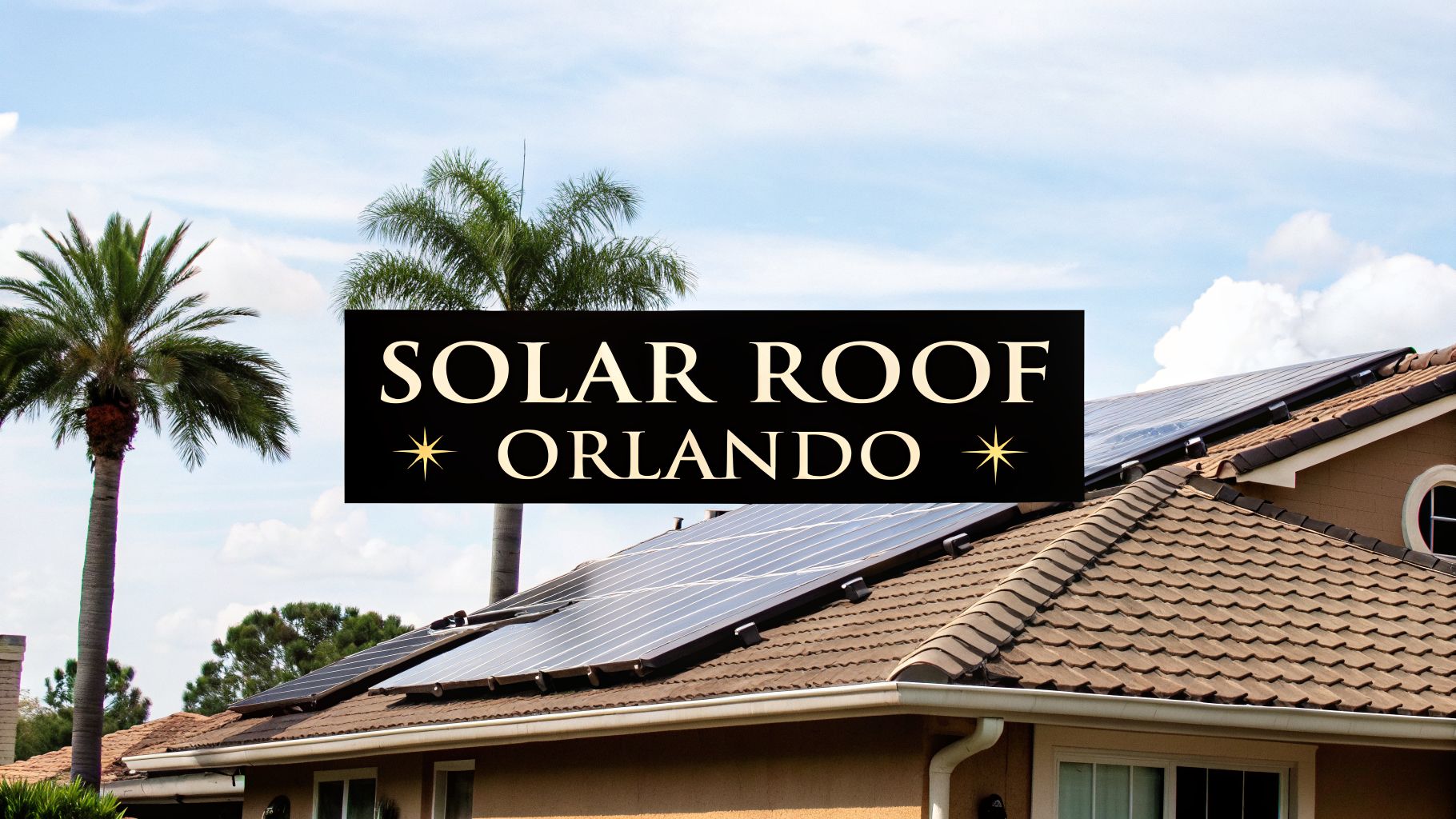
Thinking about going solar in Orlando? You're not alone. But most people picture traditional panels bolted onto their existing roof. I want to challenge that thinking. If your roof is more than a few years old or you're planning a replacement soon, a complete solar roof system is a far smarter approach.
It's not just about adding panels—it’s about investing in a single, cohesive system that both protects your home and generates its power. This is especially true here in Central Florida, where our climate practically begs for this kind of forward-thinking solution.
The numbers don't lie. Florida has exploded onto the solar scene, becoming the second-largest market for residential solar in the entire country. We now have an incredible 20,936 MW of solar capacity installed, enough to power over 2.5 million homes. Orlando is at the heart of this boom, thanks to our 233+ sunny days a year and an average of 5.6 peak sun hours daily—ideal conditions for generating serious power. You can see more data on this incredible growth over at Palmetto.com.
Here’s a quick snapshot of why Orlando is such a solar hotspot.
Orlando Solar Roof at a Glance
| Metric | Orlando Average |
|---|---|
| State Solar Rank | 2nd in the U.S. |
| Annual Sunny Days | 233+ |
| Peak Sun Hours | 5.6 per day |
| Primary Benefit | High energy production meets strong financial incentives |
This table shows why the fundamentals are so strong here. Combining a new roof with solar capitalizes on these conditions perfectly.
Why Combine Your Roof and Solar Projects?
I've seen it countless times: a homeowner installs beautiful, 30-year solar panels on a roof that only has 10-15 years of life left. It’s a costly mistake. Down the road, they’ll have to pay a crew to completely remove and then reinstall that entire solar array just to replace the shingles underneath.
Bundling your new roof and solar installation into one project from the start just makes sense.
- You Save Money. It’s that simple. When you have one crew, one permit, and one project manager, you slash redundant costs for labor and administration. It's one project, one timeline.
- No More Warranty Headaches. What happens when a leak appears? The roofer blames the solar installer, and the solar installer blames the roofer. When you use a dual-certified specialist for the whole system, you get a single, unified warranty that covers everything—the roof, the panels, and the installation. Your investment is actually protected.
- Built to Last. A combined project means your roof is prepared from day one. The team can inspect the decking, add reinforcements if needed, and integrate the solar mounts seamlessly. It ensures the foundation for your power plant is as solid as the technology itself.
Here's the key takeaway: In Central Florida, you need to treat your roof and solar array as a single, integrated system. This isn't just about maximizing your energy savings; it's about protecting the most critical part of your home—the roof itself.
And let's not forget the financial side. By pairing these projects, you can often roll the entire cost into one attractive financing package. This makes a massive home upgrade far more affordable. To see how the numbers really stack up, you should check out our detailed guide on whether solar panels are worth it in Florida. A modern solar roof isn't an expense; it's an asset that starts paying you back from the day it's turned on.
So, you’re thinking about going solar in Orlando. It’s a smart move, but it’s easy to feel overwhelmed by the process. Let’s cut through the noise and walk through what a solar roof project actually looks like on the ground here in Central Florida, from that first flicker of curiosity to the day you start generating your own power.
This isn't just a checklist. It's the real-world flow of how a quality installation gets done, starting with your home's foundation—the roof—and ending with tangible savings on your utility bill.

As you can see, a successful project all comes down to getting the foundation right. A solid roof and a smart plan lead directly to decades of energy savings.
The Foundation: A Hands-On Site Assessment
Forget getting a quote based on a satellite photo. Your solar journey should kick off with a professional site assessment, and I mean a real, in-person visit from an expert who understands both roofing and solar.
This isn’t a sales pitch. It’s a crucial diagnostic step. A dual-certified pro, like the ones at Hi Low Roofing, will get on your roof and inside your attic to evaluate two critical things:
- Your Roof's Health and Structure: They'll inspect every inch of your roof for existing damage, potential leaks, and structural integrity. They need to know if your roof can confidently support a solar array for its 25-year lifespan. Sometimes, a roof replacement beforehand is the most financially sound decision.
- Your Home's Solar Potential: They'll analyze your roof's orientation (south-facing is great, but not a deal-breaker), check for shading from our beautiful Florida oaks, and review your last 12 months of power bills. This data is what allows for a system design that actually covers your energy needs.
Don't ever settle for a remote "assessment." An on-site evaluation by someone who is an expert in both roofing and solar is the single most important step for a successful solar installation in Orlando. It’s what prevents expensive surprises later on.
Designing a System That Fits Your Home
With the on-site data collected, the engineering team gets to work. This is where the technical details become a concrete plan for your home. This is a custom-fit process, not a one-size-fits-all package deal.
Hi Low Roofing will present you with a detailed proposal that clearly lays out:
- The exact number and model of solar panels they recommend.
- A "map" showing where the panels will be placed for maximum sun.
- The specific inverter and any battery storage options.
- A realistic projection of the system's annual energy output.
- A transparent breakdown of the total project cost and any financing options.
This is your chance to dig in and ask questions. A good partner will be able to explain exactly why they chose a certain panel or layout for your specific property.
Permits, Paperwork, and Taming the HOA
Welcome to what is often the longest waiting period in the entire process. This is where having a seasoned local installer really shows its value. Before a single bolt can be installed, the project needs the green light from your local municipality (like the City of Orlando or Orange County) and, if you have one, your Homeowners Association.
An experienced contractor like Hi Low Roofing handles this entire administrative headache for you. They’ll prepare and submit all the permit applications, engineering drawings, and electrical schematics. They also know how to navigate HOA review boards, presenting the project in a way that checks all the community guideline boxes and avoids needless back-and-forth. Since they work across Central Florida every day—from Pinellas County to Orlando—they know the specific requirements for each jurisdiction, which is key to preventing frustrating delays.
The Installation: What to Expect On-Site
Once the permits are approved, things move fast. While the paperwork can take weeks, the actual physical installation is surprisingly quick—usually just 2 to 5 days.
Here’s a typical play-by-play of the installation week:
- Day 1: Roof Prep & Mounting. If your project includes a new roof, that happens first. Otherwise, the crew focuses on prepping your existing roof. They’ll install the mounting hardware and flashing, which are critical for securing the array and ensuring your roof remains 100% watertight, especially with hurricane season in mind.
- Day 2-3: Panels & Electrical. With the foundation set, the crew mounts the racking system and the solar panels themselves. At the same time, a licensed electrician runs the conduit and wiring, connecting the panels to the inverter and then tying the whole system into your home's main electrical panel.
- Day 4-5: System Checks & Cleanup. After all the hardware is in place, the team runs initial diagnostic tests to make sure every connection is perfect. Finally, they do a full cleanup, leaving your property looking just as it did when they arrived.
The Finish Line: Inspection and Permission to Operate
The panels are on your roof, but you can't flip the switch just yet. There are two final, crucial steps.
First, your contractor will schedule an inspection with your city or county. An inspector will come out to verify that every aspect of the installation meets local building and electrical codes.
Once you pass inspection, the utility company (like Duke Energy or OUC) gets the report. They’ll do a final review and, if necessary, come out to install a new bi-directional meter (a "net meter"). After they give their final sign-off, they issue the official Permission to Operate (PTO). That’s the moment you've been waiting for! Your installer will then walk you through powering on your system, and you'll officially start generating your own clean, renewable energy.
Making the Numbers Work: Solar Costs and Your ROI in Florida
Let's talk about the bottom line. When you're considering a solar roof in Orlando, the conversation quickly turns to cost and return on investment. It's not just about the initial price tag; it's about understanding how the entire financial picture comes together to create real, long-term value for your home.
The first thing any experienced solar professional will look at is the price per watt. We use dollars per watt ($/W) as a standard metric because it lets you compare different system proposals apples-to-apples, no matter the final size. It cuts right through the noise.
As of early 2026, the market in Central Florida is pretty competitive. We're seeing average installation costs hover around $2.10 per watt. So, for a common 14.72 kW residential system, you're looking at a starting price of roughly $30,965. But nobody pays that sticker price. With the incentives available here, homeowners are seeing average savings of $63,314 over 25 years.
Florida’s Big Three Solar Incentives
This is where the math gets exciting. Florida homeowners have access to a powerful combination of incentives that dramatically cut the net cost of going solar. These aren't just small rebates; they are major financial drivers.
- The Federal Solar Tax Credit: This is the heavyweight champion of solar incentives. The Residential Clean Energy Credit lets you subtract 30% of your total project cost directly from what you owe on your federal taxes. On that $30,965 system, that's a $9,290 credit right back in your pocket.
- State Sales Tax Exemption: Florida sweetens the deal by making your entire solar energy system 100% exempt from the state's 6% sales tax. That saves you another $1,858 from day one.
- Property Tax Exemption: A solar roof adds significant value to your home, but thanks to state law, you won't pay a dime more in property taxes. The value added by your system is 100% exempt from your property tax assessment.
When you stack these three incentives, the real cost of that $30,965 solar installation drops to just $19,817. That’s a game-changer for your breakeven point and overall ROI.
The Clock is Ticking on Net Metering
Beyond the upfront savings, your biggest long-term financial gain comes from something called net metering. It's the system that credits you for the extra power your panels produce and send back to the grid, effectively making your meter spin backward. It’s the engine that powers your monthly savings.
But this is where a little urgency comes in. The state's policy is set to change. A new "step-down" plan starts in 2027, which will reduce the value of the credits new solar owners receive.
Here’s the crucial part: if you install your system before the changes hit, you are grandfathered into the current, more profitable net metering rates for a full 20 years. Acting sooner rather than later locks in two decades of maximum savings—an opportunity that won't be available to those who wait.
Smart Financing Makes Solar Accessible
Even with all the credits and exemptions, we know the initial investment can feel like a hurdle. That's why smart financing has become so important. Reputable local installers like Hi Low Roofing understand this and work to make solar accessible for more families.
They offer flexible financing, including 0% interest plans for qualified homeowners. This lets you get started with little to no money down. The best part? Your new monthly loan payment is often less than what you were already paying the utility company. You’re essentially swapping your electric bill for an investment that builds equity in your home.
As you plan, always look into the latest federal and state programs. You can find up-to-date information on available Solar Tax Credits that can further slash your initial costs. And if you're thinking about energy independence during outages, you can explore the cost of solar battery backup systems to see how that fits into your overall plan. A combined approach not only lowers your bills but also insulates you from Florida's unpredictable weather and rising energy prices.
Building for Resilience With Hurricane-Ready Solar
If you're a homeowner in Central Florida, you know the hurricane question is always looming. So when you think about adding solar panels, it’s natural to wonder: how will they fare in a major storm? This isn't just an afterthought; it's one of the most critical parts of planning a solar project in our area.
The goal isn't just to generate power. It’s to build a system that can stand up to the worst weather Florida can throw at it.

Thankfully, the flimsy panels of the past are long gone. Today's solar installations are engineered specifically for our climate and often go above and beyond Florida's notoriously tough building codes, even those for High-Velocity Hurricane Zones (HVHZ).
Engineered to Handle Extreme Wind
A solar array that can withstand a hurricane doesn't happen by chance. It’s all about meticulous engineering and using the right hardware from the start. A reputable installer like Hi Low Roofing will use specialized mounting hardware tested to handle wind speeds of 180 mph or even higher.
The entire system is designed to transfer wind uplift forces away from the panels and down into your roof's structural frame. This turns the panels and your roof into a single, unified shield.
This process involves a few key details that make all the difference:
- Hurricane-Rated Hardware: We're talking specialized clamps, heavy-duty bolts, and robust racking systems that have been rigorously tested to handle intense wind loads for extended periods.
- Structural Attachment: The mounts are secured directly to your roof's rafters—the strong wooden beams—not just the thin plywood decking. This provides the strongest possible anchor.
- Advanced Waterproofing: Every single penetration point gets a high-grade flashing seal. This creates a watertight barrier that prevents leaks, even during hours of wind-driven rain.
When installed correctly by a team that understands both roofing and solar, a new solar array can actually reinforce your roof, making it more resilient than it was before.
Battery Storage: The Ultimate Upgrade for Peace of Mind
While storm-rated panels give you structural security, adding a battery to your system is what delivers true energy resilience. A standard grid-tied solar system is designed to shut down automatically during a power outage—it's a safety measure to protect utility workers. But with a battery, your home becomes its own private power station.
Think about what that means during a hurricane. The power grid goes down for days. While the rest of the neighborhood is dark, your home is humming along. Your panels recharge the battery during the day, and the battery keeps your essentials running all night—the refrigerator, lights, fans, and maybe even the A/C.
This isn't just about convenience; it's about real security. A solar-plus-battery system provides genuine energy independence, keeping your family safe and comfortable without the noise, fuel storage, and hassle of a portable generator.
Take Control of Your Power
Battery systems like the Tesla Powerwall offer more than just backup. They empower you to use every kilowatt of energy your panels produce. As utility companies continue to adjust their net metering policies, having your own storage is becoming a smarter financial move.
Instead of selling your excess solar energy back to the grid for a small credit, you can store it in your battery. When the sun goes down, you use your own stored, free energy instead of buying it back from the utility. This "self-consumption" model puts you in complete control. Our guide on how solar panels work during a power outage dives deeper into this.
Deciding on the right battery really comes down to what you want to achieve:
- Essential Backup: A smaller, more affordable battery can be set up to run just the critical circuits—your kitchen outlets, refrigerator, and a few lights—to make the power last longer.
- Whole-Home Backup: For seamless, uninterrupted living, a larger battery bank can power your entire house, including high-demand appliances like your air conditioner.
For any Orlando homeowner, a solar roof is more than an energy-saving project. It's a powerful investment in your home's resilience, preparing you for Florida's weather while giving you total control over your power.
Choosing the Right Partner for Your Orlando Solar Project

Let's be direct. The most critical decision you'll make for your solar roof installation Orlando isn't about the panel brand or battery—it's who you hire to put it all together. The Central Florida market is flooded with options, but finding a truly great installer means looking for a very specific, and surprisingly rare, combination of skills.
The non-negotiable? Find a contractor with dual certifications in both roofing and solar. I've seen it happen time and again: when you have a separate roofer and a separate solar company, any future leak becomes a blame game. The roofer blames the solar installer's penetrations, and the solar installer blames the pre-existing roof.
When one company like Hi Low Roofing handles everything, there’s no finger-pointing. Your roof’s warranty stays intact, its integrity is guaranteed, and you have one point of contact. It’s the only way to ensure your home’s shield and its power plant are treated as a single, cohesive system.
The Right Questions to Ask Any Installer
Before you even think about signing a contract, you need to vet your potential partners. A trustworthy company will welcome your questions and have direct, confident answers. Use this checklist to separate the real pros from the rest.
- "Are you a licensed roofer and a licensed solar installer?" Don't just take their word for it—ask for the license numbers. A legitimate expert like Hi Low Roofing will be fully licensed and insured for both trades in Florida. This is your first and most important filter.
- "What, exactly, does your workmanship warranty cover?" Get into the details. A solid warranty must cover the physical installation of both the roof and the solar array, especially the penetrations. Vague promises won't help you when a mysterious leak pops up five years down the road.
- "Who is handling all the permits and HOA paperwork?" The answer should be "we are." A full-service installer has the experience to navigate the specific codes in Orange and Seminole counties and knows how to deal with the dozens of different HOAs in our area.
- "Can I see your work and talk to past customers nearby?" A contractor with deep roots in Central Florida like Hi Low Roofing should have a portfolio of local projects and be proud to connect you with happy neighbors in your area.
A company's reputation is everything. Go beyond their website testimonials and look them up online. A long history of satisfied customers is the best proof that they'll do right by you.
Red Flags to Watch Out For
Just as important as knowing what to look for is knowing when to walk away. The Orlando market has its fair share of high-pressure sales tactics and pop-up installers. Be on the lookout for these warning signs.
- Aggressive, "act now" sales pitches. If you feel pressured to sign on the spot because of a "special offer that ends today," it’s time to show them the door. This is a major home improvement project, not an impulse buy.
- Vague or evasive answers. If they can't clearly explain their warranties, the installation process, or the equipment they use, that's a huge red flag. Transparency is the hallmark of a company you can trust.
- They outsource the actual work. Be wary of companies that are just sales operations. Many will sign you up and then subcontract the installation to the cheapest crew they can find. You deserve a company whose own trained and insured teams are on your roof.
Ultimately, choosing an installer for your solar roof installation Orlando is about finding a local partner you can rely on for the next 25+ years. By using a local, dual-certified expert like Hi Low Roofing as your benchmark, you ensure you’re setting a high standard for quality, accountability, and your own peace of mind.
Answering Your Top Questions About Going Solar in Orlando
When Orlando homeowners start looking into solar, I find the same handful of questions pop up every time. It makes sense—this is a big upgrade for your home, and you need straight answers before you can feel good about moving forward. Let's tackle the most common things people ask me about installing a solar roof in Central Florida.
Probably the number one question is, "How long will this all take?" From the day you sign the dotted line to the moment the utility company gives you the green light, you can generally expect the whole process to take between two and four months.
That sounds like a long time, but don't picture crews on your roof for months on end. The actual physical installation is surprisingly quick, usually wrapped up by an experienced team in just two to five days. Most of your time is spent waiting on paperwork and approvals before the real work even begins.
What Does the Solar Timeline Actually Look Like?
It helps to know what’s happening behind the scenes. Here’s a realistic breakdown of the journey from start to finish with Hi Low Roofing.
- Design & Engineering (1-3 weeks): Right after our initial chat and a detailed look at your property, our engineers get to work. They’ll design a system specifically for your roof, your energy usage, and Orlando’s weather patterns.
- Permitting (4-8 weeks): This is where patience is key, and it’s often the longest part of the process. We submit all the detailed plans to your local jurisdiction—whether that's Orange County, the City of Orlando, or another municipality—and wait for their approval. Hi Low Roofing handles all of this for you.
- Installation (2-5 days): Once the permits are in hand, our crew schedules your install. This is the exciting part where they prep the roof, install the racking and mounts, secure the panels, and run all the necessary electrical wiring.
- Inspection & PTO (2-4 weeks): After the last panel is in place, a city or county inspector needs to come out and sign off on the work. Then, your utility company (like Duke Energy or OUC) gives the final "Permission to Operate" (PTO), which means you can officially flip the switch and start producing your own power.
Will Adding Solar Panels Increase My Property Taxes in Florida?
This is a fantastic question, and the answer is even better: no, it won't. Florida has a huge incentive that takes this worry completely off the table.
Thanks to the state's Property Tax Abatement for Renewable Energy, the value a solar energy system adds to your home is 100% exempt from being included in your property tax assessment. You get a more valuable home without the higher tax bill that usually comes with it.
What If My Roof Is Old?
This is a critical point that can save you a massive headache down the road. Solar panels are built to last 25-30 years. The last thing you want is to install a brand-new system on a roof that's only got a few years of life left in it. If your roof is approaching its final 10-15 years, it's almost always the right call to replace it first.
This is where working with a dual-certified roofing and solar contractor like Hi Low Roofing is a game-changer. We can do a full roof inspection and, if needed, bundle a new roof and a solar installation into one seamless project. This ensures the roof and the solar mounts are installed together correctly, and both warranties are perfectly aligned. It’s the smart way to avoid the costly process of having to remove and reinstall your entire solar array just a few years later.
Ready to get answers tailored to your specific home? The team at Hi Low Roofing has been serving Central Florida homeowners and businesses for over 15 years and can provide a free, no-obligation inspection and quote for your roof and solar needs. Learn more and schedule your consultation today!
