

For most Central Florida homeowners, the answer is a resounding yes—solar panels are a worthwhile investment. We're blessed with abundant sunshine, and when you combine that with powerful federal tax credits and favorable state policies, the long-term benefits easily outweigh the initial cost.
Think of it this way: you can keep renting your power from the utility company forever, or you can decide to own your own personal power plant right on your roof.
Why Solar Panels Are a Smart Choice in Central Florida
When you ask, "are solar panels worth it," the answer really comes down to where you live. For anyone in the corridor from Pinellas County clear over to Orlando, our local conditions create a perfect storm for solar success. "The Sunshine State" isn't just a catchy nickname; it's a massive asset for generating clean energy, giving Florida homeowners a real advantage.
This guide will walk you through everything you need to know—from the upfront costs and long-term savings to the everyday perks of energy independence. Let's start by digging into the key factors that make solar such a compelling financial move for your home.
The Foundation of Solar Value
A few key elements really drive the value of a solar investment, impacting both your wallet and your lifestyle. For homeowners in Tampa, Kissimmee, and everywhere in between, these are the big reasons solar makes so much sense:
- Serious Long-Term Savings: Every kilowatt-hour your panels produce is one you don't have to buy from the utility. Over the 25+ year lifespan of a typical system, that really adds up, often translating into tens of thousands of dollars in savings.
- Energy Independence and Stability: When you generate your own power, you're not nearly as exposed to the grid and its ever-increasing rates. It's a fantastic hedge against unpredictable price hikes and gives you a welcome dose of peace of mind.
- Increased Property Value: Modern buyers love homes with solar. In fact, multiple studies have shown that a solar installation can significantly increase a home's resale value, making it a smart investment in your property's future.
- Powerful Financial Incentives: Strong federal and state incentives exist specifically to make solar more affordable. These programs can slash the net cost of your system, dramatically shortening the time it takes to see a return on your investment.
The question for Central Florida isn't really if going solar is a good idea. It's how much you stand to save. Thanks to our unique climate and supportive policies, the financial case is much stronger here than in many other parts of the country.
To give you a clearer picture, here's a quick breakdown of the major factors at play in our area.
Central Florida Solar At a Glance
| Key Factor | Local Impact | Why It Matters to You |
|---|---|---|
| Sunshine Hours | Florida averages 237 sunny days per year, well above the national average. | More sun means more electricity production, which directly leads to bigger savings and a faster payback period. |
| Federal Tax Credit | The 30% Residential Clean Energy Credit applies directly to your system cost. | This is a dollar-for-dollar reduction on your federal taxes, making the system significantly more affordable upfront. |
| State Incentives | Florida offers a sales tax exemption and a property tax exemption for solar. | You pay no sales tax on the equipment, and your property taxes won't increase, even though your home's value does. |
| Net Metering | Florida has state-wide net metering policies (though they are evolving). | You get credit for the excess energy your system sends back to the grid, which helps offset your bill during non-sunny hours. |
As you can see, the deck is stacked in favor of homeowners here.
Ultimately, installing solar panels is one of the most proactive steps you can take to get control over one of your biggest monthly expenses. As we dive into the specific costs and incentives, you'll see how these foundational benefits come together to build an undeniable case for going solar in Florida.
Decoding the True Cost of Solar Panels in Florida
When homeowners in Central Florida ask if solar is "worth it," what they’re really asking is: "What's the real, all-in price?" It’s easy to find ballpark figures online, but the actual cost to put solar on your residential or commercial property—whether in Orlando or Tampa—depends on a few key factors.
Getting a handle on these details demystifies the quotes you'll receive and helps you make a genuinely smart investment. The price isn't just for the panels; it's for a complete power-generating system, professionally installed and safely connected to your home and the grid.
Let’s pull back the curtain on exactly what goes into that final number.
The Core Components of Your Solar Investment
The single biggest driver of your total cost is the system size, measured in kilowatts (kW). Think of it like buying an air conditioner. A bigger home needs a more powerful AC unit, and a family that uses more electricity needs a larger solar system to offset that demand.
For a typical property in the Tampa-to-Orlando corridor, a system between 7 kW and 12 kW is pretty standard. That system is made up of several critical parts, and each one affects the final price and performance:
- Solar Panels: The panels themselves are the main event. Their cost hinges on efficiency (how well they turn sunlight into electricity) and the brand’s track record. High-efficiency panels cost more upfront but generate more power from a smaller footprint, which is great for limited roof space.
- Inverters: This is the brain of the operation. It takes the direct current (DC) electricity your panels produce and converts it into the alternating current (AC) your home's appliances actually use.
- Racking and Mounting: This is the heavy-duty framework that secures the panels to your roof. The hardware needed can change depending on your roof type, which can influence the cost.
- Installation Labor: This is not a DIY project. Professional installation by a licensed and insured team like Hi Low Roofing is non-negotiable for safety, peak performance, and keeping your warranties intact.
A complete residential solar system in Central Florida typically lands in the $20,000 to $35,000 range before any incentives. That price reflects quality equipment, professional labor, and all the required permits for a safe, code-compliant installation built to last for decades.
How Your Roof Influences the Final Cost
Your roof is the foundation for your solar array, so its condition and material are a huge part of the equation. Any reputable solar installer will start with a thorough roof inspection before they even think about giving you a final quote.
Installing panels on a standard asphalt shingle roof, for instance, is usually the most straightforward job. But if you have a tile or metal roof, that's a different story. Those materials require specialized mounting hardware and more careful labor to make sure your roof remains completely watertight and structurally sound.
Here’s the most important part: the age and health of your roof. Solar panels are built to last for 25 years or more. If your roof only has 5-10 years of life left in it, putting brand-new panels on top is a bad move. Having to remove and reinstall a whole solar array just to replace your roof down the line is a massive—and totally avoidable—expense.
If you have any doubts about your roof's condition, it's smart to figure that out first. You can learn more about how to tell if you need a new roof before you commit to solar.
The "Hidden" Costs to Watch For
Beyond the big-ticket items, a few other line items can show up on a quote. Knowing about them ahead of time means no surprises.
- Permitting Fees: Every city and county has its own rules. Local municipalities across Pinellas, Hillsborough, and Orange counties all require permits to ensure the installation meets safety and building codes.
- Electrical Upgrades: Some older homes have electrical panels that just aren't equipped to handle the extra power generated by a solar system. An upgrade might be necessary for safety.
- Trenching: This usually only applies if you're getting a ground-mounted system instead of a rooftop one. You have to dig a trench to run the electrical lines from the panels to your house, which adds to the labor costs.
By understanding all these variables—from system size and roof type to those potential extra costs—you can look at any solar quote with confidence, knowing exactly where your money is going and why.
Maximizing Your Return with Florida Solar Incentives
When you look at the price tag for a new solar panel system, it's easy to see that as the final cost. But for property owners in Central Florida, that initial number is just the starting point.
The real financial picture comes into focus when you layer in the powerful incentives available. These aren't just minor discounts; they're designed to fundamentally change the economics of solar, dramatically cutting down the time it takes for your system to pay for itself and start generating pure profit. Let's dig into how these benefits actually work for you.
The Federal Solar Tax Credit
The biggest financial game-changer on the table is the Residential Clean Energy Credit, which most people just call the federal solar tax credit. It's crucial to understand that this isn't a simple deduction from your income—it's a true, dollar-for-dollar credit that directly reduces the federal taxes you owe.
Right now, for systems installed through the end of 2032, this credit is worth 30% of your total system cost. That includes the panels, inverters, racking, professional installation, and even a battery backup system if you bundle it with your initial install.
A typical $25,000 solar project in the Orlando or Tampa area qualifies for a $7,500 federal tax credit. That means you get to wipe that amount right off your tax bill, instantly bringing your net cost down to a much more manageable $17,500.
This single incentive makes a massive dent in the upfront investment, making solar accessible for countless Florida families. As you can see below, claiming this credit is the first major step toward a great return on your investment.
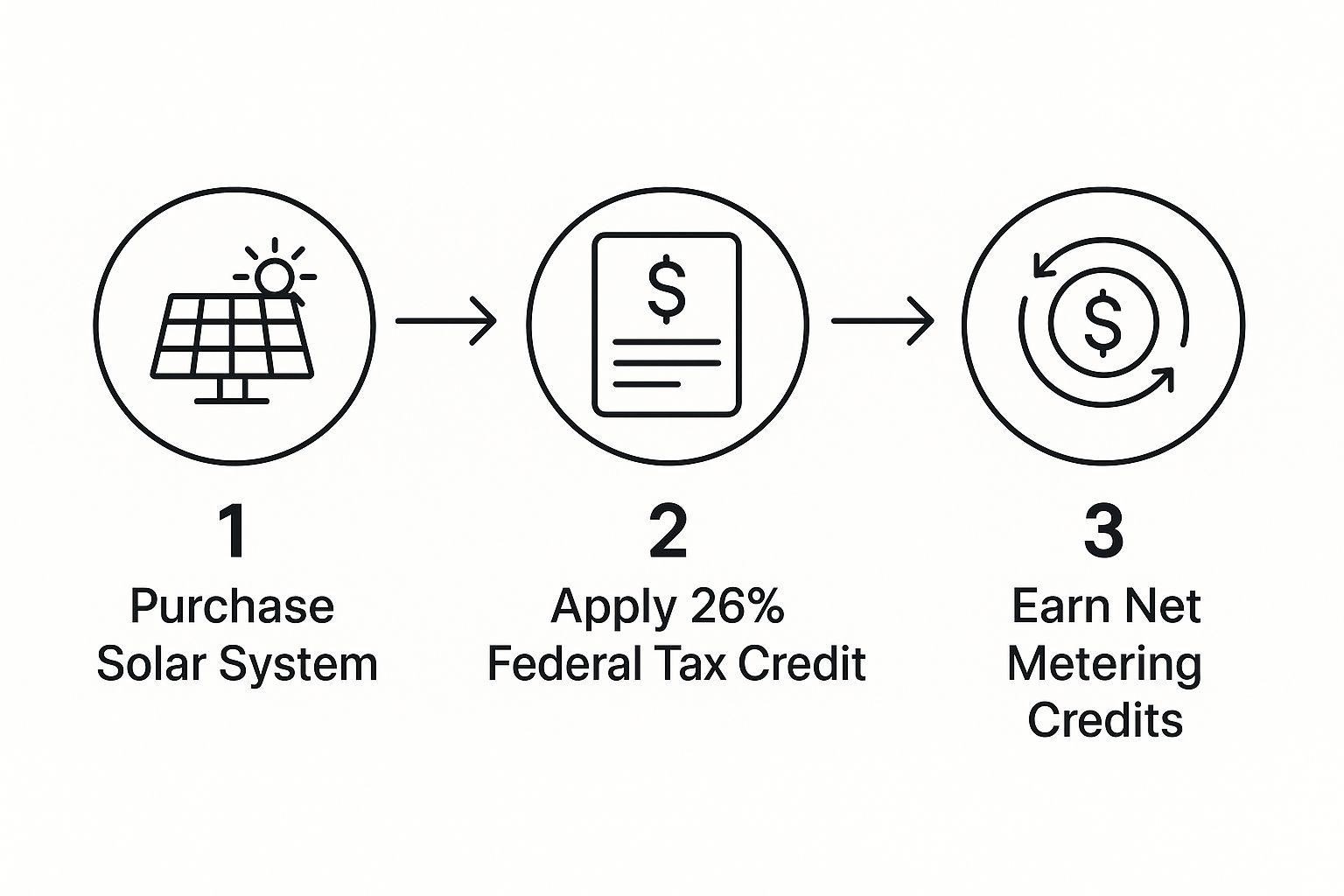
As the graphic shows, stacking this credit with ongoing savings from your utility company is what creates such a clear path to long-term financial benefits.
Florida's Property Owner-Friendly Tax Exemptions
On top of the huge federal credit, Florida rolls out the welcome mat for solar with its own set of financial perks. These local advantages chip away at the cost even further, both at the time of purchase and for years to come.
There are two key exemptions every property owner from St. Petersburg to Winter Garden needs to know about:
- Solar and CHP Sales Tax Exemption: Florida waives the sales tax entirely on solar energy systems. On that same $25,000 system, that’s an extra $1,500 (or more, depending on your county) that you simply don't have to pay. It’s an immediate, upfront savings.
- Property Tax Exemption for Renewable Energy: It's a fact that solar panels increase your property's resale value. But in Florida, you won't be penalized for it. State law prevents your property appraiser from raising your property taxes based on the value added by your solar installation. Your property is worth more, but your tax bill stays the same.
These exemptions are automatic and work behind the scenes to make owning solar that much sweeter.
Understanding Net Metering in Florida
Once your panels are soaking up that Florida sun, net metering is the policy that ensures you get credit for every single kilowatt of power you produce. It’s the program that turns the grid into a two-way street, and it's absolutely essential to making solar a smart investment here.
Think of it like rollover minutes on an old cell phone plan.
During the day, especially in the middle of a sunny Central Florida afternoon, your panels will often generate more power than your property is using. That extra electricity doesn't go to waste—it flows out onto the grid, and your utility company gives you a credit for it.
Then, at night or on a cloudy day, when you need to pull power from the grid, you automatically use up those banked credits first. You only pay for electricity after all your credits are gone. It’s a simple, fair system that lets you leverage your investment 24/7.
This kind of financial benefit is why the solar industry is booming. In 2022, the global solar market was valued at around $189.5 billion, and experts project it will hit an incredible $607.8 billion by 2030. That explosive growth is built on the real-world savings property owners see from lower bills and fantastic incentives. You can find more details in these solar energy statistics.
When you combine the federal tax credit, state-level exemptions, and the continuous savings from net metering, you're not just buying equipment—you're making a savvy financial move that pays dividends for decades.
Calculating Your Solar Payback Period
After seeing the impressive incentives available, the next question on every property owner's mind is, "So, how long until these panels actually pay for themselves?" This is what we call the solar payback period, and it’s probably the most important number you'll look at when deciding if solar is a smart move for your property.
Think of it this way: you're essentially prepaying for your electricity for the next couple of decades. The payback period is simply the moment your total energy savings catch up to what you initially paid for the system. Once you cross that line, every bit of power your panels generate is pure profit—free electricity for the life of your system.
The Simple Formula for Payback
At its heart, the calculation is surprisingly simple. It gives you a clear timeline for your return on investment, turning the fuzzy concept of "savings" into a solid financial forecast.
To get a good ballpark figure, you just need two key numbers:
- Your Net System Cost: This is the total price of your solar installation after you subtract the 30% federal tax credit and any other rebates you receive right away.
- Your Annual Electricity Savings: This is the amount you expect to save on your utility bills each year by making your own power.
The formula is straightforward:
Payback Period (in years) = Net System Cost / Annual Electricity Savings
Let's walk through a real-world example for a Central Florida property owner to see how this works in practice.
A Central Florida Payback Period Example
Imagine a family in Kissimmee is ready to go solar. Here’s a breakdown of what their numbers might look like:
- Total System Cost: They get a quote for a quality system that comes out to $28,000.
- Federal Tax Credit: They're eligible to claim 30% of that cost, which knocks $8,400 off the top.
- Net System Cost: This brings their actual out-of-pocket investment down to $19,600 ($28,000 – $8,400).
- Average Monthly Electric Bill: Before solar, they were paying their utility company around $200 a month.
- Annual Electricity Savings: That adds up to $2,400 per year ($200 x 12).
Now, let's plug those numbers into our formula: $19,600 / $2,400 = 8.16 years.
In this scenario, the solar panels would completely pay for themselves in just over eight years. Considering the panels are warrantied for 25 years or more, this family can look forward to nearly 17 years of free electricity. For many, the biggest hurdle is figuring out how to handle the initial investment. Exploring different solar financing options can make that upfront cost feel much more manageable.
The Wild Card Shortening Your Payback Time
The simple calculation is a great start, but it leaves out one crucial factor that almost always works in your favor: rising utility rates.
Electricity costs in Florida, just like everywhere else, have a habit of climbing over time. When your utility company raises its rates, the value of the energy you produce goes up, too. This means your annual savings get bigger, which can actually shorten your payback period.
This trend of increasing affordability is a major reason for the industry's rapid expansion. As of the end of 2024, global solar capacity reached over 2.2 terawatts, a 33% jump from the previous year, fueled by falling equipment prices and strong government support. This growth makes solar a more attractive investment each year. Discover more insights about this global PV market growth.
By locking in your energy costs with solar, you aren't just saving money today. You're insulating your budget from unpredictable price hikes for decades to come.
Choosing the Right Solar Installer in Central Florida
Picking the right solar panels is only half the job. The company you hire to put them on your roof is just as critical for your system's long-term success and your peace of mind. A botched installation can lead to panels that don't produce what they should, roof leaks, and a whole lot of warranty headaches.
So, for property owners wondering if solar panels are truly worth it, the answer often comes down to the quality of the installer.
In the busy market stretching from Tampa to Orlando, finding a reputable, local expert like Hi Low Roofing is your best defense against future problems. A great installer doesn't just bolt hardware to your roof; they become your long-term energy partner, making sure your system is cranking out power efficiently for the next 25 years.
The Advantage of Dual Expertise in Roofing and Solar
Let's be honest: the biggest worry for most property owners is the integrity of their roof. The idea of drilling dozens of holes into the one thing protecting your home or business from Florida’s torrential rain and hurricanes is a big deal. This is precisely why choosing a company with deep expertise in both roofing and solar is such a massive advantage.
A true roofing professional knows your roof inside and out. They understand exactly how to flash and seal every single penetration point to create a permanent, watertight barrier. A company that’s just a "solar company" might not have this deep knowledge, potentially voiding your roof's warranty or, worse, creating slow leaks that lead to costly structural damage down the road.
Choosing an installer with a roofer’s mindset means you’re not just getting a solar system; you're getting an integrated solution that protects your entire property. It’s the single best way to ensure your investment is secure from the top down.
Key Credentials to Look For
Not all solar companies are built the same. To protect your investment, you need to find an installer who can back up their claims with proven expertise and a solid commitment to quality. A little bit of homework now can save you a world of trouble later.
When you're checking out potential installers in Pinellas, Orange, or any county in between, make sure they have these credentials:
- NABCEP Certification: Think of the North American Board of Certified Energy Practitioners (NABCEP) as the "master electrician" certification for the solar world. It’s the gold standard, proving an installer has passed tough exams and adheres to the highest standards.
- A Strong Local Track Record: You want a company that has spent years working right here in Central Florida. They'll be intimately familiar with local building codes, the permitting maze, and the unique weather challenges we face.
- Glowing Customer Reviews: Don't just take their word for it. Check online reviews on several different platforms. Look for consistent themes praising their communication, professionalism, and what they do after the installation is complete.
Questions to Ask Before You Sign Anything
Comparing quotes is about more than just the price tag at the bottom of the page. Asking the right questions can reveal a lot about the quality, reliability, and long-term stability of the company you’re considering.
Before you commit to a contract, be sure to ask:
- Who is actually doing the installation? Do you use your own trained employees, or do you subcontract the work out? In-house teams almost always provide better quality control and accountability.
- What warranties do you provide? You need to understand the warranties on the panels and inverters, but the most important one is the workmanship warranty. This covers any issues that pop up because of the installation itself.
- How do you handle penetrating my roof? Have them walk you through their exact process. A good installer will be happy to explain in detail how they ensure a leak-proof installation on your specific type of roof.
By focusing on companies with proven local experience and a roofer's understanding of how to protect your property, you can move forward with total confidence. To see what this process looks like from a team of dual-certified professionals, you can explore the details of a quality solar installation in Central Florida. This is the best way to ensure your solar journey is smooth and your investment is protected for decades to come.
Beyond the Bottom Line: Environmental and Lifestyle Perks
While the financial numbers make a compelling case for solar, the conversation doesn't end there. For many Central Florida property owners, the decision to go solar is about much more than just dollars and cents—it’s a choice that reflects their values and enhances their daily life.
Powering your property with the sun brings a unique set of benefits. These perks offer a different kind of return on your investment, one measured in peace of mind, self-sufficiency, and a real, positive impact on the environment.
Reducing Your Carbon Footprint
Going solar is one of the most powerful things you can do to shrink your property's carbon footprint. A typical residential solar system can cut out three to four tons of carbon emissions every single year. That's the environmental equivalent of planting over 100 trees.
By generating your own clean electricity, you’re reducing the need for power from fossil fuel plants. This directly helps protect Florida's incredible ecosystems, from the Gulf Coast to the Atlantic shores, contributing to a healthier environment for everyone.
This local impact plugs into a much bigger global shift. In 2024, clean power generation crossed a major threshold, accounting for over 40% of global electricity. Even more impressive, solar’s contribution hit a milestone, providing over 10% of the world's electricity for the first time. It shows how your roof can be part of a worldwide energy revolution.
By tapping into the relentless Florida sunshine, you aren't just cutting your utility bills. You're becoming an active part of the solution, making our air cleaner and our communities more sustainable.
Achieving Energy Independence and Resilience
If you live in Central Florida, you know all about hurricane season and the grid instability that comes with it. Energy independence isn't just a buzzword; it's the genuine peace of mind that comes from having a reliable power source right on your roof.
A standard grid-tied system will shut down during an outage for safety. But when you pair your solar panels with a battery backup, you create your own personal microgrid. This setup is a game-changer, allowing you to keep essential appliances running—the refrigerator, lights, medical equipment—even when the rest of the neighborhood goes dark.
This kind of self-sufficiency offers a level of security you can't get when you're 100% dependent on the utility company.
Enhancing Your Property's Value and Appeal
Solar panels aren't a niche feature anymore. They're a smart upgrade that today's buyers actively look for. A property with solar is seen as more efficient, modern, and—most importantly—less expensive to own and operate.
That perception translates directly into real market value. Study after study has shown that homes with solar panel systems simply sell for more than comparable homes without them. It’s an investment that pays you back month after month on your bills and then pays you again when you decide to sell.
The forward-thinking appeal of solar isn't just limited to homes. We're seeing incredible innovation everywhere, like a solar-powered voyage achieving emission-free travel. Adding panels to your property aligns it with this sustainable, innovative future.
Answering Your Top Florida Solar Questions
Even after crunching the numbers, most property owners in Central Florida still have some very practical questions. Getting comfortable with going solar often means getting solid answers to these real-world concerns. Let's tackle the questions we hear most often from folks in Orlando, Tampa, and right here in our community.
How Do Solar Panels Hold Up in a Hurricane?
This is, without a doubt, the number one question on every Floridian's mind. The short answer is: surprisingly well.
Modern solar panels are built tough. They have to be. They are engineered to meet Florida's stringent building codes, which are some of the toughest in the country for a reason. Professional installers don't just lay panels on your roof; they anchor them with heavy-duty racking systems bolted directly into the roof's structural beams.
While nothing is 100% hurricane-proof, a properly installed system is designed from the ground up to withstand severe winds and impacts.
Should I Get a New Roof Before Installing Panels?
If your roof is getting up there in age, then yes, absolutely. Think of it this way: your solar panels are an investment that will last for 25 years or more. Your roof needs to be ready for that same long-term commitment.
It's a classic "pay now or pay a lot more later" situation. Replacing a roof before solar is a straightforward project. Having to remove a 25-year solar system just to replace your roof in 10 years is a massive, expensive headache you can easily avoid.
Pro Tip: Look for an installer who is an expert in both roofing and solar, like Hi Low Roofing. This makes a world of difference. They can inspect your roof's health and flawlessly manage both projects, ensuring everything is integrated and warrantied together. That's true peace of mind.
What Happens When It's Cloudy or at Night?
This is where the magic of "net metering" comes in. Your panels will still generate some power on overcast days—just less than on a bright, sunny one. At night, of course, they don't produce anything.
But that's okay. During the day, your system will likely produce far more electricity than your home is using. All that extra power gets sent back to the utility grid, and your power company gives you credit for it.
Then, at night or on a rainy day, you just pull electricity from the grid like you always have. The difference is, you're now using up the credits you've already stored up. The grid essentially acts like a giant, free battery for your home.
Many property owners also wonder about ongoing maintenance. To get a better handle on upkeep, you can learn more by reading this guide on Is a professional solar panel cleaning service worth the cost?
Ready to see if solar makes sense for your Central Florida property? The team at Hi Low Roofing offers free, no-pressure solar consultations to give you an honest look at your potential savings. Get your free solar estimate today!
