

When you start looking into a solar battery backup system for your home in Central Florida, the first number you'll likely see is somewhere between $12,000 and $22,000. That's the typical all-in cost for a single-battery setup.
Think of it like buying a new HVAC system for your house. The final price tag isn't just one number; it depends on the size of your home, your family's energy habits, the specific battery you choose, and how complex the installation will be. It's a customized solution, not an off-the-shelf product.
Breaking Down the Solar Battery Backup Cost in Florida
Adding a battery to your solar setup is more than just buying a fancy piece of tech—it’s an investment in genuine energy independence. This is especially true here in Florida, where hurricane season can make the power grid feel pretty fragile.
While that initial cost might seem steep, it helps to see exactly where your money is going. The price covers the physical battery unit, the skilled labor from licensed electricians, and all the extra hardware needed to get it talking to your home’s electrical panel and solar array.
For anyone living between Pinellas County and Orlando, this technology is a game-changer for peace of mind. Instead of just sending your extra solar power back to the grid, you get to keep it for yourself. You can use that stored energy at night or, more importantly, during a blackout.
This is a critical point that many new solar owners miss: a standard grid-tied solar system automatically shuts down when the grid goes down. A battery is what keeps the lights on. You can get the full story on why that happens in our guide on how solar panels function during a power outage.
A Typical Cost Breakdown
So, what do the numbers actually look like? While every installation is a little different, the costs for a home solar battery in the Orlando area tend to follow a pretty consistent pattern. The battery itself is the biggest line item, with professional labor and other components making up the rest.
A solar battery does so much more than just sit and wait for a power outage. Its real job is "time-shifting" energy. It lets you capture all that free, clean solar power during the day and use it whenever you need it most—like in the evening when electricity rates are highest. This maximizes your solar investment every single day.
To give you a clearer picture, here’s a table outlining the typical expenses for a complete solar battery installation for a Central Florida home.
Estimated Solar Battery Backup Cost for a Central Florida Home
This table shows a typical cost range for a residential solar battery backup system, breaking down the major expenses a homeowner can expect.
| Cost Component | Typical Cost Range (USD) | Percentage of Total Cost (Approx.) |
|---|---|---|
| Battery Unit | $7,000 – $14,000 | 60% – 65% |
| Installation & Labor | $3,000 – $5,000 | 25% – 30% |
| Additional Components & Permitting | $1,000 – $3,000 | 10% – 15% |
| Total Estimated Cost | $12,000 – $22,000 | 100% |
This upfront investment is your first step toward true energy resilience for the long haul.
These figures are a great starting point for understanding the costs. For a broader look at how these numbers fit into a full system, you can also check out a comprehensive Solar and Battery Package Price Guide that provides additional context.
What Actually Drives Solar Battery Prices
Ever wonder why one solar battery costs thousands more than another? It’s all about the technology packed inside. Thinking about the solar battery backup cost is a lot like choosing an engine for a car. You can get a standard, reliable engine that gets the job done, or you can invest in a high-performance electric motor built for serious power and longevity.
The same idea applies to solar batteries. For homeowners here in the Orlando and Tampa Bay areas, the choice usually comes down to two main players: old-school Lead-Acid batteries and the more modern Lithium Iron Phosphate (LiFePO4) batteries. They both store energy, but how they do it—and for how long—makes a huge difference in your upfront cost and long-term value.
This infographic gives you a quick visual breakdown of what goes into the final price tag of a complete solar battery system.
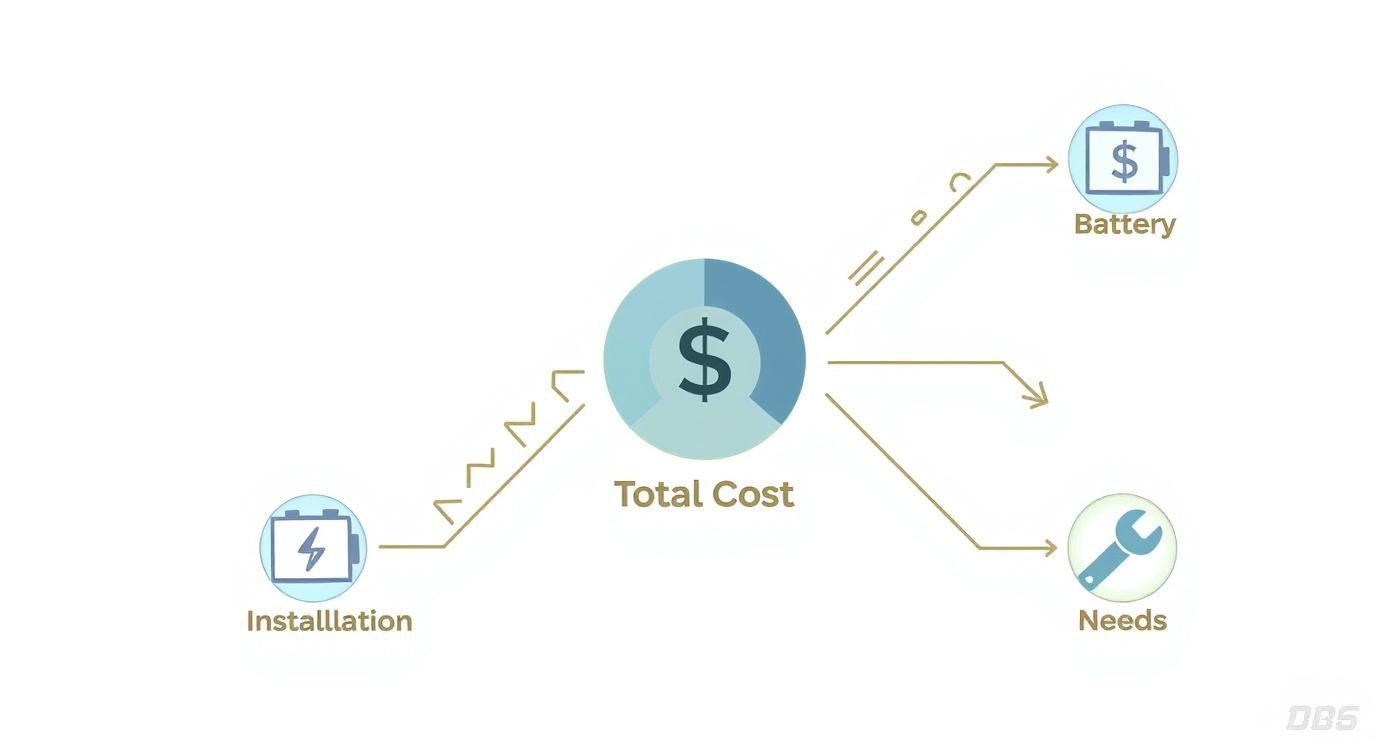
As you can see, the final number on your quote is a mix of the battery technology itself, the professional labor to install it, and your home's unique energy needs.
Battery Chemistry: The Engine of Your System
The single biggest factor dictating the price is the battery's chemistry. Lead-acid batteries are the older tech, and they tend to have a lower sticker price. The catch? They are incredibly heavy, less efficient, and have a much shorter lifespan, which means you'll be paying to replace them sooner than you think.
On the other hand, LiFePO4 batteries are the new standard for a reason. They're safer, more compact, and you can drain them much further without causing damage. This superior technology definitely comes with a higher initial cost, but it pays you back with far greater value over the life of your system.
The real difference comes down to usability. A LiFePO4 battery lets you safely use a much bigger slice of its stored power in every cycle. This means a smaller, lighter lithium battery can often provide the same amount of real-world energy as a larger, bulkier lead-acid model.
Capacity and Lifespan: Your Fuel Tank and Durability
Beyond the basic chemistry, two key numbers really determine a battery's price tag:
- Usable Capacity (kWh): Think of this as your fuel tank. It’s the total amount of energy the battery can actually store and deliver, measured in kilowatt-hours (kWh). The higher the capacity, the more lights and appliances you can keep running during a power outage.
- Cycle Life: This is all about durability. It measures how many times you can fully charge and discharge a battery before it starts to lose its ability to hold a full charge. A high-quality LiFePO4 battery can give you 6,000 cycles or more—easily lasting over a decade—while a lead-acid battery might only be good for a few hundred.
This massive difference in technology and longevity is reflected directly in the price you pay per kWh. For 2025, you can expect LiFePO4 batteries to cost somewhere between $450 and $600 per kWh. They strike a great balance between the initial investment and long-term performance.
In comparison, traditional lead-acid batteries run from about $200 to $350 per kWh. While that looks cheaper on paper, their short lifespans and lower effective capacity often lead to higher replacement costs and less value over time. You can even see this price difference in other applications, where things like golf cart battery costs vary wildly based on the underlying technology.
Picking the right capacity is critical, and we cover exactly how to figure that out in our guide on what size solar system you need: https://hilowroofing.com/what-size-solar-system-do-i-need/
Understanding Installation and Labor Costs
The battery itself might be the star of the show, but it's only one piece of the solar battery backup cost. The "soft costs"—which really just means professional installation and labor—are what make the whole system come together safely and efficiently for years to come. Think of it like this: you can buy a top-of-the-line engine, but without a skilled mechanic to install it, you’ve just got a very expensive paperweight.
For homeowners here in Central Florida, from St. Petersburg clear over to Orlando, getting a pro to install your system isn't just a good idea; it's a must. This is way more involved than just hanging a heavy box on the wall. It’s a complex electrical job that requires a serious amount of precision and expertise.
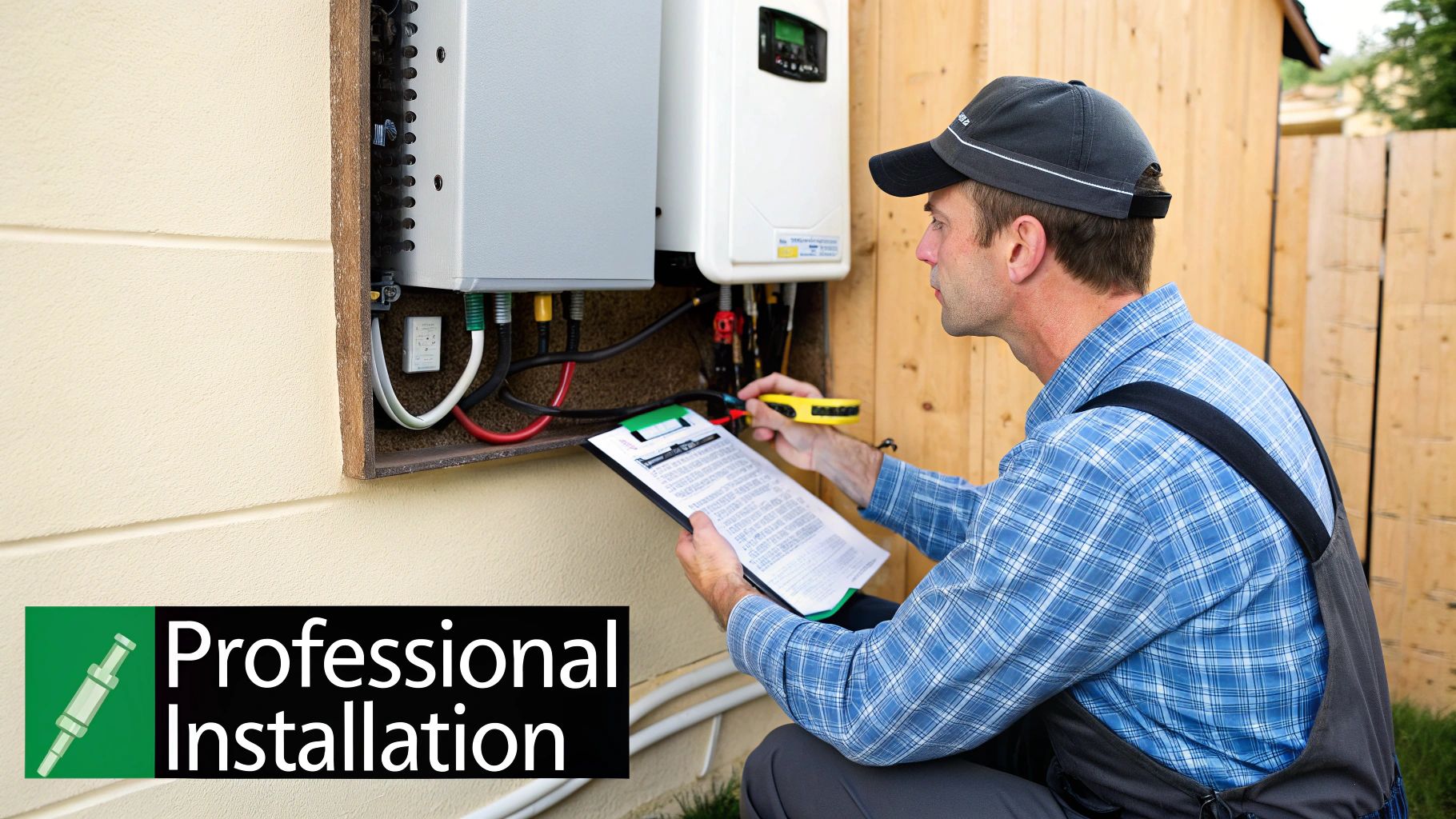
A proper installation makes sure your battery plays nice with your existing solar panels and your home's main electrical panel. This guarantees that power is flowing exactly where it needs to, whether it's charging up from the sun or keeping your lights on during a blackout.
Why Professional Installation is Essential
Choosing a certified installer like Hi Low Roofing isn’t about convenience; it’s about protecting your home and your investment. Trying to DIY a battery installation or hiring a general handyman can backfire spectacularly, leading to dangerous electrical faults, voiding your warranty, and creating serious safety risks for your family.
Here’s what a professional installation in Florida actually involves:
- Licensed Electricians: Only licensed pros have the training to handle the kind of high-voltage connections a battery requires, making sure everything is done to code.
- Local Permitting: A professional handles the headache of navigating the specific permit rules in counties like Hillsborough, Pinellas, or Orange, ensuring your system is 100% legal.
- System Integration: The crew ensures your new battery communicates perfectly with your solar inverter and home’s grid connection, which is key to maximizing its efficiency.
- Safety Compliance: Certified installers live by strict safety protocols. It's their job to protect your home from any electrical risks tied to a high-powered energy system.
Trusting a certified solar installer is the only way to protect your investment. It guarantees that your system is not only safe and efficient but also fully covered by the manufacturer's warranty, giving you complete peace of mind.
The True Value of Expert Labor
When you see the labor portion of your quote—typically between $3,000 to $5,000—it’s reflecting the deep expertise needed for this kind of specialized work. That cost covers everything from the first site visit and system design all the way to the final commissioning, where they test and fire up the system for the first time.
Ultimately, paying for professional labor is how you protect the much larger investment you made in the battery itself. It’s the difference between a system that works and one that works perfectly—reliably giving you power when you need it most, especially during Florida's wild storm seasons.
How Florida Incentives Lower Your Final Cost
The sticker price for a solar battery backup system is really just the starting point. For homeowners in Central Florida who know where to look, a handful of powerful financial incentives can slash that final number, putting energy independence well within reach. We're not talking about small-time rebates; these are serious savings that make a huge dent in your initial investment.
The biggest game-changer for homeowners from Pinellas to Orange County is the Federal Solar Investment Tax Credit, often called the ITC. It's simple: this is a dollar-for-dollar reduction on what you owe in federal income taxes. For any system installed this year, you can claim a credit for 30% of the total cost.
Let's put that into perspective. On a $15,000 system, that 30% credit means you get $4,500 back on your taxes. That’s a massive discount that fundamentally changes the math on securing your home’s power supply.
This federal credit covers both the battery itself and all the associated installation costs, making it the foundation of any smart solar financing strategy. If you're wondering how these numbers pencil out for your own home, our guide on whether solar panels are worth it in Florida breaks down the complete financial picture.
Florida-Specific Savings You Can't Ignore
On top of the generous federal credit, Florida has its own perks that make going solar even sweeter. The state has put these in place to encourage homeowners just like you to invest in cleaner, more reliable energy.
Here’s a quick summary of the key financial incentives available right now.
Key Financial Incentives for Florida Homeowners
| Incentive Name | What It Does | How It Helps You Save |
|---|---|---|
| Federal Solar ITC | Provides a 30% tax credit on the total system cost. | Directly reduces your federal income tax liability by thousands of dollars. |
| Property Tax Exemption | Prevents your property taxes from increasing due to the added home value from the solar system. | You get the full value of a home upgrade without the usual tax hike. |
| Sales Tax Exemption | Eliminates the 6% state sales tax on all solar and battery equipment. | Saves you hundreds of dollars right off the top on your initial purchase. |
These state-level incentives are a huge bonus. The Property Tax Exemption is fantastic because while a solar and battery system definitely increases your home’s value, Florida law ensures you won’t get penalized for it with a higher tax bill.
And don't forget the Sales Tax Exemption. By avoiding Florida's 6% sales tax on all your equipment, you're saving hundreds, sometimes thousands, of dollars before the system is even installed.
When you stack these savings together, the financial case for adding a battery to your solar setup becomes incredibly compelling. This is all happening at a time when equipment costs are falling. Believe it or not, the price for solar power paired with battery storage dropped by 22% in just one year, with battery costs alone plummeting 40% in 2024. You can discover more insights about these price trends to see just how quickly the market is moving in favor of homeowners.
Calculating Your True Return on Investment

A solar battery isn't just another home appliance; it's a serious investment in your family's security and your own energy independence. It's easy to get fixated on the solar battery backup cost upfront, but to really grasp its value, you need to look at the complete Return on Investment (ROI). This is a calculation that goes way beyond a simple payback period.
For anyone living in Central Florida, from Pinellas to Orange County, the real worth of a battery isn't just measured in the dollars you save on your utility bill. It’s also measured in the priceless peace of mind that comes from knowing your home will stay powered through a hurricane, a summer storm, or a random grid failure.
This true ROI is a mix of hard financial savings and those critical, intangible benefits.
The Tangible Financial Returns
The most direct way a battery pays you back is by making your solar panels work smarter, not just harder. Instead of sending all that extra power you generate during the day back to the grid, you store it for later.
Then, you can tap into that stored energy during the peak evening hours when electricity rates can be high. This strategy, often called "time-shifting," directly slashes your dependence on the utility company and lowers your monthly bills. Over the years, these daily savings really add up, steadily chipping away at your initial investment.
A solar battery transforms your solar panels from a part-time power source into a 24/7 energy solution. It ensures that every kilowatt-hour your panels produce is put to work for you, maximizing the value of your entire system every single day.
The Priceless Intangible Benefits
Now, let's talk about the value you can't really put on a spreadsheet. If you’re a Floridian who's ever endured a week-long power outage after a hurricane, you know that the ability to keep the lights, AC, and refrigerator running is invaluable.
This is the resilience factor, and it covers a lot:
- Hurricane Preparedness: Having reliable backup power means no more last-minute scrambling for fuel for a noisy, smelly generator.
- Family Safety: You can keep critical medical devices, communication tools, and home security systems online during an emergency.
- Uninterrupted Life: It allows you to work from home, keep your kids comfortable, and maintain some sense of normalcy when things outside are chaotic.
While we've seen a welcome drop in equipment costs over the last few years, it’s smart to keep an eye on future market shifts. Projections suggest the era of rock-bottom prices might be drawing to a close. Due to policy changes in China, solar module prices are expected to rise by about 9% starting in late 2025. You can learn more about these market projections from Wood Mackenzie to see why now is such a good time to invest.
Ultimately, the true ROI of a solar battery is the powerful combination of daily savings and the absolute certainty that your home will remain a safe, powered sanctuary—no matter what the Florida weather throws at it.
Your Top Solar Battery Cost Questions, Answered
As you start looking into the solar battery backup cost for your home, you're bound to have questions. That's a good thing. Getting solid, straight-up answers is the only way to feel truly confident in your decision. Here in Central Florida, we hear a lot of the same concerns from homeowners, so let's tackle the most common ones head-on.
How Many Solar Batteries Do I Actually Need?
This is the big one, and the honest answer is: it depends entirely on what you want to accomplish. Think of it like this—are you packing a small bag for an overnight trip, or are you loading up the car for a week-long family vacation? The goal determines what you need to bring.
It's the same with solar batteries. The number you need comes down to what you want to keep running when the grid goes down.
- Covering the Essentials: If you just want to power the basics—the refrigerator, a few lights, maybe the Wi-Fi router so you can stay connected—a single battery is usually plenty. This is a really popular setup for homeowners in the Orlando area who just want to ride out a short-term outage without major disruptions.
- Whole-Home Backup: Now, if your goal is to keep your entire house running like nothing ever happened, you're looking at a different scale. Powering everything, especially heavy hitters like your air conditioner, will almost certainly require two or more batteries. This approach gives you total peace of mind, which is a massive advantage during a long power outage after a hurricane.
The best way to figure this out is to look at your daily energy use, which is measured in kilowatt-hours (kWh). A pro can help you run the numbers and find the perfect fit.
Can I Add a Battery to My Existing Solar Panels?
Absolutely. Adding a battery to a solar panel system you already have is a common upgrade—in the industry, we call it a "retrofit." The process involves connecting the new battery to your existing solar inverter and your home's main electrical panel.
The key thing to watch out for is compatibility. Your new battery and your current solar equipment need to be able to communicate effectively. This is precisely why you want a professional installer involved. They'll take a look at your setup and recommend a battery solution, like an AC-coupled battery, that can be added smoothly without having to tear apart your whole solar array.
Is a Solar Battery Really Worth It in Florida?
This is the bottom-line question for most folks in Central Florida. The value of a solar battery is about so much more than just selling a little extra power back to the utility company (a practice called net metering). While that's a nice perk, the real game-changer is gaining energy independence and resilience.
For a Florida homeowner, a solar battery’s true value isn't just about saving money on daily utility bills—it’s about the priceless security of having your own power plant ready to go when the grid fails during hurricane season.
Here’s why a battery makes so much sense here:
- Hurricane Preparedness: It’s your own personal, uninterruptible power supply. You can keep your family safe and comfortable without the noise, fumes, and constant refueling that comes with a gas generator.
- Energy Independence: You get to use more of the clean power you generate yourself. This means you're less reliant on the utility company and its ever-changing rates.
- Savings on Peak Rates: Many utilities charge more for electricity during "peak" hours, usually in the late afternoon and evening. With a battery, you can just switch over to your stored solar power during these expensive times, which directly cuts down your monthly bill.
For so many people in our community, from Pinellas County all the way to Orlando, these benefits easily make the solar battery backup cost a smart investment in a safer, more predictable future.
Ready to take control of your home's power and see what a solar battery system would cost for your specific needs? The team at Hi Low Roofing & Solar provides free, no-obligation consultations to design a system that fits your home and budget perfectly. Contact us today to secure your energy independence.
