

This might come as a shock, but the answer to "Do my solar panels work during a power outage?" is almost always no. Most homeowners are surprised to learn that standard grid-tied solar systems are designed to shut down completely when the grid fails, leaving you in the dark just like everyone else.
Why Your Solar System Shuts Down During a Blackout
It’s a common and perfectly logical assumption: solar panels on the roof should mean power during a blackout. But for the vast majority of systems here in Central Florida, from Tampa to Orlando, a critical safety feature makes that impossible.
This automatic shutdown is a mandatory safety protocol called anti-islanding. It’s there to protect utility workers who are out repairing downed lines. If your system kept sending power to the grid, it would create a dangerous "island" of live electricity, putting line workers at risk of electrocution. It’s a non-negotiable part of any solar installation connected to the grid.
To give you a clearer picture, here's a quick look at how a standard solar system compares to one with battery backup when the grid goes down.
Solar System Function During a Grid Outage
| System Type | Power During Outage | Why It Happens |
|---|---|---|
| Grid-Tied Solar Only | No Power | The inverter shuts down to prevent back-feeding the grid and protect utility workers (anti-islanding). |
| Solar + Battery Backup | Yes, Power | The system safely disconnects from the grid and uses stored battery energy to power your home. |
As you can see, the battery is the missing piece of the puzzle for true energy security.
The Real Solution for Energy Independence
So, how do you keep the lights on when a storm hits? The answer is a solar battery storage system. Adding a battery transforms your system, creating a self-sufficient microgrid for your home that gives you genuine energy independence.
When the grid fails, a solar-plus-battery system instantly and safely isolates your home from the utility. Your battery then kicks in, supplying the solar energy it has stored to run your essential appliances. All the while, your panels can continue soaking up the Florida sun, recharging the battery and keeping your home powered for as long as the outage lasts.
For those of us in Central Florida, this isn't just about convenience—it's about hurricane season readiness. The average American already deals with around 8 hours of power outages each year, but that number can be much higher in states prone to extreme weather. Without a battery, your solar investment can't help you when it matters most. You can explore more data about grid reliability and solar safety protocols to get the full picture.
For a Florida homeowner, a solar battery isn't just a luxury—it's a core part of a resiliency plan. It transforms your solar array from a grid-dependent system into a personal power station that can outlast extended blackouts.
How a Solar Battery Creates Your Personal Power Grid
A solar battery is what truly unlocks energy freedom, turning your home into a personal power station. It’s the critical piece of technology that lets you use your solar panels during power outage events—something we see all too often during Florida's unpredictable storm season.
When a blackout hits your Orlando, Tampa, or Pinellas County neighborhood, your system immediately springs into action. An automatic transfer switch senses the loss of utility power and, in a split second, safely disconnects your home from the main grid. This is an absolutely essential safety measure that prevents your solar array from sending power back into downed lines, which could endanger utility crews.
Once you're safely islanded from the grid, your solar battery takes over. The clean energy your panels have been busy generating and storing is now routed directly into your home, keeping the lights on and essential appliances running. Your system has just created its own safe, independent microgrid.
Keeping the Power Flowing
The real magic happens the next morning. As the sun comes up, your solar panels get back to work generating electricity. This fresh power accomplishes two things at once: it runs your home and recharges your battery. You've now created a sustainable energy loop that can help you ride out even multi-day outages with ease.
This infographic gives you a great visual of how these components work together to provide seamless backup power when you need it most.
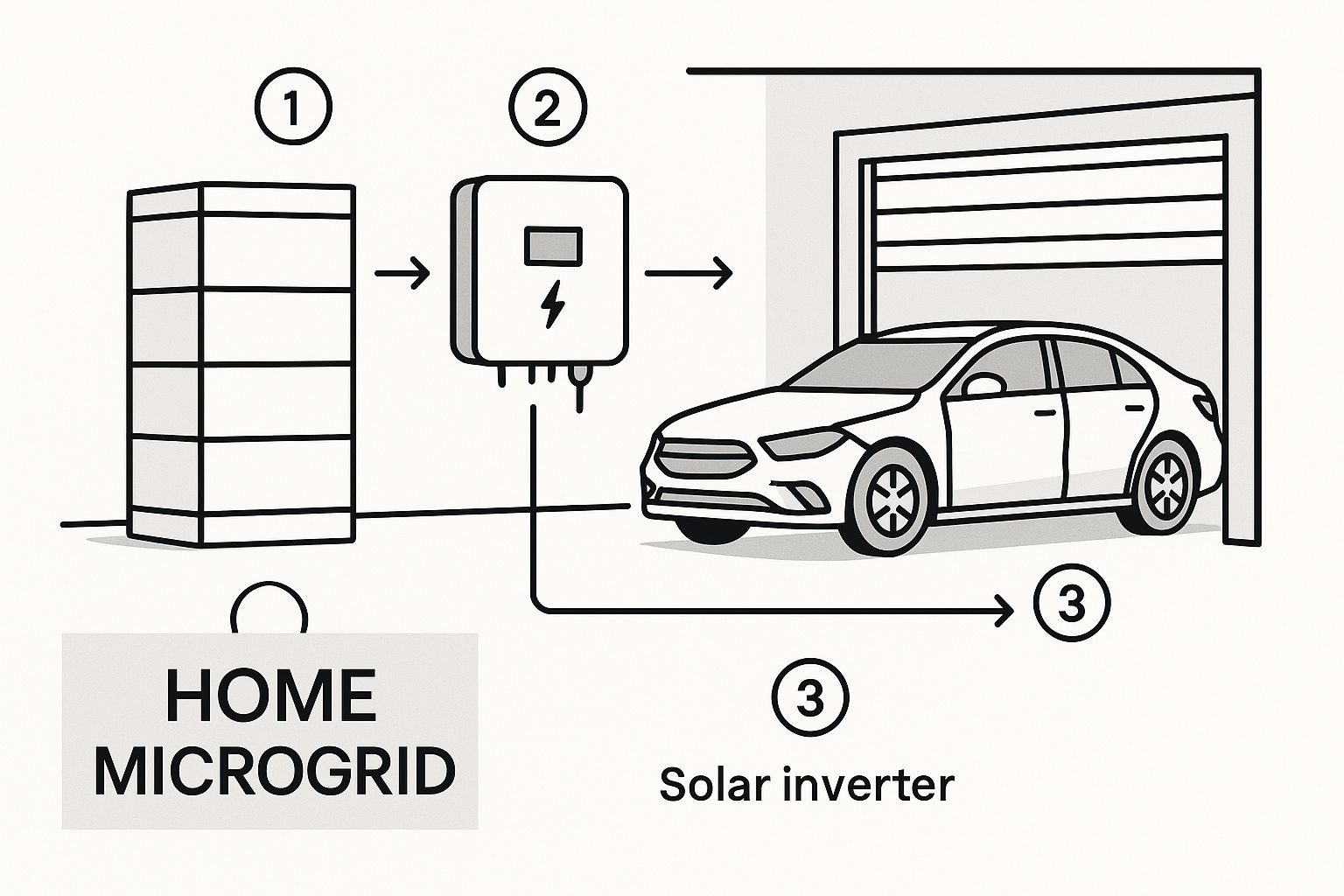
As you can see, when the grid is down, your battery and inverter become the new hub of your home's power, ensuring total continuity.
By storing solar energy, you're not just preparing for an outage; you're building a resilient energy source that recharges itself daily. This is a significant advantage over a gas generator, which relies on a finite fuel supply.
Understanding the investment is just as important as the technology itself. Hi Low Roofing offers various programs to make this upgrade more accessible, and you can explore our flexible financing options to see what works for you.
For an even broader perspective on what's possible, looking into various mobile energy solutions shows how this same technology can create an independent power grid on wheels. This kind of capability is what delivers true peace of mind.
What Should You Power When the Grid Goes Down?
Having a solar battery is a huge step towards energy independence, but the real trick is knowing exactly what to do with that power when you're relying on solar panels during a power outage. Your battery holds a limited amount of energy, so the strategy is to focus on your home's critical loads—those absolute essentials you can't go without.
This is about more than just keeping the lights on. For a family here in Central Florida, it means running the equipment that ensures safety, saves you from costly losses (like a freezer full of spoiled food), and keeps things comfortable when the unexpected happens. The whole point is to build a smart plan that directs your battery’s power to where it matters most for your family.
Pinpointing Your Must-Have Appliances
Before anyone can design the right battery system for you, you've got to decide what stays on. This is a personal choice, but after helping hundreds of homeowners from Pinellas County to Orlando, we've seen a clear pattern of what provides the most peace of mind.
Here are the critical loads that come up again and again for Florida homes:
- Refrigerator & Freezer: This is almost always number one. Preventing hundreds of dollars worth of groceries from spoiling is a no-brainer. Modern fridges are pretty efficient, making them an ideal candidate for backup power.
- Medical Equipment: If you rely on a CPAP machine, oxygen concentrator, or other home medical devices, keeping them powered is absolutely non-negotiable.
- Well Pump: For homes on well water, no power means no running water. The well pump is a lifeline and an essential load.
- Internet & Communications: In an outage, information is key. Keeping your modem, router, and phones charged allows you to get updates, check on storm paths, and stay in touch with family.
- A Fan or Small AC Unit: Let's be real, Florida heat is no joke, and it can be dangerous during an extended outage. Powering a few fans or a single, efficient window AC can make a massive difference in comfort and safety.
Think of your critical load plan as the blueprint for your home's resilience. When you focus on what truly matters, you ensure every last drop of stored solar energy is used effectively. This stretches your battery's runtime and keeps your family safe and comfortable when it counts.
Once you have your list of must-haves, the next step is figuring out how much juice they actually draw. This sounds more technical than it is. While a professional installer will do the precise math, having a rough idea helps you make smarter decisions about what size battery you really need.
To give you a head start, here’s a quick look at the typical power consumption of common household items. This can help you start thinking about what to prioritize.
Estimating Your Critical Load Energy Needs
Typical wattage for key household appliances to help you plan your battery backup strategy.
| Appliance | Average Running Watts | Priority Level During Outage |
|---|---|---|
| Refrigerator/Freezer | 100-200 W | High |
| CPAP Machine | 30-60 W | High |
| Well Pump (1/3 HP) | 750 W | High |
| Wi-Fi Router & Modem | 10-20 W | High |
| Ceiling Fan | 60-100 W | Medium |
| Window AC Unit | 500-1,500 W | Medium |
| Phone/Laptop Charger | 25-65 W | Medium |
| LED Lights (per bulb) | 5-15 W | Low |
| Television (55" LED) | 60-80 W | Low |
This table is just a starting point, of course. We can walk through your specific appliances and create a detailed load calculation for you during a free consultation.
Why Florida's Weather Demands a Battery Backup Plan
If you live anywhere in Central Florida, from Pinellas County clear over to Orlando, you know that hurricane prep is just a part of life. We've all seen how even a strong tropical storm can leave entire neighborhoods in the dark for days on end. This is exactly why a solar battery isn't just an add-on; it's a critical piece of your home's hurricane plan.
When the grid goes down, that fully charged battery becomes your lifeline. It’s not just about convenience—it's about genuine security. You can keep phones charged to check on family or get the latest storm updates. For many, it's about keeping essential medical equipment running, which is completely non-negotiable.
Surviving Storm Season with Solar
Beyond staying connected, a battery lets you control your immediate environment. You can run a few fans to fight off that suffocating post-storm humidity or power the refrigerator to avoid tossing out hundreds of dollars' worth of groceries. In Florida's climate, a solar-plus-storage setup is the cornerstone of real resilience.
A solar battery isn’t just about keeping the lights on. It’s about securing your family's health, safety, and communication lines when community infrastructure is at its most vulnerable.
Even if your panels escape the storm without a scratch, the weather itself is going to choke your power production. During a Category 1 hurricane, for example, the heavy, dark cloud cover will slash your solar output. In fact, studies show that power generation can plummet to just 27% of what you'd normally get. You can read more about how hurricanes affect solar energy production to see the data for yourself.
This is precisely why a robust battery backup is so important—your panels alone simply won't cut it when you're in the middle of the storm. If you're weighing the bigger picture, our guide on whether solar panels are worth it for your Florida home offers some more valuable insights.
Finding the Right Local Solar and Roofing Pro
Let's be honest, setting up a solar backup system isn't a weekend DIY job. If you want your solar panels to work during a power outage without a hitch, you absolutely need a professional on your side. Teaming up with a local expert who knows solar technology and roofing is the single most important decision for a safe, efficient, and durable system.
A true professional does far more than just bolt panels to your roof. They'll start with a deep dive into your home's electrical panel to make sure it can handle the new system. They'll also give your roof a thorough inspection to head off any potential leaks and, most importantly, they'll analyze your family's actual energy usage to design a system that’s just right for you. This groundwork is what makes the difference between a system that works and one that works when you need it most.
Why a Central Florida Pro is Your Best Bet
For anyone living between Pinellas County and Orlando, going with a local specialist is a game-changer. A Central Florida expert already knows the unique building codes, the ins and outs of local permitting, and exactly what the utility companies require. That kind of insider knowledge saves you from frustrating delays and expensive mistakes.
When you're vetting installers, you'll want to find a trusted residential electrician who has a solid track record with solar projects. This is key to making sure every piece of the puzzle—from the panels on the roof to the battery in the garage—plays nicely together.
To help you narrow down your choices, here are a few critical questions you should ask any company you're considering:
- Which battery brands hold up best in Florida's heat and humidity? Our climate can be brutal on electronics. A seasoned installer will have go-to brands they know can take the heat.
- How do you plan to integrate the solar panels with my specific type of roof? You need a team that's as much a roofing expert as a solar expert, using proper flashing and sealing to protect your home.
- Can you show me your license and insurance for both roofing and electrical work in my county? This is a deal-breaker. It protects you and your investment.
Handing your project over to a company that's dual-certified in both roofing and solar, like Hi Low Roofing, means every aspect is handled by an expert. It’s simply the smartest path to real energy independence.
Ready to see what a professional approach looks like? You can get a better sense of our solar installation process and see how we customize every system for our clients.
Questions We Hear All the Time About Solar Backup
When you start digging into solar battery systems, a lot of questions pop up. As the go-to experts for both roofing and solar here in Central Florida, we've pretty much heard them all. Let's walk through some of the most common ones we get from homeowners looking for a little more energy independence.
How Long Will a Solar Battery Actually Power My House?
This is always the first question, and the honest answer is: it depends. The runtime really comes down to three things: the size of your battery, what you choose to run, and, of course, the weather.
A properly sized battery system will typically keep your essential appliances—think the refrigerator, lights, critical medical equipment, and your internet—running for a solid 8-12 hours on a full charge.
The real magic for us here in Florida is what happens the next day. As soon as the sun comes out, your panels get right back to work recharging the battery. This cycle can keep your critical loads powered indefinitely through a multi-day outage, as long as you get a bit of sun.
Can I Add a Battery to My Existing Solar Panels?
You sure can. Most of the time, we can retrofit a battery to a solar panel system that's already up and running. The most common way we do this is through a method called AC coupling.
A certified installer will integrate the battery with its own smart inverter. This new inverter acts as the traffic cop for your home's energy, directing power from the panels, to the battery, and into your house so everything plays nicely together.
The best thing about modern battery systems is that they're completely hands-off. The switch from grid power to your battery is instantaneous. You won't have to do a thing—in fact, it happens so fast you probably won't even see the lights flicker.
What’s the Investment for a Solar Battery System in Florida?
The final cost really depends on the battery's capacity, the brand you go with, and the complexity of the installation. But there's good news.
The Federal Solar Tax Credit can take a significant bite out of the price tag. This credit doesn't just apply to the solar panels; it also covers the battery, as long as it's charged by your solar array. This makes adding that extra layer of resilience a much more affordable option for homeowners from Pinellas County all the way to Orlando.
Ready to put together a rock-solid backup power plan for your home? The team at Hi Low Roofing has the local know-how to design a system that keeps your family safe and comfortable, no matter what the grid throws at you. Reach out for a free, no-pressure consultation today. Learn more at hilowroofing.com
