

That little water stain on your ceiling? It's easy to ignore, but here in Orlando's humid climate, it's often the first whisper of a much bigger problem brewing overhead. Catching roof damage early is the single best way to keep a small, affordable fix from turning into a massive, wallet-draining structural nightmare. You are your home's first line of defense, and that means knowing what to look for.
Your Guide to Identifying Early Roof Damage
Think of your roof as a billboard for its own health. It's constantly sending signals, but you need to know how to read them. A single cracked shingle might seem like no big deal, but it's like a "check engine" light for your house. Ignore it, and you're gambling against the next big storm. Here in Central Florida, that combination of intense sun, torrential rain, and hurricane-force winds can turn a tiny issue into a total failure in no time.
The good news? You can spot most of these warning signs from the safety of the ground. A quick visual inspection can save you thousands down the road. It’s a simple habit that protects both your home and your bank account.
This infographic shows you exactly where to focus your attention during a quick walk-around.
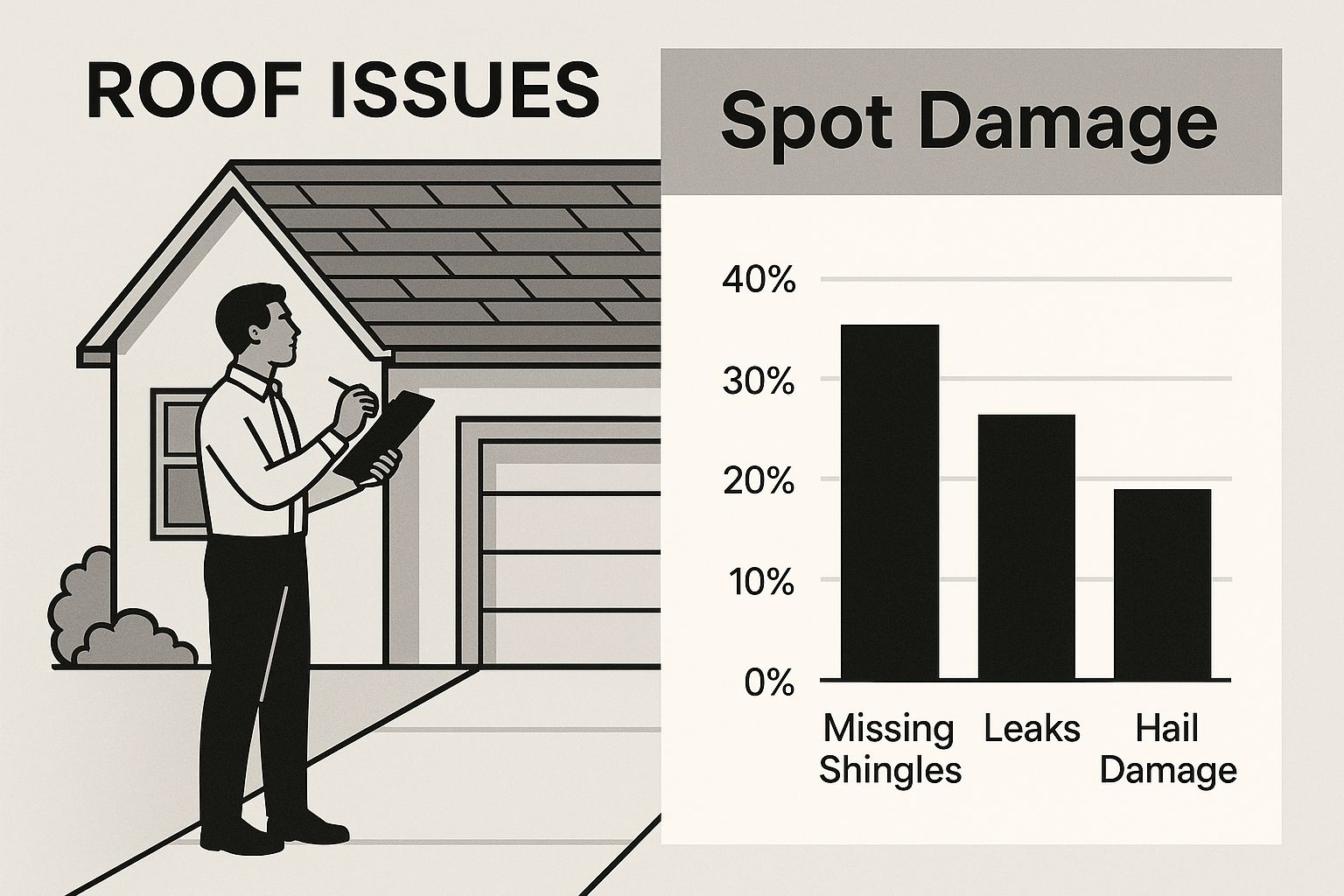
This isn't about climbing ladders; it's about developing a keen eye for trouble before it gets serious—a crucial skill for any Central Florida homeowner.
What to Look for From the Ground
You really don't need to get up on the roof to get a solid idea of its condition. All you need is a pair of binoculars and a few minutes to walk the perimeter of your house. Making this a routine—maybe twice a year and definitely after any major storm—is your best strategy for early detection.
Keep an eye out for these tell-tale signs:
- Shingle Granules in Gutters: See all that sand-like grit in your downspouts? Those are the protective granules from your asphalt shingles. When they start washing away, it means the sun has cooked your shingles, leaving them brittle and vulnerable.
- Dark Streaks or Algae Growth: Those ugly black streaks are an algae called Gloeocapsa magma, and it loves Florida's humidity. At first, it's just a cosmetic issue, but if it gets too thick, it holds moisture against the roof surface and accelerates aging.
- Curling, Buckling, or Missing Shingles: Your shingles are designed to lie perfectly flat. If you see the edges curling up like old potato chips or entire sections bubbling up, that's a red flag for heat damage and age. A completely missing shingle is an emergency—it's a direct invitation for water to pour in.
- Damaged Flashing: Pay close attention to the metal strips around your chimney, vents, and skylights. This flashing is a notorious weak point. If it looks rusted, bent, or has pulled away from the roof, you’ve got a leak waiting to happen.
Spotting these problems early is what separates a targeted roof repair in Orlando from a full-blown replacement. A professional roofer can often fix these minor issues in a matter of hours, but only if they're caught before water gets through to the underlying wood.
Knowing these visual cues empowers you to make an informed call. While some of these signs point to an immediate need for repair, others are hints that your roof is getting close to the end of its life. To help you tell the difference, check out our detailed guide on the signs you need a new roof to better understand when a simple patch job just won't cut it.
Understanding Orlando Roof Repair Costs
Trying to budget for a roof repair in Orlando can feel like guesswork. The final price isn't a single flat rate; it’s a mix of several factors that all contribute to the size and complexity of the job. Getting a handle on these variables is the best way to get a clear financial picture and sidestep any last-minute surprises.
It's a lot like taking your car to the mechanic. A simple oil change has a predictable, low cost. But if the mechanic finds a serious issue under the hood, the scope—and the bill—changes completely. It’s the same with your roof. Replacing a few shingles torn off by the wind is a minor fix, but repairing a slow leak that has rotted the underlying wood is a whole different ballgame.
At the end of the day, the two biggest drivers of your final bill will be the extent of the damage and the type of material on your roof. A small, contained problem will always be cheaper to fix than widespread damage that stretches across different sections of your roof.

Key Factors That Influence Your Bill
A few key elements come together to build your final estimate. Labor costs, the specific materials needed for the fix, and how easy (or difficult) it is to access the damaged spot all play a role. For instance, a steep, two-story roof is going to demand more time and safety gear than a low-slope, single-story home, and that's reflected in the price.
Given the unique weather we face here in Central Florida, roof repair costs can vary quite a bit. As of early 2025, the average cost for a roof repair in the Orlando area hovers around $893. Most homeowners find themselves paying somewhere between $432 and $1,380. That range covers everything from quick patches to more involved leak repairs.
The material on your roof is another huge piece of the puzzle. Asphalt shingles are by far the most common and generally the most affordable to repair. On the other hand, materials like clay tile or standing seam metal require a more specialized touch and specific parts, which naturally bumps up the price. To see a direct comparison, you can explore the cost difference between metal roofs and shingles in our detailed guide.
Estimated Roof Repair Costs in Orlando by Damage Type
To give you a clearer idea of what to expect, we've put together a table outlining typical repair scenarios we see all the time in the Orlando area. Remember, every roof is unique, but this gives you a realistic starting point for what a repair might cost.
| Type of Repair | Common Causes in Orlando | Estimated Cost Range |
|---|---|---|
| Minor Shingle Replacement | High winds from thunderstorms, hail, or falling tree limbs. | $250 – $500 |
| Flashing Repair/Replacement | Sun exposure causing seals to crack, rust from humidity. | $300 – $750 |
| Small Leak Patching | Punctures from debris, failed sealant around vents. | $400 – $1,000 |
| Replacing Damaged Decking | Long-term moisture intrusion from a persistent leak. | $700 – $2,500+ |
This table shows how a seemingly small issue can have a wide cost range depending on what the roofer finds once they get up there.
Navigating Homeowner's Insurance for Storm Damage
After a big storm blows through, the first question on every Orlando homeowner's mind is, "Will my insurance cover this?" The answer usually comes down to the fine print in your policy and what caused the damage.
Most standard homeowner's insurance policies cover damage caused by "acts of God," such as hurricanes, wind, and hail. However, they typically do not cover damage resulting from neglect or a roof that has failed due to old age.
If you think you have a claim, here’s how to approach it:
- Document Everything: Before anyone touches the roof, take plenty of clear photos and videos of the damage from the ground. Get shots of missing shingles, dented flashing, or any water spots you see on your ceiling.
- Get a Professional Inspection: Call a trusted local roofer for a thorough inspection. A professional report will accurately identify the storm damage and give you the detailed estimate your insurance company will need to see.
- Contact Your Insurance Agent: With your photos and the professional estimate in hand, you’re ready to file your claim. An experienced roofer can be a huge asset here, helping you navigate the process and making sure all storm-related damage is properly accounted for.
A Guide to Repairing Different Roof Types in Orlando
Fixing a roof in Orlando isn't a one-size-fits-all kind of job. It’s a bit like being a car mechanic—you wouldn't use the same tools and approach on a big rig as you would on a sports car. The most common roofs you see around Central Florida are asphalt shingles, classic tiles, and tough metal panels, and each one has its own set of quirks and common repair needs for both residential and commercial properties.
Knowing the difference is huge for a homeowner or property manager. What works like a charm on a shingle roof could be a disaster on a tile one. That's why any good roofer starts by figuring out exactly what they're working with and then diagnoses the problem based on that material's specific weaknesses.
This kind of tailored expertise means you’re not just getting a temporary patch. You’re getting a real, lasting fix that can handle everything our brutal sun and wild storm seasons throw at it.
Asphalt Shingle Repair
Walk through any neighborhood from Orlando to Tampa, and you'll see asphalt shingles everywhere. They're popular because they're affordable and relatively easy to install. But they have one major enemy here: the relentless Florida sun. That constant UV blast literally cooks the asphalt, causing the tiny protective granules to break loose and wash right into your gutters.
Once those granules are gone, the shingle is left brittle and exposed. This is when the most common problems start popping up:
- Replacing Blown-Off Shingles: After a good gust of wind, it's not uncommon to see a few shingles missing. A proper repair involves gently prying up the damaged shingle and its nails, making sure not to mess up its neighbors. Then, a new, color-matched shingle is slid into place and secured with fresh, corrosion-resistant roofing nails.
- Sealing Curled Edges: You've probably seen it before—the corners of shingles start to curl up. This creates a perfect little ramp for wind-driven rain to get underneath. A roofer will fix this by applying a heavy-duty roofing sealant under the curled edges to glue them back down, sealing that weak spot for good.
Tile Roof Repair
Tile roofs, whether they're clay or concrete, give a home that timeless Florida look and are incredibly durable. Their Achilles' heel isn't slow wear-and-tear; it's sudden impact. A fallen tree branch during a thunderstorm or even someone walking on the roof incorrectly can crack or shatter a tile, creating an instant problem.
A single cracked tile might not look like a big deal, but it's an open door for water to get to the underlayment. That underlayment is the real waterproofing shield for your home, so protecting it is priority number one.
Fixing a tile roof is delicate work.
- First, the broken tile has to be carefully removed without cracking the interlocking tiles around it.
- Next, the roofer inspects the underlayment for any signs of water damage.
- Finally, a new, matching tile is set in its place with the right adhesive or fasteners, making sure it fits seamlessly into the pattern.
Metal and Flat Roof Repair
Metal roofing has become a go-to choice for property owners looking for serious longevity and storm resistance. Most problems with metal roofs don't come from the panels themselves, but from the seams and fasteners. The metal is constantly expanding and contracting with our wild temperature swings, which can cause sealants to break down and screws to work their way loose. A typical repair involves cleaning the problem area, applying a high-grade elastomeric sealant to the seams, and swapping out failed fasteners for new, oversized ones to get a tight seal.
Flat and low-slope roofs, common on commercial buildings and some modern homes, are a different beast entirely. Systems like TPO rely on a completely seamless membrane to keep water out. The usual suspects for leaks are punctures from storm debris, failing seams, or "ponding" water that sits for too long. Repairing them means cleaning the damaged area and heat-welding or adhering a compatible patch to make the surface whole again. You can see why these are such robust systems by exploring options for residential TPO roofing.
What to Expect During Your Roof Repair
The thought of a team of roofers showing up at your house can be a little unnerving. But knowing what a professional repair process actually looks like can take a lot of the stress out of the experience. A quality roof repair in Orlando is more than just slapping on some new shingles; it's a systematic process designed to be safe, efficient, and completely transparent.
Think of it like a minor surgery for your home. It starts with a proper diagnosis, moves to a precise treatment plan, and ends with a clean bill of health for your roof. From the moment you pick up the phone to the final nail being swept from your driveway, every step has a purpose. Understanding this workflow helps you know what to look for and easily tell the difference between a pro and someone just winging it.
The Initial Inspection and Detailed Estimate
It all starts with getting a handle on the real problem. A true professional isn't going to give you a quote from their truck window. They're going to get up on your roof and conduct a thorough, hands-on inspection to figure out exactly what’s going on. This is, without a doubt, the most critical part of the entire process.
The roofer will obviously examine the damaged area up close, but their work shouldn't stop there. A comprehensive inspection also involves:
- Checking the surrounding shingles: Are there other shingles nearby that look brittle, curled, or about to give up? A small problem can often be a symptom of a larger issue.
- Inspecting flashing and seals: The metal strips around chimneys, vents, and skylights are notorious weak points. A detailed check here is non-negotiable.
- Assessing the attic: If they can, a quick look in the attic is a game-changer. Hidden water stains, damp insulation, or soft spots in the wood deck tell the real story of a leak.
After this deep dive, you should get a detailed, written estimate—not just a number on the back of a business card. This document is your project's roadmap. It should clearly break down the scope of work, the specific materials they'll use, the labor costs, and a realistic timeline. No surprises, no guesswork.
The Day of the Repair
Once you've given the green light and scheduled the job, the actual repair day should run like clockwork. A professional crew, like the ones from Hi Low Roofing, will treat your property with care, focusing on quality and safety from the moment they arrive until the moment they leave.
A smooth repair day is the signature of a well-run company. The crew should operate like a well-oiled machine, with clear communication, an efficient process, and a constant focus on protecting your home and yard.
Here’s a step-by-step look at what you can expect on the big day:
- Site Preparation: Before a single shingle is touched, the team will prep the area. They'll lay down tarps to protect your flowerbeds and lawn, cover your A/C unit, and move any patio furniture out of the way to keep it safe from falling debris.
- Executing the Repair: Next, they get to work. The crew will carefully remove the damaged roofing materials, inspect the wood decking underneath for any rot, and replace it if necessary. Only when the foundation is solid will they install the new materials, making sure everything is done to the manufacturer's standards and meets Florida's strict building codes.
- Thorough Cleanup and Final Walkthrough: This is what separates the pros from the amateurs. Once the repair is done, the crew should clean the site meticulously. That means running a powerful magnetic roller across your lawn and driveway to pick up every last nail—a vital safety step, especially if you have kids or pets.
- Final Inspection: To wrap things up, the project manager should walk you through the finished work. They’ll show you exactly what they did, explain the repairs, and answer any questions you have. This final sign-off is all about making sure you are 100% satisfied with the result.
How to Choose the Right Orlando Roofing Contractor
Let’s be honest: in a market as crowded as Orlando’s, picking a roofing contractor can feel overwhelming. But this is single-handedly the most important decision you'll make for your home or commercial property. The right choice is the difference between a quick fix that fails next season and a solid, lasting repair that gives you genuine peace of mind.
Your mission is to find a local, reliable pro who takes pride in their work and stands behind it. It's not about chasing the absolute lowest bid. It's about finding the best long-term value from someone who will treat your property with the same care they’d treat their own.

The Absolute Must-Haves: Contractor Credentials
Before you even glance at a quote, there are a few non-negotiables. Think of these credentials as your first line of defense against shoddy work, scams, and potential legal trouble. Don't even consider a contractor who can't provide proof of these right away.
- Florida State Licensing: Any roofer worth their salt must hold a current license from the state of Florida. This is your proof that they’ve met the official standards for skill and knowledge in the trade.
- Full Insurance Coverage: This is a big one. The contractor needs two key policies: general liability to cover any accidental damage to your property and worker's compensation to protect their crew if someone gets hurt on your job. If they don't have it, you could be on the hook for accidents.
A word of advice: don't just take their word for it. Ask to see physical copies of their license and insurance certificates. A true professional will have them on hand and be happy to show you. Any hesitation is a massive red flag.
Beyond the Paperwork: Checking Their Reputation and Past Work
Once you've vetted the essentials, it's time to see what they can actually do. Online reviews and project portfolios are where you get the real story about what it's like to be their customer.
Look for a consistent pattern of positive reviews across a few different sites. A single bad review isn't the end of the world—what matters is how the company responded. Did they try to make it right, or did they get defensive? Their portfolio should also show off a range of projects on homes like yours, proving they have experience with the materials and challenges specific to Central Florida.
Florida’s roofing industry has seen steady growth, fueled by our state's population boom and new construction, particularly around Orlando. On a larger scale, the global industry is expected to grow at 3.7% annually by 2025. Much of that is driven by a demand for energy-efficient options like cool roofing and solar—perfect for our sunny climate. You can explore the latest roofing industry trends on useproline.com to learn more about where the market is headed.
Key Questions to Ask Every Potential Roofer
You've got your shortlist. A final conversation can help seal the deal. How they answer these questions will tell you everything you need to know about their professionalism and process.
- What kind of warranty do you offer on your work and materials? A quality roofer provides their own workmanship warranty to cover the installation, which is separate from the manufacturer's warranty on the shingles or tiles.
- Who is my go-to person if I have questions during the project? Great communication is essential. Having a dedicated point of contact prevents mix-ups and keeps the entire process running smoothly.
- How do you handle surprises? Sometimes, tearing off old shingles reveals hidden damage. A good contractor has a clear plan for documenting the problem, walking you through the options, and getting your sign-off before doing any extra work.
Taking the time to choose the right partner for your roof repair in Orlando is an investment in your home’s future. A little extra diligence now can save you from major headaches down the road.
A Few Common Questions About Roof Repair
Even after you've got the basics down, a few specific questions always seem to pop up for homeowners in Central Florida. It's completely normal. Let's tackle some of the most common ones we hear from people around Orlando so you can feel confident about the next steps.
How Long Does a Typical Roof Repair Take?
This is usually the first thing everyone wants to know, and the honest answer is: it really depends on what we're dealing with. Think of it this way—fixing a dripping faucet is a quick job, but re-plumbing the whole bathroom is a different story. The same idea applies to your roof.
For most minor issues, the work is over before you know it.
- Small fixes, like replacing a few shingles that a storm ripped off or sealing the flashing around a vent pipe, usually take just 2 to 4 hours. A good crew can get in and out in a single morning or afternoon.
- Bigger jobs, say, fixing a leak that's damaged some of the plywood decking underneath, might take up a full day. These repairs have more steps, from tearing off the old materials to making sure the new wood is solid before laying down the new shingles.
Any roofer worth their salt will work efficiently without rushing the job. The whole point of a roof repair in Orlando is to get it done right so you don't have to think about it again for a long time.
What’s the Best Time of Year for Roof Repairs in Orlando?
Here in Central Florida, the weather calls the shots for any outdoor project. While emergencies have to be handled no matter what the calendar says, there are definitely better windows of time for scheduled repairs.
The sweet spots are typically fall and spring. The weather is usually drier and milder, the humidity drops, and we aren't dealing with those daily afternoon thunderstorms that define our summers. This kind of stable weather is perfect for letting roofing materials and sealants cure properly, and it's a whole lot safer for the crew working up there.
But let me be clear: you should never put off an urgent repair to wait for the "perfect" season. A small leak left to drip through our rainy summer can cause thousands in damage, which is a much bigger headache than scheduling a repair on a less-than-ideal day.
Can I Just Do My Own Roof Repairs?
I get the DIY impulse, I really do. But when it comes to roofing, this is one area where it's almost always a bad idea to go it alone. The biggest reason is safety. Getting up on a roof, especially one with any kind of slope, is incredibly dangerous without proper safety gear and experience. One wrong step can have devastating consequences.
But beyond the obvious danger, you're also risking the quality of the work and your home's warranty.
Here's a little-known fact: improperly installing just one shingle can void the manufacturer's warranty for your entire roof. Professionals are trained on the exact installation methods needed to protect that warranty and, more importantly, to ensure the fix actually solves the problem.
A simple mistake, like using the wrong nail or putting it in the wrong spot, can create a brand-new path for water to get in. You could easily turn a small issue into a much larger, more expensive one. Hiring a licensed and insured pro protects you, your home, and your investment.
How Do I Know If I Need a Repair or a Full Replacement?
This is the million-dollar question, and figuring it out is one of the most critical decisions you'll make as a homeowner. It really boils down to two things: the age of your roof and the scope of the damage.
I like to use a car tire analogy. If you get a single nail in a brand-new tire, you patch it. But if all four tires are bald, cracked, and worn out, you replace the whole set. It’s a matter of safety and long-term reliability.
- You should lean toward a repair when: The problem is isolated to one or two small spots, your roof is still relatively young (less than 12-15 years old), and the rest of the shingles look healthy. A few shingles that blew off during a storm on a 10-year-old roof is a textbook repair job.
- You need to consider a replacement when: Your roof is getting close to the end of its life (around 20 years for most asphalt shingles in Florida's climate), the damage is widespread, or you're calling a roofer about new leaks every year. These are all signs that the whole roofing system is starting to fail.
The only way to know for sure is to have a professional get up there and take a look. An honest contractor will walk you through what they see and give you a straight answer on which option makes the most sense for your home's future.
When your home's first line of defense is on the line, you need a team you can trust. For expert inspections, honest advice, and quality repairs that stand up to the Florida weather, turn to Hi Low Roofing. As a Central Florida-based company, we also provide solar solutions for residential and commercial properties from Pinellas County all the way to Orlando. Schedule your free inspection today by visiting https://hilowroofing.com.
