
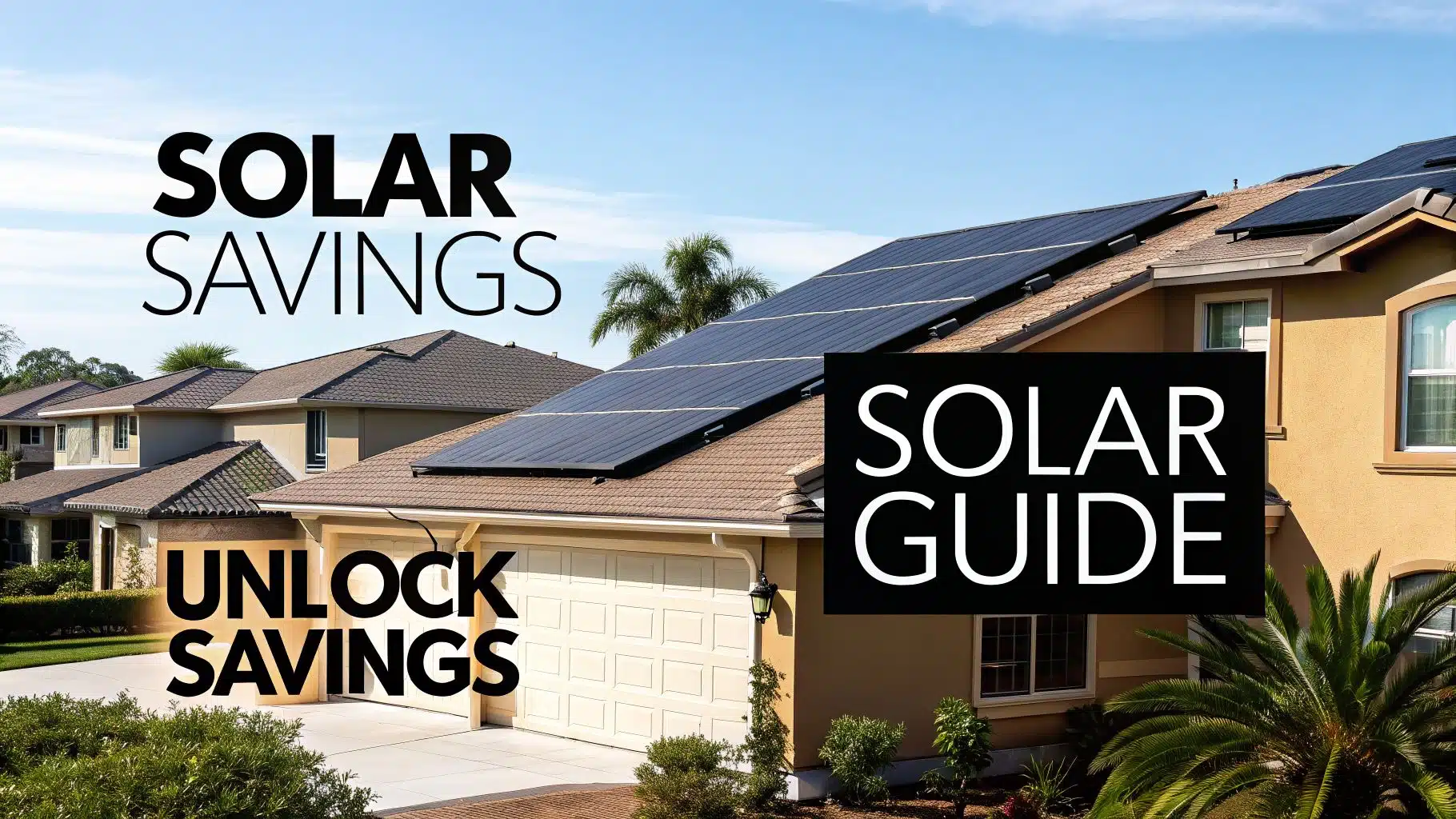
Are you ready to finally get a handle on your power bills? For homeowners in Tampa and across Central Florida, installing solar panels is one of the smartest financial decisions you can make. It's all about turning our relentless Florida sunshine into real savings, giving you energy independence and a much smaller carbon footprint. The secret, though, is finding an expert who knows a great solar system always begins with a solid roof.
Why Tampa Homeowners Are Going Solar
All across Central Florida, from the beaches of Pinellas County to the suburbs of Orlando, more and more homeowners are having the same lightbulb moment: the sun that bakes our homes can also power them. This isn't just an environmental fad; it's a practical, wallet-friendly defense against the ever-increasing electricity rates from local utility providers.
The motivation behind it is really about one thing: predictability. Instead of bracing for a surprise on your utility bill each month, a solar panel system lets you lock in a fixed, and often lower, monthly payment for the system itself. Once it's paid off, you're generating your own electricity for free. That means drastically reducing—or even completely eliminating—your reliance on the grid.
Think of it this way: your roof stops being just another overhead expense and becomes a hard-working asset. On every sunny day, it’s not just protecting your family—it’s actively driving down your cost of living and boosting your home's value.
For Tampa homeowners, the upsides are clear and immediate. We've summarized the key advantages you can expect when making the switch.
Quick Look At Tampa Solar Benefits
| Benefit | Impact For Tampa Residents |
|---|---|
| Energy Cost Control | Hedge against rising electricity rates with predictable solar payments. |
| Increased Home Value | Homes with solar sell faster and for a premium in the competitive Tampa market. |
| Federal & Local Incentives | Take advantage of the 30% federal tax credit and local net metering programs. |
| Energy Independence | Reduce or eliminate your dependence on the public power grid. |
| Hurricane Resilience | When paired with a battery, solar can provide backup power during outages. |
| Environmental Impact | Significantly lower your household's carbon footprint. |
These benefits paint a compelling picture, showing why so many of your neighbors are making the investment in their home's energy future.
A Statewide Solar Boom
This shift isn't just a small local trend; it's a massive, statewide movement. Florida has truly become a solar powerhouse. We now have enough installed capacity to power nearly 2.5 million homes, landing us at 3rd in the entire nation.
That growth is especially strong right here in the Tampa Bay area and throughout Central Florida. In fact, local utility-scale projects alone are already powering over 215,000 homes. This boom is happening for a good reason: electricity prices have shot up by 26% since 2020, making solar a powerful way to protect your budget from future rate hikes.
More Than Just Panels
A successful solar panel installation in Tampa is about more than just the panels themselves. It's about looking at the entire system, and that starts with your roof. The two most critical pieces of the puzzle are your roof’s integrity and the solar system’s performance.
When you hire a separate roofer and a separate solar company, you're setting yourself up for a potential nightmare. If a problem like a roof leak pops up, the finger-pointing begins, and you're stuck in the middle.
This is exactly why working with a dual-certified expert is so important. At Hi Low Roofing, we bring decades of roofing mastery and solar design expertise together under one umbrella for both residential and commercial properties. We guarantee your project starts on a solid foundation—a healthy, durable roof that's ready to support your energy investment for the long haul. By handling both, you get a single point of accountability and complete peace of mind.
Curious if the numbers pencil out for your specific home? Check out our guide on whether solar panels are worth it in Florida.
Your Solar Installation Journey Step By Step
Getting solar panels installed in Tampa can seem like a huge undertaking, but when you have an experienced team guiding you, it’s actually a very straightforward process. We’ve broken down the entire journey into clear, predictable stages so you know exactly what to expect from our first chat to the moment you flip the switch.
It all begins with a simple conversation. One of our consultants will sit down with you to understand your energy goals and take a look at your past electricity bills. We’ll also do a quick property review using satellite imagery. This initial meeting is all about making sure we’re on the same page and gathering the info we need to design a system that’s right for you.
Next comes the on-site assessment, which is one of the most important steps. This isn't just a quick glance at your roof; it's a deep dive into the specifics of your home.
- Roof Health Check: We get boots on the roof to physically inspect its condition. We’re looking at its age, the health of the shingles, and its underlying structure. A solar array is a 25-year investment, so it absolutely needs a solid foundation.
- Shading Analysis: We’ll map out the sun’s path across your property throughout the day and year. This helps us spot any trees, chimneys, or neighboring buildings that could cast a shadow on your panels and hurt their performance.
- Electrical System Review: We also take a close look at your home's main service panel. Sometimes, older homes need minor electrical panel upgrades to safely handle the new power source from your solar system.
This detailed survey helps us iron out any potential issues ahead of time, ensuring your system is designed for peak performance right from the start.
Designing Your Custom Solar System
With all the data from the site assessment in hand, our engineers get to work. This is where your system transforms from an idea into a detailed blueprint. We use your home's unique energy consumption, roof measurements, and local sun exposure data to design a solar array tailored specifically for you.
We’ll then present you with a full proposal that shows you exactly what you’re getting. It will detail the system size, the number of panels, where they’ll be placed on your roof, and what you can expect in terms of energy production. The plan also includes a clear estimate of your long-term savings. If you're curious about the math behind it, you can learn more about how we size a solar system in our guide.
People often think one solar system is just like the next. The reality is, a truly high-performance system is custom-built. It has to perfectly balance your energy goals with your roof's unique layout to be both effective and look great.
Navigating Permits And Approvals
Once you’ve approved the design, we take care of all the red tape. A professional solar installer like Hi Low Roofing handles the entire permitting process so you don't have to. We prepare and submit all the necessary applications to your local municipality, whether that's in Pinellas County, Hillsborough County, or Orange County.
We also manage the interconnection agreement with your utility company. This is the official application to connect your system to the electrical grid, and it’s what allows you to get paid for the extra power you send back through net metering. Having an experienced team handle this paperwork is key to avoiding delays and ensuring everything is done by the book.

As you can see, the process flows from a solid roof to a professional installation, which ultimately leads to energy savings.
Installation Day And Final Inspections
After all the permits are approved, it’s time for the exciting part: installation day. Our crew will show up ready to get to work mounting the racking system, securing the panels, and running the wiring to your home’s electrical system. For most homes, the physical installation takes just one to three days. We pride ourselves on working cleanly and efficiently to cause as little disruption as possible.
Once our crew is finished, there are a couple of final inspections that need to happen.
- Local Building Inspection: An inspector from your city or county will come out to verify that the installation meets all local building and electrical codes.
- Utility Company Inspection: Your utility provider will then conduct its own check to ensure the system is safely and correctly connected to the grid.
As soon as both inspections are passed, the utility grants "Permission to Operate," or PTO. That’s the official green light we've all been working toward. We'll then commission the system, and you can finally "flip the switch" and start generating your own clean, free power from the Florida sun.
The Real Cost And Savings Of Solar In Tampa
Alright, let's get down to brass tacks: what does going solar in Tampa actually cost, and what kind of savings can you expect? It’s the first question on every homeowner's mind. While the initial investment is obviously a big part of the conversation, the real story is what you get back from it—and how quickly you can start enjoying freedom from those unpredictable utility bills.
We often hear, “What’s the final number going to be?” The price of a solar project is measured by its cost per watt. This figure is influenced by a few key things: the system's overall size, the brands of panels and equipment you select, and the unique layout of your roof. A simple, south-facing roof is a more straightforward project than a complex one with lots of angles, dormers, or shade to work around.
At Hi Low Roofing, our entire process is built on transparency. We design a system that’s not just about generating power, but about hitting your financial goals and achieving the fastest possible return on your investment.

Calculating Your Payback And Long-Term Gains
The most exciting part of going solar isn't what you spend; it's what you save. We measure this with the payback period—the time it takes for your energy savings to completely cover your initial cost. After you hit that milestone, every bit of power your panels produce is pure profit.
In the Tampa Bay area, the numbers are seriously impressive. Let's look at a typical home as an example. This table breaks down the investment for a common 7kW system, showing how the incentives and long-term savings stack up.
Tampa Solar Investment Breakdown (Example 7kW System)
| Metric | Estimated Value |
|---|---|
| Gross System Cost | ~$20,580 |
| Federal Tax Credit (30%) | -$6,174 |
| Net Cost After Credit | $14,406 |
| Estimated 25-Year Energy Savings | ~$82,000 |
| Net 25-Year Profit | ~$67,594 |
As you can see, the return is substantial. A typical 5 kW system in Tampa can cost around $10,290 after the federal tax credit, which averages out to $2.94 per watt. With numbers like that, local homeowners can often see a payback period as short as six years and enjoy over $24,000 in savings after 20 years. You can dive deeper into Tampa-specific solar costs and savings to see how it applies to you.
Over the full 25-year life of the system, a Tampa solar owner could pocket an estimated $82,000 in savings, especially with electricity prices having already jumped 26% since 2020. These aren't just numbers—they represent a powerful financial tool working for you every day.
This incredible return is a direct result of Florida’s endless sunshine and the ever-increasing cost of grid power. Every single month, your solar panels are actively shrinking your utility bill, creating a predictable and rewarding financial outcome.
Making Solar Accessible With Smart Financing
Thinking you need a pile of cash to go solar? Think again. That might have been true years ago, but modern financing has made solar panel installation in Tampa more accessible than ever. For many homeowners, the monthly loan payment ends up being the same or even less than what they were already paying the utility company.
Here’s a quick look at the most common ways people fund their solar projects:
- Solar Loans: These work just like a standard home improvement loan. You own the system from day one, which means you get to claim all the valuable tax credits and incentives. You’ll have a fixed monthly payment for a set period, usually between 10 and 25 years.
- $0 Down Options: This is a huge one. Many homeowners qualify for financing that requires absolutely no money out of pocket, so you can start saving on your electric bills from the very first month.
- Cash Purchase: If it works for your budget, paying in cash delivers the absolute best long-term return. You avoid interest payments entirely and reach your payback period much faster.
Hi Low Roofing works with top-tier financing partners to offer incredibly flexible plans, including some great 0% interest options for qualified buyers. Our team will gladly sit down with you, explain the pros and cons of each path, and help you find the one that perfectly matches your financial goals.
Maximizing Your Return With Florida Solar Incentives
Let's talk about the numbers that really matter. The sticker price for a solar panel installation in Tampa is just a starting point. The real story is how financial incentives can dramatically shrink that number and accelerate your payback period. This is where you unlock every available dollar of savings.
Think of it this way: the initial cost is one thing, but incentives are like a massive, immediate discount on your investment. It’s not just a small coupon, either. These programs, from the federal government down to the state level, are designed to make switching to solar a financial no-brainer for Florida homeowners.
The single biggest incentive you’ll encounter is the Federal Solar Investment Tax Credit (ITC). For homeowners in Central Florida, it’s an absolute game-changer.
The 30% Federal Solar Tax Credit
The ITC isn't a simple deduction—it’s a powerful, dollar-for-dollar reduction of the federal income tax you owe. For any new residential solar system, you can claim a credit worth 30% of the total project cost.
So, how does this actually play out in your bank account?
- Let’s say your complete solar system costs $20,000. Your tax credit would be a whopping $6,000.
- If your federal tax bill for the year is $7,000, that $6,000 credit slashes what you owe down to just $1,000.
- Don't have enough tax liability to use the full credit in one year? No problem. The remainder simply rolls over to future years until it's used up.
To qualify, you just need to own your system (whether you paid cash or financed it with a loan) and have a federal tax bill to offset. A good solar installer can walk you through the details, but this one credit alone completely changes the financial math of going solar.
Florida-Specific Solar Advantages
While the federal credit is a huge piece of the puzzle, Florida offers its own set of perks that make solar even more appealing. The Sunshine State might not have a state-level tax credit, but it provides other substantial, long-term financial benefits.
These state-level incentives are all about removing financial roadblocks. They make sure your investment in clean energy isn't unfairly taxed and that you get full credit for every bit of power you generate.
Two of the most impactful Florida incentives are:
- Property Tax Exemption: Adding solar panels instantly increases your home's value. In normal circumstances, that would mean a bigger property tax bill. But Florida law specifically exempts the value added by a solar system from your property tax assessment. You get a more valuable home without paying a penny more in property taxes.
- Sales Tax Exemption: Every piece of solar equipment sold in Florida is completely exempt from the state's 6% sales tax. For a typical family's system, that exemption saves you somewhere between $1,300 and $2,100 right off the top, lowering your initial investment before you even get started.
Getting Paid For Your Power With Net Metering
Finally, we have net metering. This is the brilliant program that ensures you get paid for the extra electricity your solar panels produce. Here in the Tampa area, and throughout Central Florida, your local utility operates under this program.
Here’s the simple breakdown:
- On a sunny day, your panels will often generate more power than your house needs at that moment.
- That surplus energy doesn't go to waste. It’s automatically sent back to the grid, and your utility meter literally spins backward.
- By law, your utility must give you a full, retail-rate credit for every kilowatt-hour your system sends them.
- You then "spend" those credits to cover the cost of any electricity you need to pull from the grid at night or on a cloudy day.
With a properly sized system, net metering can effectively wipe out the energy portion of your utility bill, leaving you with just a small monthly service fee. It’s the key that unlocks the full financial power of your solar investment month after month.
Protecting Your Home With A Hurricane-Ready Solar Roof
Living in Central Florida, we all know it's not a matter of if a hurricane will hit, but when. It's a natural question to ask: how will a big solar array on my roof handle those destructive winds? For anyone thinking about a solar panel installation in Tampa, it’s one of the most important questions you can ask.
Fortunately, modern solar systems are engineered to be incredibly tough—but only if they're installed the right way. The real key to a hurricane-proof solar system isn't just in the panels. It’s all about the deep integration between your solar equipment and the roof it sits on. Your solar array is only as strong as its foundation.

Why Dual Expertise Matters In Hurricane Zones
The installer you choose is the single most important decision in your solar journey. When you hire a solar-only company, they often see your roof as little more than a platform to mount their equipment. But as roofers, we see your roof as what it is: your home’s first and most critical line of defense.
A dual-certified roofing and solar contractor, like us at Hi Low Roofing, understands the complete picture. This expertise closes the gap between two separate trades that can leave your home vulnerable. We make sure your installation not only produces clean energy but also maintains, or even improves, your roof's structural integrity. Best of all, there's no finger-pointing if a problem ever comes up. You have one team responsible for the whole system, from the shingles to the solar panels.
Before you even consider putting panels up, it's critical to know the condition of your roof, especially here in Tampa. This homeowner’s guide to solar panel roof replacement is a great resource for understanding the costs and considerations involved.
The Anatomy Of A Storm-Resistant Installation
So what exactly goes into an installation that can stand up to a hurricane? It's a system of a few key elements working together, and it's far more involved than just bolting panels onto your roof.
It’s a meticulous process built on a roofer's perspective:
- A Pre-Solar Roof Inspection: The very first thing we do is a comprehensive roof health check. We look at the age and condition of your shingles or tiles, searching for any weak spots. It just doesn't make sense to install a 25-year solar system on a roof that only has five years of life left.
- Secure Racking And Mounting: The racking is the skeleton that holds your panels. We use high-grade, corrosion-resistant hardware built for Florida's wind and salt air. The key is anchoring this system directly into your roof’s rafters—the structural bones of your house—not just the plywood decking. This provides maximum resistance against wind uplift.
- Proper Flashing Techniques: Every hole in your roof is a potential leak. We use specialized metal flashing that slides under your shingles to create a watertight, triple-sealed barrier around every single anchor point. This is how you protect your roof’s warranty and prevent water intrusion for years to come.
A properly installed solar array can actually make your roof stronger. By tying the panels together, the racking system helps distribute high wind loads more evenly across the entire roof surface, adding a layer of reinforcement during a major storm.
Built To Withstand Florida’s Worst
Today’s solar panels are incredibly durable. They undergo strict testing to prove they can handle extreme weather, including hail impacts and sustained high winds. In fact, most panels we install are rated to withstand winds of 140 mph or higher, covering the majority of hurricanes that come our way.
When you pair these tough panels with a rock-solid racking system and expert installation, you get a solar array that’s truly ready for storm season. With Hi Low Roofing, you get peace of mind knowing your energy investment is secured by decades of hands-on roofing expertise.
And with a solar battery, that system can even keep the lights on when the grid goes dark. To see how that works, check out our article on how solar panels perform during a power outage.
How To Choose The Right Tampa Solar Installer
Let's be direct: picking the right contractor is the single most important decision you'll make when going solar. A solar panel installation in Tampa is a 25-year commitment to your home, and the quality of that return on investment rests squarely on the shoulders of the company you hire. With so many installers out there, how do you find one you can actually trust for the long haul?
It really comes down to doing your homework and asking the tough questions. You'll want to see a proven local track record, glowing customer reviews, and all the proper credentials. But here in Florida, there’s one qualification that’s more important than all the rest: your solar installer should also be an expert roofer.
The Power Of Dual Expertise
Think about it for a second. Your solar array is going to be mounted on your roof for decades. If you hire a company that only does solar, they often see your roof as nothing more than a platform to hold up their panels. A roofer, on the other hand, sees your roof for what it is—the single most critical shield protecting your entire home.
When a company is a master of both trades, like Hi Low Roofing, it’s a total game-changer. This dual expertise gets rid of the dreaded finger-pointing game that can happen between separate contractors. If a leak ever pops up, you have one phone number to call and a single point of accountability for a system that’s watertight and fully warrantied.
Choosing an installer who is also a licensed roofer is the ultimate insurance policy for your home. It guarantees that every single decision, from the first look at your roof to the final placement of each panel, is made with your home's total structural integrity as the top priority.
Your Vetting Checklist
As you start getting quotes and talking to potential installers, use this checklist to tell the real pros from the pretenders. Any reputable company will welcome these questions and give you straight answers.
- Licensing and Insurance: Are they a state-licensed solar contractor (CVC) and a licensed roofing contractor (CCC)? Ask to see the paperwork for both, along with proof of general liability and worker's compensation insurance. Don't just take their word for it.
- Local Experience: How many systems have they installed right here in the Tampa Bay, Pinellas, or Central Florida area? Deep local experience means they know the ins and outs of working with local utilities and navigating the permitting offices in Hillsborough, Pinellas, and Orange counties.
- Customer Reviews: Don't just rely on the testimonials they put on their own website. Dig into third-party sites like Google and see what real customers are saying about their communication, the quality of their work, and what happens after the job is done.
- Equipment and Warranties: What brands of panels, inverters, and racking systems do they use? A great installer will partner with top-tier manufacturers that offer strong warranties, and they'll back it all up with their own workmanship warranty to cover the installation itself.
Finally, trust your gut and watch out for red flags. Quotes that seem too good to be true, high-pressure sales tactics, or vague answers about their process are all clear signs to walk away. The partner you choose for your solar panel installation in Tampa should be a transparent, experienced guide you can count on for the next 25 years and beyond.
Tampa Solar Installation FAQ
It’s smart to have questions. Going solar is a big decision for your home, and it’s natural to want all the facts straight. Let's tackle some of the most common questions we get from homeowners right here in the Tampa area.
How Long Will My Solar Panels Last?
Think of your solar panels as a long-term investment, because they're built to last. The high-quality panels we trust for our installations come with a 25-year performance warranty. This is the manufacturer's guarantee that even after two and a half decades, your panels will still be producing at 80-85% of their original capacity.
But the panels themselves often keep going well beyond that, sometimes for 30+ years. We also stand behind our own work. At Hi Low Roofing, every project includes our workmanship warranty to cover the installation itself and a roof penetration warranty, giving you total peace of mind that your roof is secure.
Will My System Work During A Power Outage?
This is a really important question, especially with Florida's unpredictable weather. A standard solar system that's tied to the grid will automatically shut down during a power outage. It's a required safety measure to protect utility crews working on the power lines.
But you absolutely can have power when the grid is down. The solution is to add a battery backup solution to your system. With a solar battery, you can store the extra power your panels generate during the day and use it to run your home during an outage. It's becoming a must-have for many Florida homeowners who want real energy independence.
Pairing solar with a battery is like having your own personal power plant. You can keep essential appliances like your refrigerator, lights, and AC running, providing security and comfort when your neighbors are in the dark.
What Kind Of Maintenance Do Solar Panels Require?
You'll be pleasantly surprised by how little you have to do. Solar panel systems are designed to be incredibly low-maintenance. They don't have any moving parts and are built tough enough to handle Florida's sun, heat, and rain.
In fact, our frequent afternoon showers do most of the cleaning for you, washing off the dust and pollen that can gather on the panels. While you won't have any daily chores, we do recommend a professional check-up every few years to make sure every connection is tight and all the components are working perfectly. Your system is meant to work for you, not create more work.
Ready to get answers to your specific questions about a solar panel installation in Tampa? The dual-certified experts at Hi Low Roofing are here to provide an honest, no-pressure consultation for your home or business. Contact us today for a free estimate and custom solar proposal.
