
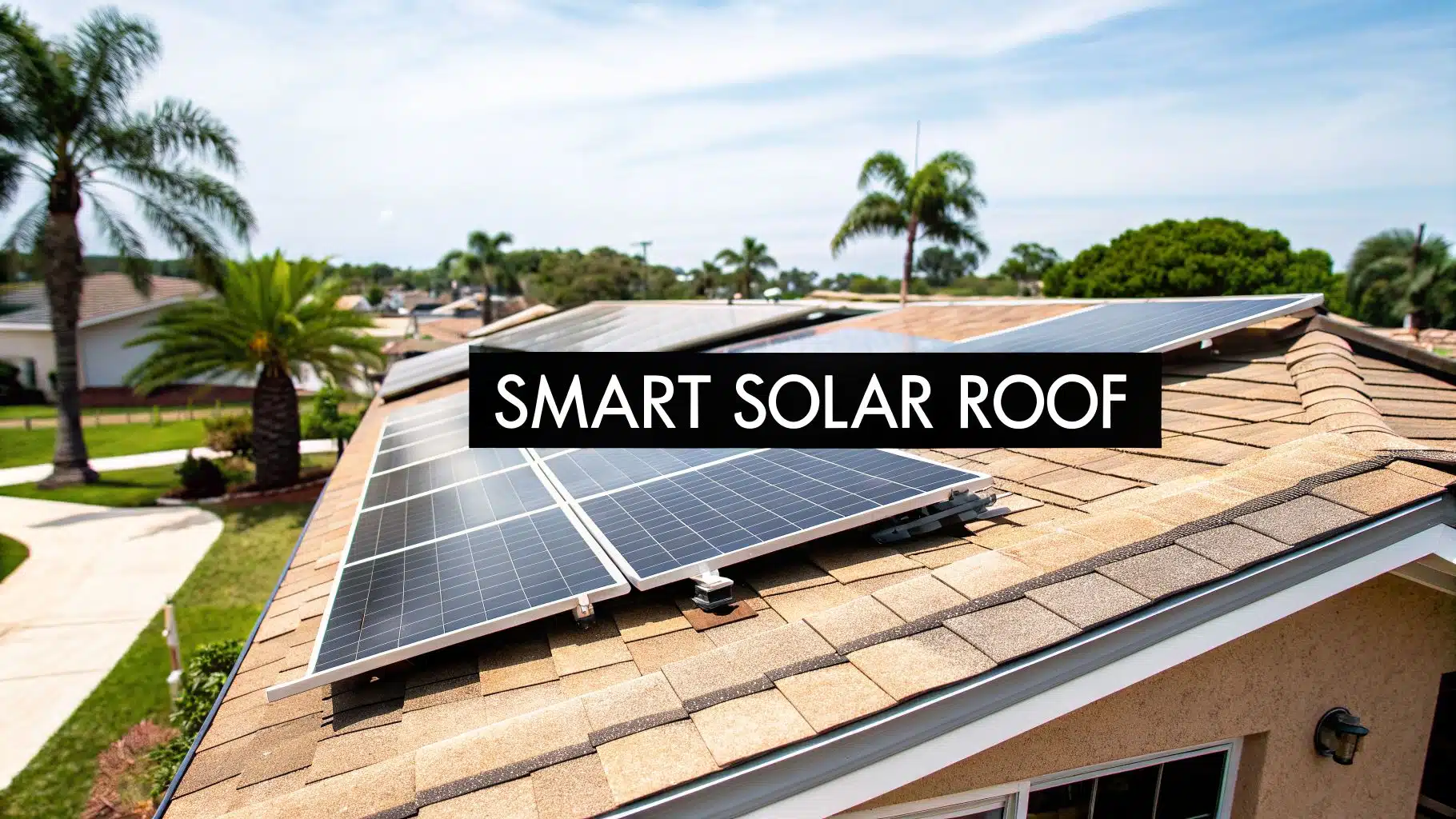
Going solar in Central Florida just makes sense, but when you pair it with a new roof, you're not just making a smart financial move—you're making a long-term investment in your home's protection and energy independence. This is your guide to a solar roof installation in Tampa, walking you through the entire process from an expert's point of view. We'll cover everything from getting your roof ready for panels to navigating local incentives so you can maximize your return.
Why Tampa and Central Florida Are Perfect for a Solar Roof

For homeowners here in Central Florida, from Pinellas County to Orlando, the conversation around solar has shifted. It’s no longer a question of if, but when. With electricity rates on the rise and our abundant sunshine, the math for generating your own power is compelling. But this is about more than just slapping panels on your house; it's about creating one unified, resilient system that starts with the most important part of your home: a solid roof.
The Sunshine State isn't just a nickname—it’s an economic engine. Florida's solar market has exploded, making us the third-largest solar state in the country with a staggering 20,936 megawatts (MW) of installed capacity. You can see the latest state-specific data over on the SEIA website.
What that means for you in the Tampa to Orlando corridor is simple. We get an average of 233 sunny days a year and about 5.7 peak sun hours daily, making our rooftops some of the most productive real estate you can own.
To give you a quick snapshot, here are the numbers that make a Central Florida solar project so attractive right now.
Tampa Area Solar at a Glance: Key Metrics
| Metric | Tampa/Florida Data |
|---|---|
| Installed Solar Capacity | 20,936 MW (Statewide) |
| Annual Sunny Days | 233+ |
| Daily Peak Sun Hours | 5.7 hours |
| Federal Tax Credit | 30% |
| Property Tax Exemption | 100% of value added |
| Sales Tax Exemption | 100% on solar systems |
These metrics show why waiting might mean leaving money on the table, especially with incentives that could change in the future.
The Smart Way to Go Solar in Central Florida
Going solar here means planning for our unique weather. A proper solar roof installation has to account for everything from intense sun to hurricane-force winds. This is why it’s so critical to work with a team that specializes in both roofing and solar. A dual-specialist like Hi Low Roofing ensures your system is perfectly integrated, protecting your residential or commercial property from storms while cutting down those high utility bills.
This guide will give you the clarity and confidence you need by breaking down:
- Your Roof's Health: Why a thorough roof inspection is the non-negotiable first step before a single panel is ordered.
- System Design Choices: Deciding between traditional panels or solar shingles and whether a battery backup is right for you.
- Permits and Approvals: A real-world look at navigating the local permitting and utility interconnection maze.
- The Bottom Line: Making sense of the costs, incentives, and financing options available to you.
A solar roof isn't just an energy upgrade. It's a fundamental improvement to your home's value and resilience. When you pair a new roof with a solar installation, you get one seamless warranty and total peace of mind for decades.
Ultimately, a professional solar roof installation in Tampa is your path to serious long-term savings and true energy freedom. Acting now ensures you can lock in today's incentives. For a more detailed look at the financial benefits, check out our complete guide on unlocking savings with solar panel installation in Tampa.
Your Roof's Health Comes First: The Pre-Solar Check-Up

Before we even talk about panels or inverters, we have to talk about your roof. Here in Central Florida—from the Pinellas coast to the suburbs of Orlando—a thorough roof health check isn't just a box to tick; it’s the bedrock of a successful solar project. Any legitimate solar roof installation in Tampa must start with an honest look at what’s already overhead.
It’s a simple but crucial bit of math. Your new solar panels are designed to last for 25 years or more. Your roof has to be ready to hold them for that entire time. Imagine putting a brand-new, high-tech solar array on a roof that only has 10 years of life left in it. You’re just setting yourself up for an expensive and avoidable problem.
You’d end up paying for the same job twice. Once for the solar, and again in a decade to have a crew come out, take all the panels off, replace your entire roof, and then put the solar system back on. That's a massive hit to your wallet, purely from redundant labor costs.
What a Real Roof Inspection Uncovers
When an experienced roofer who also specializes in solar inspects a roof, we’re not just looking for a few loose shingles. It’s a full-on structural and material deep-dive to make sure your home or commercial building is truly solar-ready.
Here’s what’s on our checklist:
- Remaining Lifespan: We analyze the condition of your shingles, tiles, or metal. We're looking for the tell-tale signs of aging—like granule loss on asphalt shingles, hairline cracks, or brittleness—that tell us how many good years the roof has left.
- Structural Soundness: Your roof structure needs to handle the weight of the solar panels and racking, which can be thousands of pounds. We get in the attic to inspect the trusses and decking for any sagging, water stains, or rot that could compromise its strength.
- Florida-Specific Damage: Our climate is brutal. We hunt for subtle signs of old storm damage, slow leaks around vents and flashing, and moisture intrusion that you’d never spot from the ground. Catching these issues before panels go on is non-negotiable.
For any property owner in the Tampa Bay to Orlando area, this step is also a key part of your hurricane prep. Your roof is your primary shield against storms, and adding solar means that shield needs to be in perfect shape.
The Smartest Financial Move: Combine Your Roof and Solar
So, what if the inspection shows your roof is on its last legs and will need replacing in the next 5-10 years? That’s actually great news. It presents the single most cost-effective and logical path forward: combining a new roof with your solar roof installation in Tampa.
A combined roof and solar project creates one seamless, fully-integrated system. You get a single warranty that covers everything from the shingles to the solar output, all from one company. That’s real peace of mind.
This unified approach makes everything simpler. The permitting process with Hillsborough County or your local jurisdiction is handled as one project, not two. You also avoid the scheduling headaches and potential finger-pointing that can happen when you have a separate roofer and solar installer trying to work on top of each other.
Most importantly, by bundling the projects, we ensure every solar mounting point is perfectly flashed and sealed on a brand-new surface. This practically eliminates the risk of future leaks and guarantees your roof’s warranty isn't compromised. At Hi Low Roofing, we’ve built our business around this integrated strategy, making sure your investment is protected from the decking all the way up to the panels.
To see exactly what our team evaluates, you can find more details on what goes into a professional roof inspection in Tampa right here.
Designing a Solar System for Your Tampa Home or Business

Okay, so your roof is in great shape and ready to go. Now we get to the fun part—designing a solar power system that’s made just for your property and how you live or work. This is where a solar roof installation in Tampa goes from a concept to your personal power plant. It's all about finding that sweet spot between aesthetics, performance, and your budget to build a system that will serve you well for decades.
This isn't about slapping a few panels on your roof and calling it a day. A proper design is based on hard numbers. We start by looking at your actual power consumption, pulling your last 12 months of electricity bills. This data tells us exactly how much power your family or business uses and when you use it, so we can build a system to zero out as much of that bill as possible.
Panels or Shingles: The Two Main Paths
Your first big decision really comes down to what you want your solar to look like. Here in Central Florida, you have more options than just the traditional panels you might be picturing.
Traditional Solar Panels: These are the industry's workhorses for a reason. They offer the best bang for your buck when it comes to performance and efficiency. Today’s monocrystalline panels are sleek and all-black, creating a much more uniform, modern look that property owners really appreciate. They’re mounted on a tough racking system attached directly to your roof’s structure, built to handle Florida’s intense weather.
Solar Shingles: If you're after a completely integrated look, solar shingles are the top-tier choice. These are engineered to blend right in with your roofing materials. They act as both a protective shingle and a power-generating cell, giving you a clean, low-profile appearance that’s perfect for stricter HOAs or anyone who wants their solar to be nearly invisible. While they come at a premium, the curb appeal is undeniable.
The right answer depends entirely on your property, your budget, and what you find visually appealing. We walk home and business owners through this choice every day, from St. Pete all the way to Orlando.
The Game Changer for Hurricane Season: Battery Backup
Here’s a critical detail for any Floridian: a standard solar system is grid-tied. For safety, that means when the utility grid goes down in a storm, your solar system shuts off, too. To get true energy independence and peace of mind during hurricane season, you need a battery backup.
A battery backup, like the popular Tesla Powerwall, acts like a home energy reservoir. It stores the extra power your panels generate during sunny days. The moment a power outage strikes, your property automatically switches to that stored battery power, keeping your lights on, your refrigerator cold, and maybe even your AC running without a hiccup.
This technology is what really turns your property into a self-reliant powerhouse. It’s not just about saving money anymore; it’s about having security and control when you need it most. To get a better feel for the whole process, it helps to understand the basics of how a solar power system works and how all the components interact.
Customizing for Maximum Output
The final system design is like putting together a high-stakes puzzle. Our engineers use specialized software to create a digital twin of your roof, accounting for every single variable that affects power production. We’re talking about your roof’s specific orientation (south-facing is great, but we can make almost anything work), its pitch, and any shade cast by trees, chimneys, or even neighboring buildings.
From there, we map out a precise panel layout to capture as much sun as possible all day long. The goal isn't just to meet your current power needs, but to think ahead. Planning on getting an electric vehicle? Adding a pool heater down the line? We factor that in now. For a deeper look at this process, check out our guide on what size solar system you need. This level of detail is what ensures your investment pays off for years to come.
The Cost and Incentives for Your Tampa Solar Roof
Let's talk money. For most property owners I talk to, the biggest hesitation about going solar in Tampa isn't the technology—it's the bottom line. But here’s the good news: getting a solar roof in Central Florida has never been more affordable, thanks to a powerful mix of dropping equipment costs and some really solid financial incentives.
That initial price tag can look intimidating, I get it. But it's so important to understand that the sticker price is almost never what you actually end up paying. A whole suite of programs at the federal and state level are designed to slash that number and turn your solar roof into a high-return asset.
The Real Cost of Solar in the Tampa to Orlando Area
First, you need to know what you’re working with in the local market. Florida has a mature, competitive solar industry, which is great for consumers because it means prices are often better than the national average.
Recent data shows a typical solar installation in the Tampa area averages around $23,128. That’s roughly 16% cheaper than in other parts of the country, a benefit of our local market's efficiency. For property owners from Pinellas County out to Orlando, we've found that pairing a re-roof with a solar project is the best way to maximize that value. You can see a more detailed cost analysis for solar in Florida on SolarReviews.com to get a feel for the numbers.
This pricing makes solar a very real possibility for a lot of families and businesses, particularly when you start layering on all the financial tools designed to bring that number way down.
Don't let an initial quote scare you off. The true cost of a solar system is the final price after all tax credits and incentives have been applied. We're often talking thousands of dollars less than the original estimate.
Unlocking Thousands in Savings with Incentives
This is where the numbers get really exciting. Several key incentives work together to dramatically cut your net cost and speed up how quickly your system pays for itself.
The Federal Solar Tax Credit
The biggest one, without a doubt, is the federal solar Investment Tax Credit (ITC). This is a game-changer. It allows you to claim 30% of the total cost of your solar system as a direct, dollar-for-dollar credit against your federal income taxes.
So, on a $25,000 system, that’s a straight $7,500 back in your pocket at tax time. It's not a simple deduction—it's a real credit that directly shrinks your tax bill.
To give you an idea of how these incentives can stack up, here’s a sample breakdown for a common system size in our area.
Sample Solar Installation Cost Breakdown for Tampa (7.2 kW System)
| Cost Component | Average Amount |
|---|---|
| Gross System Cost | $24,000 |
| Florida Sales Tax Exemption (6%) | -$1,440 |
| Subtotal Before Federal Credit | $22,560 |
| Federal ITC (30%) | -$6,768 |
| Final Net Cost After Incentives | $15,792 |
As you can see, what starts as a $24,000 project quickly becomes a much more manageable investment once the incentives are factored in.
Florida's Big Tax Breaks
On top of the federal credit, Florida offers two fantastic tax exemptions that make a huge difference:
- No Sales Tax: Your solar energy system is completely exempt from the state's 6% sales tax. On a typical system, that saves you well over $1,000 right off the bat.
- No Property Tax Increase: This one is huge. While a solar system definitely increases your property's value, Florida law says that added value can’t be used to raise your property taxes. You get a more valuable property without the higher tax bill.
Understanding how these government programs work can feel a little tricky, but it's similar to how other green-tech incentives operate, like the various electric vehicle tax credits designed to encourage more sustainable choices.
The Urgency of Net Metering
Beyond the upfront savings, the long-term financial return of your solar system hinges on a policy called net metering. This is the billing arrangement you have with your utility where they give you full retail-rate credit for any excess power your panels push back onto the grid.
But here’s the catch: this policy is changing. Systems installed in the near future will get less favorable credit rates.
By acting now, you can get grandfathered into the current, more lucrative net metering rules for 20 years. This locks in the highest possible returns and ensures your system pays for itself as fast as possible. It truly makes timing a critical piece of the puzzle.
The Installation Process: From Paperwork to Power-Up
So, you’ve picked your solar panels, finalized the design, and signed on the dotted line. Now for the exciting part—seeing it all come to life. Getting from contract to a fully operational solar system is a process, but knowing what to expect can make all the difference.
While you might be picturing crews on your roof right away, the first phase is all about paperwork. Honestly, this is where a huge chunk of the project timeline is spent. A good local installer like Hi Low Roofing earns their keep here by navigating the maze of permits and approvals for you. The whole process, from signing your contract to flipping the switch, typically takes between one and three months.
The Pre-Installation Paperwork Push
Before any physical work starts, we have to get the green light from two important entities:
- Your City or County Building Department: Every solar project needs a permit. We draw up and submit detailed engineering plans to your local authority—whether that's the City of Tampa or another jurisdiction in the Central Florida area—to prove the system is designed to all current structural and electrical safety codes.
- Your Utility Company: We also have to get formal approval from your power company to connect your system to their grid. This "interconnection agreement" is what ensures you get credited for all the extra power your system sends back to them.
What a lot of property owners don't realize is that this behind-the-scenes coordination is one of the most critical parts of the project. A seasoned installer manages all this red tape so that when work does begin, it’s all fully compliant and ready to go without a hitch.
From Blueprints to Your Rooftop
Once the permits are secured, things start moving quickly. Our engineering team takes the approved plans and creates the final blueprints. These are the master plans our installation crew will follow, detailing everything from where each roof attachment goes to how the wiring is routed.
With the plans locked in, we'll get you on the schedule. Most residential and commercial solar installations in the Tampa to Orlando corridor are surprisingly fast, taking just one to three days to complete. Your project manager will be in touch well ahead of time to confirm the dates and walk you through what to expect.
On installation day, the process is a well-oiled machine:
- Site Prep: The crew arrives and immediately sets up to protect your property and landscaping.
- Mounting & Racking: We install the racking system that will hold the panels. Every single attachment point is sealed and flashed with meticulous care to guarantee your roof stays 100% watertight.
- Panels & Inverter: The solar panels are secured to the racks, and we install the system's inverter—its "brain"—usually in a utility room, garage, or on an exterior wall.
- Electrical Tie-In: Finally, our electricians connect the panels to the inverter and then run the wiring to your property’s main electrical panel.
This chart breaks down how the initial investment pays off through various incentives and long-term energy savings.

You can see how the costs are offset by incentives, leading directly to financial savings over time.
The Final Checks Before Power-Up
With the panels on the roof, there are just a couple of final steps before your system goes live. This is all about final verification and safety.
First, we schedule the final inspection with your local building department. An inspector will come out to verify the work was done according to the approved plans and meets all safety codes. At Hi Low Roofing, we take a lot of pride in our track record of passing these inspections on the very first try.
After that, your utility company does their part. They’ll come out to install a new bi-directional meter, which is what allows them to track both the power you use and the power you generate. Once they give the official "Permission to Operate" (PTO), it’s go-time. That’s the moment you’ve been waiting for—when your property officially starts running on sunshine.
What to Expect After Your Solar Roof Is Installed
You've made it through the planning and installation, and now comes the best part: living with your new solar roof. This is where your investment really starts to work for you, not just by slashing your monthly bills, but by giving you a level of energy freedom that's incredibly valuable here in Central Florida.
Let's be honest, the financial payoff is a huge driver. With utility rates constantly on a one-way track, a solar system puts a stop to that, effectively locking in your energy costs and shielding your budget from that kind of volatility.
The Long-Term Financial Picture
When you zoom out and look at the big picture, the value of a solar roof installation in Tampa becomes undeniable. Our fantastic sunshine and high electricity rates create a perfect storm for savings. For a deeper look at the numbers, you can explore the financial returns of Tampa solar at Palmetto.com.
What does this mean for you? After an initial payback period—which is often just nine years here in Florida—you're looking at over a decade of essentially free power. Your roof stops being a liability and starts acting like an asset that actively improves your bottom line.
Think of your solar roof as a long-term partnership for your property. Hi Low Roofing is your single point of contact for both your roof's integrity and your solar system's performance, ensuring seamless support for decades to come.
Simple Care for Decades of Power
One of the most common questions I get is about maintenance. The good news is, modern solar systems are incredibly low-maintenance. Here in Florida, our regular afternoon showers do most of the cleaning for you, rinsing off the pollen and dust that can settle on the panels.
Beyond that, a quick professional check-up once a year is all you really need. This just makes sure all the connections are solid and the system is generating power exactly as it should. When your roof and solar are installed together as one integrated system by a company like Hi Low Roofing, you can pretty much set it and forget it, enjoying clean energy for years with almost no effort.
Ready to see what your long-term savings could look like? Get in touch with Hi Low Roofing for a personalized quote. You can lock in today's incentives before they change and finally start your journey toward energy independence.
Your Central Florida Solar Questions, Answered
If you're considering solar for your Central Florida home or business, you probably have a few questions. That's completely normal. We hear the same concerns from property owners all the time, so we've put together some straightforward answers based on our experience serving the area from Pinellas County to Orlando.
How Long Does a Solar Installation Take?
Many people think the whole process happens in just a few days, but a quality installation takes a bit more time behind the scenes. From the day you sign the paperwork to the day you're officially generating your own power, a solar roof installation in Tampa typically takes between one and three months.
Why so long? A good chunk of that time isn't spent on your roof. It's dedicated to crucial administrative work:
- Pulling the right permits from your local city or county.
- Getting the official green light from your utility company.
- Creating the detailed engineering plans specific to your property and roof.
Once all that paperwork is cleared, the actual on-site work is surprisingly fast. Our crews are usually in and out in just one to three days.
Will My Solar Roof Survive a Hurricane?
This is the question on every Florida property owner's mind, and we can answer with a confident "yes." Modern solar panel racking systems are built like a tank. They are professionally installed and engineered to handle extreme weather, with most systems rated for wind speeds of 160+ MPH.
But the equipment is only half the battle—the installation is what truly makes it storm-proof. When a roofer who is also a solar expert handles the job, every attachment point is drilled directly into your roof's trusses and meticulously sealed. This integrated approach ensures your solar array becomes a part of your roof, just as tough and resilient as the structure beneath it.
One key thing to remember: a standard solar system will automatically shut down during a grid outage for safety. But if you pair your panels with a battery backup like a Tesla Powerwall, you create your own little power island. Your lights, fridge, and AC can keep running even when the rest of the neighborhood is dark.
Can I Go Solar if I Live in an HOA?
Absolutely. While a Homeowners Association (HOA) does add one more layer of approval, it can't stop you from going solar. Florida law (Statute 163.04) actually protects your right as a homeowner to install solar panels.
Your HOA can’t flat-out deny your request, though they might have some reasonable rules about where the panels can be placed to keep the neighborhood looking uniform. The best strategy is to be proactive. A good installer like Hi Low Roofing will have experience dealing with local HOAs and will prepare a professional plan to submit to the board for you, making the approval process smooth and simple.
Ready to see what solar could look like for your home or business? Hi Low Roofing offers free, no-obligation consultations to explore your options and answer every question you have. Secure your energy independence and lock in today's incentives by getting a personalized quote. Learn more at https://hilowroofing.com.
