

When a storm rips through Central Florida and leaves your roof a wreck, you need help, and you need it fast. A small leak can quickly spiral into a catastrophic mess, but the good news is that professional help is available 24/7. The right team can get to your home quickly to secure it, often starting with a heavy-duty tarp to stop the water in its tracks.
What to Do When Your Roof Is Damaged
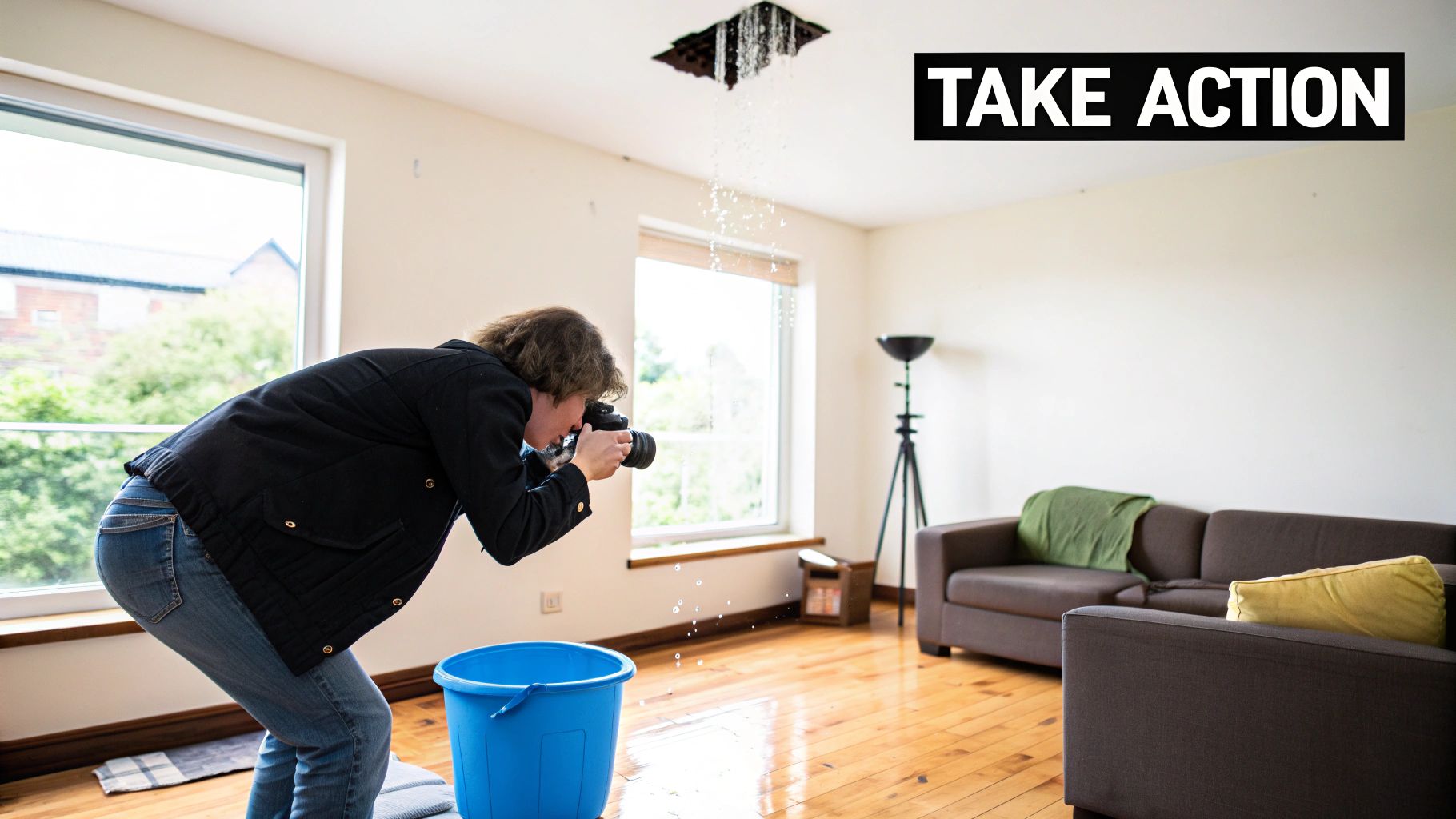
It’s easy to panic when you discover roof damage, but a clear head and a methodical approach will save you a lot of grief—and money. The absolute first rule: stay off the roof. Seriously. Especially during or after a storm, that surface is slick, and the structure could be compromised. The risk of a fall is just too high.
Instead, start your damage assessment from inside your house. Walk through each room and look up. Are there any obvious drips? Dark, spreading water stains on the ceiling? Paint that's starting to bubble or peel? These are all red flags that water is getting in where it shouldn't be. If you spot an active leak, your mission is to contain the damage immediately.
Take Control of the Situation
First, get your valuables out of the way. Move any furniture, electronics, and keepsakes from the affected area. Then, grab buckets, towels, pots, pans—whatever you can find to catch the dripping water.
If you notice the ceiling is starting to bulge, that’s a sign it’s holding a dangerous amount of water. It sounds strange, but your best move is to carefully poke a small hole in the center of the bulge with a screwdriver. This will release the water in a controlled way and prevent the entire section of the ceiling from collapsing under the weight.
Next, become a detective. Pull out your smartphone and document everything with photos and videos. Get shots of the damage inside your home and, from the safety of the ground, capture any visible damage to the exterior. This evidence is absolutely critical when you file your insurance claim.
Key Takeaway: Your immediate actions—assessing from the ground, containing leaks inside, and thoroughly documenting the damage—are the most powerful things you can do to minimize the loss while you wait for a professional to arrive.
Don't forget about other hidden dangers inside your home. It’s crucial to understand things like preventing electrical hazards after a storm. If you see water anywhere near outlets or light fixtures, head straight to your breaker box and shut off the power to that area. Once you've made things safe, getting a professional roof repair in Orlando is the next logical step to getting your home back in order.
You’ve stopped the active drip, but the fight isn’t over. Now, the goal is to prevent the slow, silent spread of water that causes the real long-term headaches. This is a critical window of time, especially for those of us living anywhere from Pinellas County to Orlando, where the weather can turn on a dime. What you do next can be the difference between a simple repair and a massive restoration bill.
The single most effective thing you can do is get the roof covered with an emergency tarp. I'm not talking about a flimsy blue sheet from the hardware store, but a heavy-duty, professionally secured tarp that creates a genuine barrier. A bucket catches what's already inside, but a proper tarp stops more water from getting in and saturating your drywall, insulation, and the home's structural framing. It’s the only real way to seal the breach until a permanent fix can be made.
Spotting the Sneaky Damage
Water is a master of hide-and-seek. It rarely stays put, often traveling along rafters and inside walls before showing itself. You have to play detective and look for clues far from the initial drip.
Here’s what to look for:
- Ghostly Stains: Keep an eye out for faint, yellowish-brown spots on your ceilings or high on your walls. They might seem minor at first, but they're a dead giveaway that water is pooling somewhere.
- Paint Problems: If you see paint starting to bubble, blister, or peel, it's a sure sign moisture is trapped behind it. The drywall is acting like a sponge.
- That Musty Smell: Don't ignore a persistent damp or earthy odor, especially in your attic or closets. That smell is often the first sign of hidden moisture and the beginning of a potential mold problem.
Your roofer will (and should) take extensive photos of all this for your insurance claim, but don't wait. Grab your phone and document everything yourself. Proving you took immediate action to mitigate the problem can make a huge difference when you file your claim.
Dealing with a roofing emergency is stressful, no doubt about it. But taking these smart, controlled steps helps protect your biggest investment. For a deeper dive, check out our guide on what to do when you have a leaking roof for even more tips.
Ultimately, finding the right emergency roofing services near me isn't just about plugging a hole—it’s about finding a partner who helps you navigate the crisis from the very first minute.
Finding a Trustworthy Florida Emergency Roofer
When a storm hits and your roof is leaking, the natural instinct is to Google "emergency roofing services near me" and call the first number you find. But in the chaos, a little bit of caution goes a long way.
The unfortunate reality is that after a major weather event, predatory "storm chasers" often flood neighborhoods. They knock on doors offering quick, cheap fixes that can cause much bigger headaches—and expenses—down the line. Resist the urge to hire the first person who shows up.
A legitimate Central Florida roofer, like us here at Hi Low Roofing, will have deep roots in the community, serving both residential and commercial properties from Pinellas County all the way to Orlando. We'll never pressure you into signing something on the spot or demand a huge cash deposit upfront. Those are massive red flags.
Vetting Contractors Under Pressure
I get it—water is coming into your house and time is of the essence. You don't have hours for deep research. Instead, focus on a few key checks that can tell you almost everything you need to know.
A reputable contractor makes this information easy to find.
- Verify Their License: This is non-negotiable. Make sure they hold a valid Florida state license. It's your proof that they meet professional standards and are accountable.
- Check for a Local Office: Do they have a real, physical address in Central Florida? Storm chasers often use P.O. boxes or temporary setups, and they'll be long gone when you need them for warranty work.
- Insist on a Written Estimate: Never, ever work off a verbal agreement. A detailed, itemized estimate protects you from surprise costs and clearly defines what they're going to do to fix the problem.
This infographic lays out a simple but effective plan for what to do the moment you spot a leak.
As you can see, the first priority is always containing the water to stop the immediate damage from spreading.
With thousands of roofing companies in Florida, you have plenty of options. Taking a few minutes to verify credentials is your best defense, especially when the average emergency repair costs around $1,150. You want that money to be a permanent fix, not a temporary patch.
To quickly separate the pros from the predators, use this simple checklist.
Emergency Roofer Vetting Checklist
| Verification Check | What to Look For | Red Flag to Avoid |
|---|---|---|
| Florida State License | A valid, current license number you can verify online. | "We're in the process of renewing" or no license at all. |
| Proof of Insurance | General liability and worker's compensation certificates. | Reluctance to provide insurance docs or expired policies. |
| Local Physical Address | A brick-and-mortar office in the Central Florida area. | A P.O. Box, an out-of-state address, or a hotel room. |
| Online Reviews | A consistent history of positive reviews from local customers. | No online presence, fake-looking reviews, or all-negative feedback. |
| Payment Terms | A clear contract with reasonable payment terms. No large upfront deposit. | Demands for the full amount in cash before work starts. |
| Written Estimate | A detailed, itemized quote outlining scope of work and materials. | A vague, verbal quote or a price written on a business card. |
This table isn't exhaustive, but it covers the most critical points you need to check when you're in a hurry.
Pro Tip: Ask any potential roofer for local references—and actually call them. A contractor with a solid reputation in your area will be happy to connect you with satisfied customers. This is often the best real-world indicator of their quality and reliability.
Choosing the right partner is about more than just plugging a hole in your roof; it's about safeguarding your home and your peace of mind. For a more comprehensive look at what to look for, our complete guide on how to choose a roofing contractor is a great resource.
What to Expect From an Emergency Roof Repair
So, you’ve made the call and have a professional on the way. Knowing what happens next can take a lot of the stress out of the situation. Here’s a rundown of how a good emergency roofer will tackle the job, from the moment they arrive to the final repair.
First thing’s first: a proper damage assessment. A true pro won't just glance at the hole from the ground. They’ll get up on the roof (if it's safe) and then head into your attic. They're looking for the obvious entry point, but just as importantly, they're tracking how far the water has traveled to find any hidden or secondary damage. This detailed inspection is the foundation for a solid repair plan.
With the assessment done, the immediate priority is stopping the bleeding. This means professional emergency tarping. We’re not talking about a flimsy blue tarp from the hardware store. Reputable roofers use heavy-duty, reinforced tarps secured correctly to handle Florida's notorious wind and rain. This is a crucial temporary fix to prevent thousands more in water damage while you wait for the permanent solution.
From Estimate to Final Repair
Once your home is protected from further water intrusion, your roofer will put together a detailed, itemized repair estimate. This isn't just a number on a piece of paper; it’s a critical document for your insurance claim. It should clearly break down the cost of labor, all necessary materials, and a precise scope of work for the final fix.
Here in Central Florida, we often run into an extra layer of complexity: solar panels. If you have them, your roofer needs specific expertise. At Hi Low Roofing, we specialize in both roofing and solar, so we know how to safely disconnect, remove, and then reinstall the panels without voiding any warranties. This integrated expertise is crucial and can streamline the project's timeline and overall cost.
Technology is really changing the game here, too. More and more, we're using drones to get a quick, safe look at the roof, especially after a big storm when climbing might be risky. You can explore more about roofing industry trends to see how these tools are making the whole process safer and more efficient.
Finally, once the estimate is approved, the permanent repair is scheduled. A roofer you can trust will handle everything from that point on—coordinating material deliveries, managing the crew, and making sure every last shingle is perfectly in place. The goal is to get your roof, and your life, back to normal as quickly as possible.
Navigating Your Homeowners Insurance Claim

Once your home is safe from further immediate damage, it’s time to face the paperwork: the insurance claim. This part can feel intimidating, but remember those photos and notes you took right after the storm? They're your best friends now. They offer undeniable proof of what happened and when.
Your insurance adjuster will need this documentation to understand the full scope of the loss. This is also where a professional roofer becomes your most valuable player. Their detailed, itemized estimate provides the official validation your insurer needs to see.
Communicating Effectively with Your Insurer
When you get on the phone with your insurance company, the key is to be clear, concise, and organized. Just stick to the facts you’ve documented. Think of it as a partnership—you’re working with them to get the coverage you've been paying for.
This is more important than ever. With severe weather on the rise, insurers are swamped. One recent year saw Florida impacted by multiple billion-dollar disasters, and that’s not even counting every smaller storm. A high volume of claims means that clear communication and solid proof will make your file stand out for all the right reasons.
Key Insight: Treat your roofer as a key partner in the claims process. Their expert assessment and detailed report provide the technical validation that adjusters need to approve your claim, ensuring you receive fair compensation for the required work.
This partnership can make or break your claim experience. To get a better handle on what your policy covers, it’s always a good idea to review resources on understanding home insurance policies. A little knowledge here goes a long way, empowering you to ask the right questions and make sure your claim is handled properly, whether you're in Pinellas County or Orlando.
Your Top Questions About Emergency Roof Repairs
When your roof springs a leak in the middle of a storm, your mind starts racing with questions. It's a stressful situation, especially here in Florida where the weather can turn in an instant. Getting clear, straightforward answers is the first step to taking control. Let's tackle some of the most common concerns we hear from homeowners from Pinellas County all the way to Orlando.
What Should an Emergency Roof Repair Cost in Florida?
This is usually the first question on everyone's mind, and the honest answer is: it varies. A lot.
For a basic, temporary fix like getting a professional to install a heavy-duty tarp, you're likely looking at a range of $200 to $500. The goal here is simple—stop the water from getting in right now.
However, if a tree limb has crashed through your roof and damaged the underlying structure, the cost for a more involved emergency repair will climb into the thousands. Any roofer who gives you a price over the phone without seeing the damage is waving a major red flag. A true professional will insist on an on-site inspection before giving you a detailed, itemized estimate that clearly outlines all the costs.
Will My Homeowners Insurance Cover This?
More often than not, the answer is yes. Most standard Florida homeowners insurance policies are designed to cover damage from sudden, unexpected events. Think hurricanes, hailstorms, or a tree falling on your house.
The key phrase here is "sudden and accidental." Insurance won't cover a leak that's been slowly developing for months because of an old, poorly maintained roof. This is exactly why taking photos of the storm damage immediately is so crucial—it provides proof that the event was sudden and directly caused the problem.
A Quick Tip on Insurance: Your policy almost certainly has a clause that requires you to "mitigate further damage." This means you have a responsibility to prevent the problem from getting worse. Calling a pro to tarp the roof isn't just a smart move; it's a critical step to make sure your insurance claim goes smoothly.
How Quickly Can a Roofer Get Here in an Emergency?
After a big storm rolls through Central Florida, every good roofer's phone is ringing off the hook. Realistically, they won't be at your door in 30 minutes.
What you can expect from a dedicated emergency roofer is a prompt response to your call. They'll work to get you on their schedule as quickly as possible, prioritizing the most severe cases. This is why it’s so important to handle the immediate interior leaks yourself while you wait for the professionals to arrive—it buys you precious time and protects your home from further harm.
When an unexpected storm hits, you need a local team you can trust to act fast. For reliable emergency roofing services for both residential and commercial properties across Central Florida, reach out to Hi Low Roofing & Solar. Get your free inspection and protect your home before the next storm rolls in.
