

That little drip you've noticed in the corner of your warehouse ceiling? It might look like just another small thing to add to the to-do list, but for any Central Florida business, it's a serious red flag. What you're seeing is often just the first sign of a much bigger, and potentially far more expensive, problem brewing overhead.
When we talk about effective commercial roof leak detection, we're not just talking about finding the source of a drip. We're talking about preventing a domino effect of financial hits that can disrupt your entire operation. An ignored leak is never just an isolated issue.
The Hidden Financial Drain of an Unchecked Roof Leak
A small, persistent leak is a silent killer for your bottom line, with costs that go way beyond a simple repair bill. If you're managing a facility anywhere from Pinellas County to Orlando, getting a handle on these compounding costs is crucial for protecting your assets. It’s no secret that Florida's climate is tough on roofs—the combination of relentless UV rays and sudden, torrential downpours wears down roofing materials fast, turning tiny weak spots into major failures before you know it.
The financial fallout snowballs quickly, starting with the immediate water damage and spiraling into long-term operational nightmares.
Beyond the Puddle: Inventory and Equipment Damage
The most obvious cost is, of course, damaged inventory. A leak dripping over a storage area can easily ruin thousands of dollars in products, making them completely unsellable. Picture a retail stockroom in St. Petersburg where boxes of new electronics get soaked overnight, or a Tampa manufacturing plant where a slow, steady drip starts corroding a vital piece of machinery. More often than not, these direct losses aren't covered by insurance if the leak is traced back to deferred maintenance.
The High Price of Operational Downtime
What happens when that leak forces you to shut down a part of your business? A wet, slippery floor isn't just a cleanup job; it's a serious liability risk for slip-and-fall incidents. You might have to rope off sections of your sales floor, warehouse, or office, which directly kills productivity and cuts into revenue. For any customer-facing business in a busy area like Orlando or Clearwater, this kind of disruption can do real damage to your reputation and send customers looking elsewhere.
For many businesses, the most crippling hidden cost is the operational downtime. Every hour your team can't work or your customers can't shop is a direct blow to your revenue—an expense that can easily dwarf the price of the roof repair itself.
This growing awareness of risk is why we're seeing a huge boom in prevention technology. The global market for roof water leak detectors is on track to nearly double, jumping from USD 3.2 billion in 2025 to an estimated USD 6.2 billion by 2035. This surge is largely driven by an increase in severe weather events and the push for smarter building infrastructure. You can learn more about this market growth in the full report from Future Market Insights.
Ultimately, the goal is to get out of a reactive mindset and into a proactive one. When you understand the total potential cost of a leak, the value of regular inspections and catching problems early becomes crystal clear. Your initial flat roof repair cost will always be more manageable when you catch the issue early, stopping that chain reaction of water damage before it can compromise your entire building.
Mastering the Visual Roof Inspection
The most powerful tool in your leak detection arsenal costs absolutely nothing: your own eyes. Before you ever bring in high-tech diagnostic gear, a solid visual inspection can tell you almost everything you need to know. It’s all about learning to spot the subtle warning signs of trouble before they snowball into a major headache for your Central Florida business.
A complete inspection has two parts: what you see on the roof itself, and what you find inside the building. Up top, you’re hunting for anything that looks out of place or compromises the roof's membrane. We always tell clients to pay extra attention to the areas around HVAC units, vents, and skylights—those are the usual suspects when a leak appears.
What to Look For on the Roof
A healthy commercial roof should look uniform and well-kept. Anything that breaks that pattern is a red flag that deserves a much closer look. Of course, safety comes first. When you're up there, using the right gear like a roof hook ladder extension can make the whole process safer and more secure.
Here are the big-ticket items to watch out for:
- Ponding Water: If you see standing water on a flat roof more than 48 hours after it rains, you have a drainage problem. That standing water puts a ton of stress on your roofing materials and speeds up wear and tear.
- Blisters and Cracks: Keep an eye out for bubbles, blisters, or any "alligator skin" cracking on the surface. These are tell-tale signs that the material is aging, getting brittle, and becoming prime real estate for leaks.
- Failing Sealants: Check the caulk and sealant around all the flashing, vents, and seams. If it’s cracked, looks dry and brittle, or is pulling away, it’s not doing its job anymore.
A visual check isn't just about finding an active leak; it's about spotting vulnerabilities. Fixing a cracked sealant today could easily prevent a thousand-dollar water damage claim next month. It’s that simple.
Tracing Leaks from the Inside
More often than not, the first clue you have a roof leak shows up inside your building. The tricky part? The water stain on your ceiling tile is almost never directly below the entry point on the roof. Water is sneaky; it can travel along decking, pipes, and beams before it finally decides to drip.
Start by looking for the classic signs: discolored ceiling tiles, paint peeling near the top of a wall, or a musty smell you just can't shake. Once you find a spot, try to play detective and work backward. Note the location, then get above the ceiling if you can. Look for damp insulation or wet spots on the underside of the roof deck. This process of elimination is crucial for helping a professional roofer from Hi Low Roofing pinpoint the exact source.
To make sure you don't miss anything, it helps to follow a system. Using our detailed commercial roof inspection checklist walks you through a methodical examination of your property, covering both the interior and exterior from top to bottom.
This graphic really drives home how quickly the costs of a single unchecked leak can spiral, from ruining inventory all the way to causing serious structural problems.
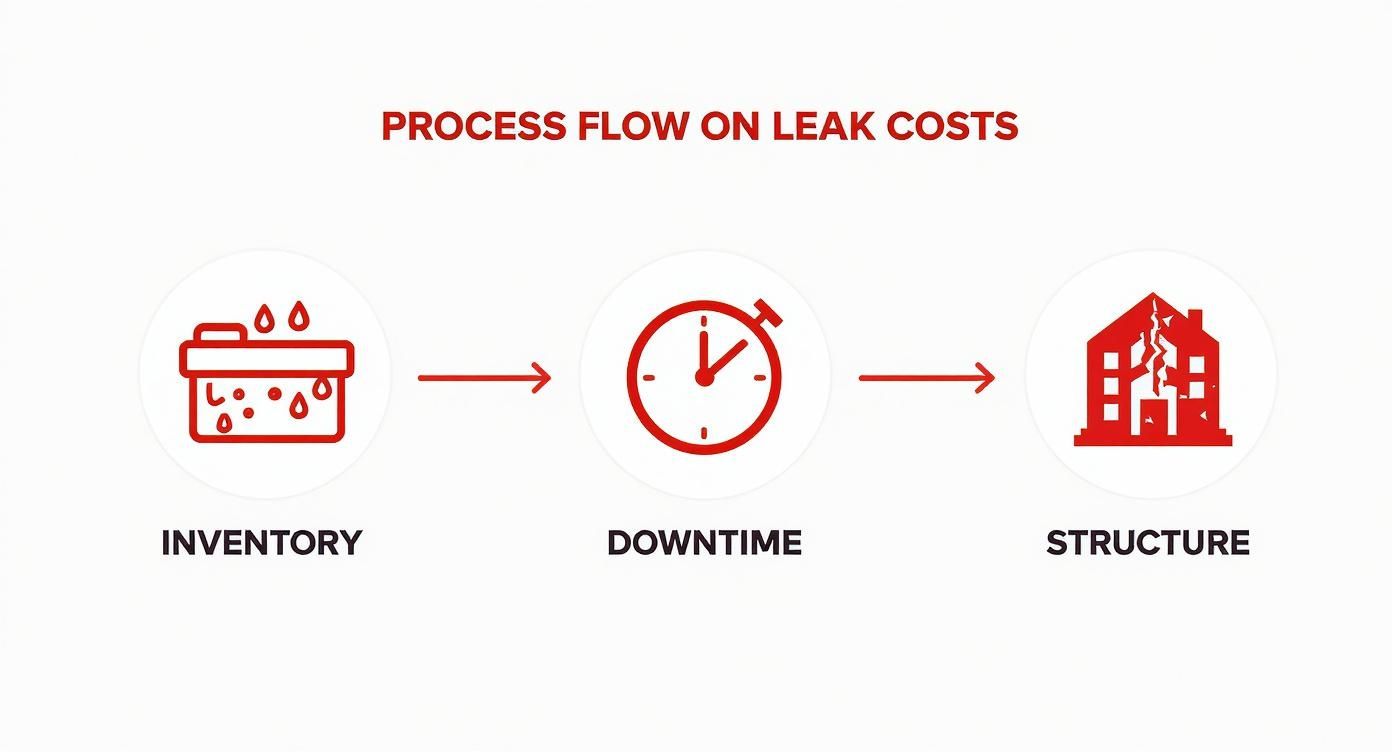
As you can see, what starts as a simple asset loss can cascade into operational downtime and eventually threaten the building's structural integrity. The costs just keep compounding at every stage.
Using Advanced Diagnostics for Pinpoint Accuracy
Sometimes, a visual inspection just won't cut it. You can walk a roof for hours and still not find the source of a stubborn leak. That’s because the real problem often lurks beneath the surface, completely invisible to the naked eye. This is when we at Hi Low Roofing bring in the big guns—specialized commercial roof leak detection technology that gives us the precision needed to find hidden moisture.
For facility managers across Central Florida, from St. Petersburg to Orlando, this approach is a game-changer. It saves a massive amount of time and money by taking the guesswork out of the equation. No more chasing phantom leaks or, even worse, tearing off perfectly good sections of the roof. We get a clear, data-driven map of exactly where the water is hiding.
Seeing Through the Roof with Infrared Thermography
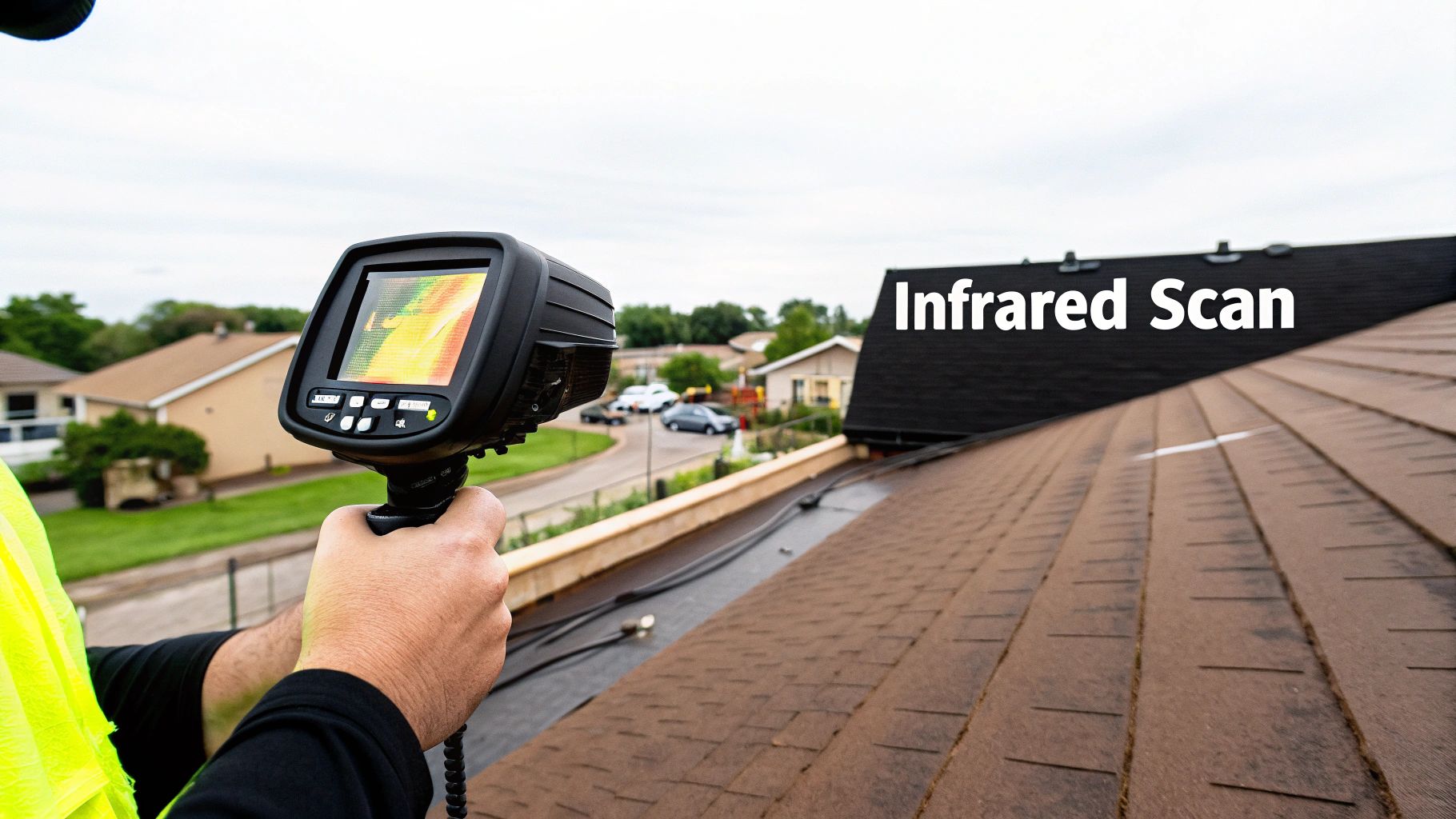
One of the most powerful tools in our arsenal is infrared (IR) thermography. It’s a non-destructive way to find trapped moisture by detecting tiny temperature differences on the roof's surface. Think of it like an X-ray for your roof.
Here’s how it works: during the day, the sun heats the entire roof. As the sun sets and the roof cools, any areas with wet insulation hold onto that heat longer. An IR camera picks up these warmer spots, which glow brightly on the screen, showing us exactly where water has saturated the insulation.
This technique is especially effective in Florida. After a blazing hot day, a thermal scan at dusk can create a perfect map of every hidden water pocket. We’ve seen this work wonders on a huge TPO roof on a warehouse in Tampa. The leak was slow and mysterious, but the IR scan instantly lit up the compromised section, even though the actual entry point in the membrane was several feet away.
Verifying Moisture with Electronic Tools
While an infrared scan gives us a fantastic overview, we always need to confirm what we're seeing. That's where other electronic tools come in to provide ground-truth data.
- Moisture Meters: These are handheld devices we use to verify the presence of water in the specific areas flagged by the IR scan. We press the meter’s probes into the roofing material, and it gives us an instant moisture reading. This confirms that a warm spot is, in fact, a wet spot.
- Electronic Leak Detection (ELD): This is a brilliant method for most membrane roofs. We create a low-voltage electrical field across the roof surface. Since water is a great conductor of electricity, any tiny pinhole or breach in the membrane will complete the circuit. Our equipment can then trace that electrical path directly to the source of the leak.
The real power of advanced diagnostics comes from using these technologies together. An infrared scan finds the potential problem areas, and a moisture meter provides the ground-truth verification needed to recommend a precise, effective repair.
Comparing Advanced Leak Detection Technologies
Choosing the right diagnostic tool is crucial, and it largely depends on your specific roof type. The table below breaks down the most common technologies to help you understand where each one shines.
| Technology | How It Works | Ideal Roofing System | Primary Advantage |
|---|---|---|---|
| Infrared Thermography | Detects temperature differences caused by trapped moisture that retains heat longer than dry areas. | TPO, EPDM, PVC, Mod-Bit (smooth surface) | Quickly scans large areas to find "hot spots." |
| Electronic Leak Detection | Creates a low-voltage electrical field; water completes the circuit at breaches, pinpointing the exact leak location. | EPDM, TPO, PVC (non-conductive membranes) | Finds microscopic pinholes that are visually undetectable. |
| Moisture Meter | Measures the moisture content in a specific spot by inserting probes into the roofing material. | All systems (used for verification) | Provides instant, on-the-spot confirmation of wetness. |
As you can see, there’s no one-size-fits-all solution. A tool that works perfectly on one roof might be completely ineffective on another.
Matching the Technology to the Roof System
Understanding the nuances of your roof is key. For instance, ELD is incredibly effective on non-conductive single-ply membranes like TPO and EPDM, but you can’t use it on a metal roof.
On the flip side, a gravel-covered built-up roof (BUR) can make both IR scans and ELD difficult. The gravel layer interferes with temperature readings and electrical fields. In those situations, we often have to rely on a combination of a thorough visual inspection and strategic core sampling, guided by where the leaks are showing up inside the building. Knowing how to adapt the approach is what separates an experienced roofer from an amateur.
Building Your Proactive Roof Maintenance Plan
When it comes to commercial roof leaks, the best defense is a good offense. Instead of waiting for a drip to turn into a disaster, a proactive maintenance strategy protects your biggest asset and, frankly, saves a ton of money down the road. Especially here in Central Florida, where our roofs bake in the intense sun one minute and get hammered by hurricane-season downpours the next, a solid plan isn't just a good idea—it's essential.
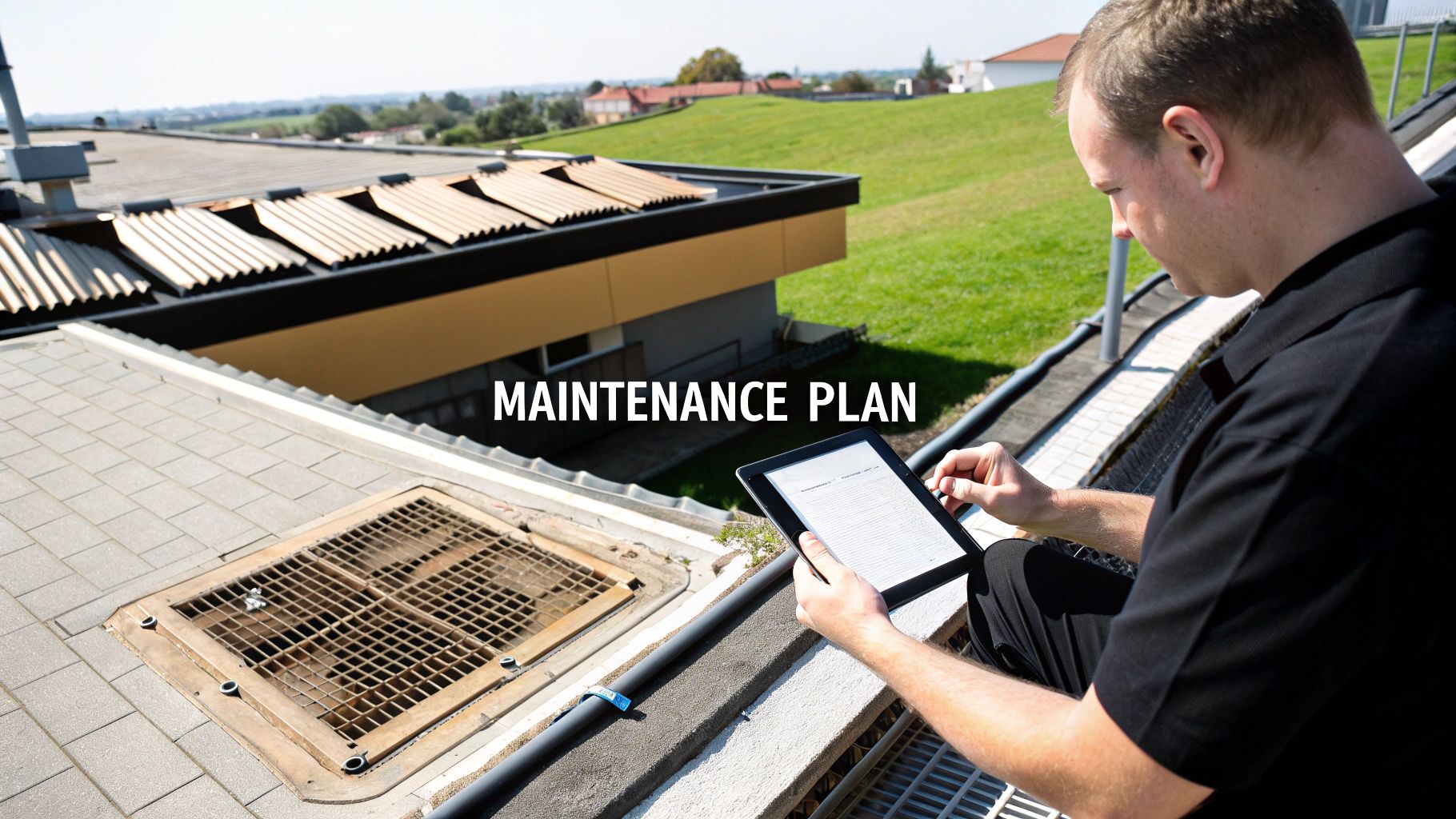
A proactive plan doesn’t have to be complicated. It really just boils down to consistency. Think of regular, documented inspections as creating a health record for your roof. This allows you to spot the small stuff, like a failing sealant or a clogged drain, before it spirals into widespread damage and a business-halting emergency.
Your Central Florida Seasonal Checklist
You can't treat a Florida roof the same way you would a roof up north. Our weather patterns demand a specific, seasonal approach. What your roof needs in May before the storms roll in is completely different from its needs in November after they've passed. The smartest approach? Build your entire maintenance schedule around hurricane season.
Pre-Hurricane Season (April-May)
- Clear Every Drain and Scupper: Spring storms love to dump leaves and debris, which can quickly choke your roof's drainage system. Making sure water can get off the roof fast is your #1 defense against ponding water, a notorious roof-killer that adds incredible weight and stress.
- Inspect and Reseal Penetrations: Get eyes on the sealant around every single HVAC unit, vent pipe, and skylight. Florida's brutal UV rays absolutely cook sealants, causing them to crack and fail. These spots are almost always the first to give way during a heavy, wind-driven rainstorm.
- Secure All Loose Materials: Check that all rooftop equipment, flashing, and coping caps are bolted down tight. You'd be amazed at what high winds can turn into a dangerous projectile.
Post-Hurricane Season (November-December)
- Do a Full Debris Sweep: Get all the accumulated leaves, branches, and whatever else the storms blew up there off the roof. This not only prevents future clogs but also gives you a clear, unobstructed view of the membrane surface.
- Scan for Punctures and Damage: This is the time for a careful walk-through. Look for any punctures, tears, or seams that have been lifted by high winds or flying debris. Even a tiny puncture can let in a surprising amount of water over the winter.
- Document Everything: Snap photos of any area that looks suspicious and keep detailed notes. This documentation is gold, both for scheduling repairs and for backing up any potential insurance claims you might have to file.
Proactive maintenance is more than just a checklist; it's an investment in keeping your doors open. A well-documented plan shows you're doing your due diligence, which can be a game-changer when you're on the phone with an insurance adjuster after a major storm.
Establishing a Routine and Keeping Records
Your maintenance plan should be a living document, not something you create once and then file away. For real, continuous protection and to keep surprise expenses at bay, it's worth looking into professional property inspections and upkeep services. They can often spot subtle issues an untrained eye might miss.
A simple logbook or a digital folder on a shared drive is all you really need. For every inspection, just jot down the date, who did it, what they found, and what actions were taken. Over time, this history becomes incredibly valuable for spotting recurring problems and proving your commitment to protecting the building. It’s this consistent effort that transforms a potential liability into a reliable, long-lasting asset.
Knowing When to Call a Professional Roofer
A hands-on approach to roof maintenance is fantastic, but let's be realistic—some situations are simply out of a facility manager's wheelhouse. The real skill is knowing when to monitor an issue yourself and when to bring in an expert from Hi Low Roofing to protect your Central Florida property.
Drawing that line correctly can be the difference between a simple fix and a full-blown catastrophe.
There are certain red flags that should have you immediately reaching for the phone to call a certified roofer. These aren't just minor blemishes; they're symptoms of deeper problems where a DIY attempt could make things a whole lot worse. If you spot any of these, it’s time for a professional opinion.
Critical Signs Demanding an Expert
Widespread or repeating problems are almost always a sign of a bigger, underlying failure. Here are a few scenarios where professional commercial roof leak detection isn't just a good idea—it's essential:
- Significant Ponding Water: Are you seeing small lakes on your roof that stick around for more than 48 hours after it rains? That’s a classic sign of a major drainage or even a structural problem.
- Widespread Membrane Damage: If you see extensive blistering, cracks running across large sections of the roof, or seams that are peeling back everywhere, the material itself is giving up. Patching this is like putting a band-aid on a broken leg.
- Signs of Structural Sagging: Any visible dips, bows, or sagging in the roof deck are urgent, serious warnings. This often means the insulation is completely saturated with water and the underlying structure is compromised, which is a massive safety hazard.
- Leaks You Can't Pinpoint: You’ve got water stains on the ceiling, but after a thorough search, you can't find an obvious entry point on the roof. Professionals have the advanced tools—like infrared scanners—to find what the naked eye can’t.
The real value of a professional isn’t just their ability to slap on a patch. It’s their diagnostic skill. Our teams have seen it all on commercial properties from Pinellas County to Orlando and know how to trace a symptom back to its true root cause.
Trying to tackle these bigger issues on your own often backfires. A poorly applied patch can actually trap moisture underneath, speeding up rot and corrosion. Worse, it could void your roof's warranty, leaving you on the hook for the full cost when the system inevitably fails.
A professional assessment from Hi Low Roofing gives you a clear, actionable plan. It might be a targeted repair, a restoration coating, or a full replacement. To get a better feel for what's involved, you can explore the different types of professional commercial roof repair that handle these complex problems.
At the end of the day, making that call is about managing risk—protecting your building, your assets, and your own peace of mind.
Burning Questions About Commercial Roof Leaks
Even with the best maintenance plan, you're going to have questions. It's only natural. As a facility manager or building owner here in Central Florida, you're not alone in the challenges you face. Let's tackle some of the most common questions we get asked about finding, managing, and stopping commercial roof leaks.
Getting a handle on these key issues will help you make smarter, more cost-effective decisions to protect your building.
How Often Should I Get My Commercial Roof Professionally Inspected In Florida?
For any commercial building in Central Florida, our rule of thumb at Hi Low Roofing is twice a year, minimum. The best times are in the spring, just before hurricane season ramps up, and then again in the fall to check for any damage storms may have left behind. Of course, you should always get an inspection after a major weather event, like a named hurricane or a bad hailstorm.
Think of it as routine care for one of your biggest investments. It's the best way to catch small problems before they morph into massive, expensive headaches.
Can A Small, Slow Leak Really Do That Much Damage?
Without a doubt. In our experience, a slow, hidden leak is often far more destructive than a sudden, gushing one. Why? Because it can go undetected for weeks or even months.
That quiet little drip silently soaks your insulation, turning it into a heavy, useless sponge. The trapped moisture then starts to rust out your metal decking, rot the wood supports, and creates a five-star resort for mold. By the time you spot a water stain on a ceiling tile, you can bet the damage above it is already widespread and much more costly to fix.
A slow leak is a quiet disaster for your building’s structure and air quality. The cost of ignoring it will always be higher than the cost of a professional inspection.
What’s The Difference Between A Roof Repair And A Roof Restoration?
This is a fantastic question and one that causes a lot of confusion. They are two very different strategies for dealing with roofing issues.
- Roof Repair: Think of this as a spot-fix. It's a targeted, surgical solution for a specific problem—patching a puncture, sealing a separated seam, or replacing a piece of damaged flashing.
- Roof Restoration: This is a comprehensive, proactive solution. It involves applying a seamless, waterproof membrane coating over your entire existing roof. This doesn't just fix minor leaks; it seals the whole system, adding years to its life for a fraction of what a full replacement would cost.
Will My Commercial Property Insurance Cover Leak Detection Services?
This really boils down to your specific policy and what caused the leak in the first place. If the damage came from a sudden, covered event like a hurricane, the associated detection costs are often covered.
However, insurers will almost always deny claims for leaks caused by deferred maintenance, neglect, or just an old roof that's at the end of its service life. This is precisely why having a documented maintenance plan is so critical. It proves you've been doing your due diligence, which can be a game-changer when you file a claim.
When you need straight answers and dependable solutions for your commercial roof, the team at Hi Low Roofing & Solar is here to help. From tracking down those tricky leaks to setting up a long-term maintenance strategy, we protect businesses all over Central Florida, from Pinellas to Orlando. Schedule your free, no-obligation inspection today by visiting us at https://hilowroofing.com.
