

If you're planning a roofing project in Clearwater, there's one thing you absolutely shouldn't overlook: your attic insulation. Tying these two upgrades together is, without a doubt, the single smartest move you can make to slash your energy bills and make your home drastically more comfortable.
Think of your home like a high-end cooler. Your roof is the lid, but the insulation is the thick foam wall that actually keeps the heat out. A great lid on an uninsulated cooler won't keep your drinks cold for long, and the same is true for your house under the intense Florida sun.
Why Your Roof and Attic Are a Single System
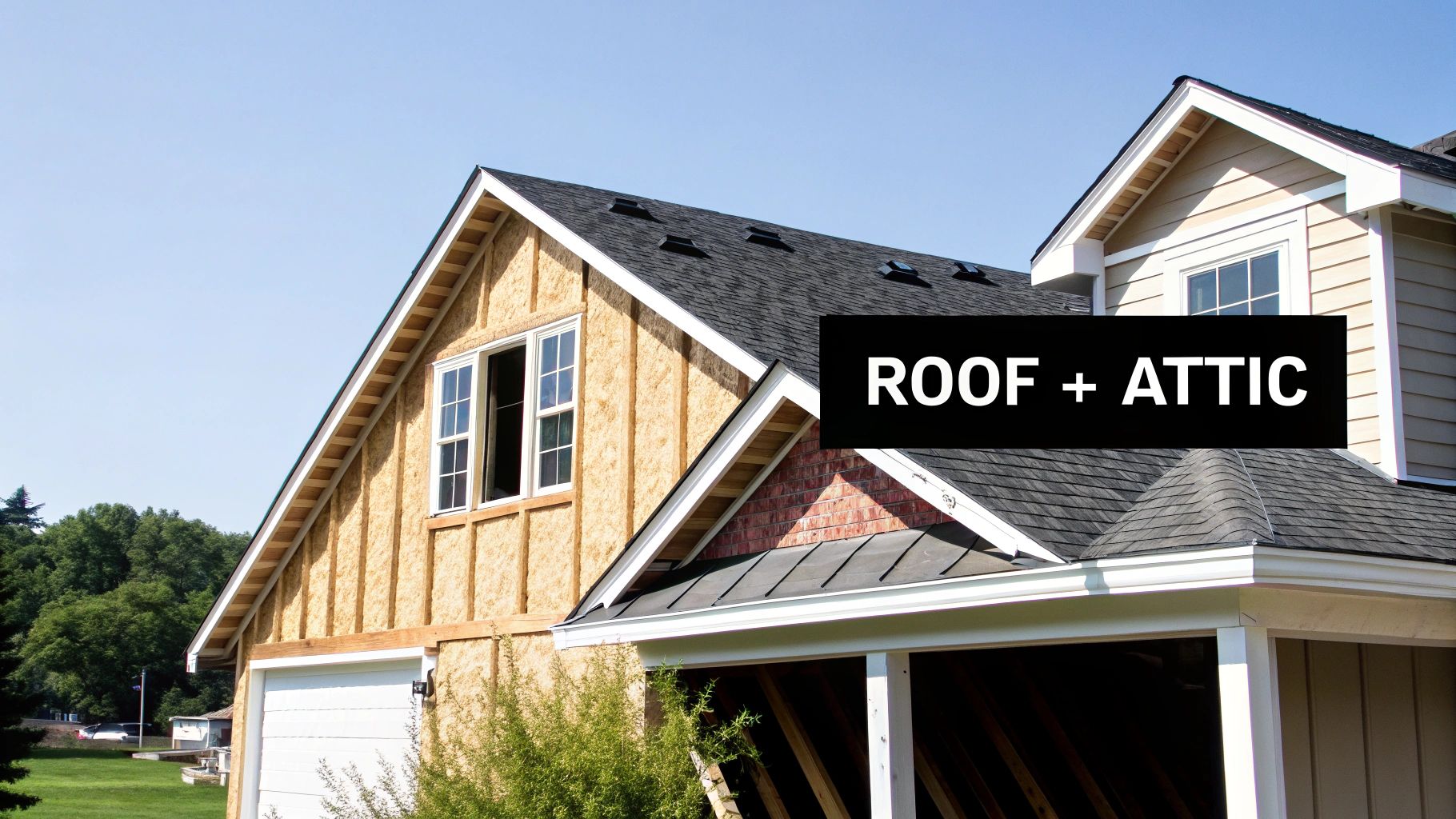
It’s easy for homeowners in Pinellas County to see their roof and attic as two different things. But from a performance standpoint, they're two halves of the same whole, working as a single system to protect your home. A shiny new roof is great at stopping rain, but it does very little to block the crushing radiant heat that can bake your shingles and turn the attic into a 150-degree oven.
That superheated air doesn't just stay up there. It radiates downward, pushing into your ceilings and living spaces. This forces your air conditioner to run constantly, fighting a losing battle to keep your home cool. It’s a huge strain on your HVAC system, leading to early breakdowns and shockingly high power bills, month after month.
Your roof is the first line of defense against sun and rain, but your attic insulation is the thermal shield that keeps the heat out of your home. When they work together, your home becomes an energy-efficient sanctuary.
The Power of an Integrated Approach
When you replace your roof, the plywood decking is completely exposed. This brief window is the absolute perfect time to sort out any issues in your attic. It's the most logical—and most affordable—moment to upgrade your insulation. If you wait and try to do it later, contractors have to work in a cramped, finished space, which makes the job harder and more expensive.
At Hi Low Roofing, we approach this as engineering a complete thermal and moisture barrier. By doing both jobs at once, we make sure every component, from the shingle on top to the insulation below, works in perfect concert.
We’ve seen firsthand how a unified strategy delivers for homeowners across Central Florida. Here’s a quick breakdown of what you stand to gain.
Key Benefits of Combining Roofing and Insulation Upgrades
| Benefit | Why It Matters for Clearwater Homes | Long-Term Impact |
|---|---|---|
| Maximized Energy Efficiency | Cuts down on the massive heat gain that forces your AC to work overtime. | Significant monthly savings on your electric bill and less wear-and-tear on your HVAC unit. |
| Consistent Home Comfort | Eliminates hot spots and rooms that feel impossible to cool, especially upstairs. | A stable, comfortable indoor temperature year-round, no matter how hot it gets outside. |
| Structural Protection | Controls extreme attic temperatures and humidity that can lead to mold and wood rot. | Protects the integrity of your roof deck and framing, preventing costly future repairs. |
By tackling these projects simultaneously, you're not just getting a new roof; you're investing in a comprehensive system that pays you back for years to come.
Ventilation: The Missing Piece
There's one more critical part of this system: proper ventilation. Insulation is designed to slow heat transfer, but ventilation is what actually gets the hot, moist air out of the attic. Without good airflow, even the best insulation can’t do its job properly.
This balance between insulation and ventilation is the secret to a long-lasting roof and a dry, healthy home. To get a better handle on this, you can check out our guide on roof ventilation tips for Kissimmee attics—the principles are the same across Central Florida. Combining roofing, insulation, and ventilation all at once is the ultimate home performance trifecta.
How Florida's Climate Challenges Your Home
Living in Clearwater is fantastic, but that beautiful sunshine is relentless. It wages a constant war on your home, and the fight is on two fronts: intense solar radiation and crushing, year-round humidity. Once you understand these specific climate forces, you'll see why attic insulation paired with roofing in Clearwater isn't just a home improvement project—it's your home's essential line of defense.
Think of your roof as a massive solar collector, soaking up the sun's energy all day. This process, known as radiant heat transfer, is incredibly effective at turning your attic into an oven. It's no exaggeration for attic temperatures here in Pinellas County to climb past 140°F, even on a typical sunny afternoon.
All that superheated air creates a blanket of heat pressing down on your ceilings, trying to force its way into your living space. The result? Your air conditioner runs non-stop, fighting a losing battle to keep you comfortable.
The Attic as a Heat Amplifier
Imagine leaving a cast-iron skillet on a hot stove. Even long after you turn the burner off, that pan stays scorching hot, radiating warmth into the kitchen. Your attic works the exact same way, continuing to push heat down into your house long after the sun has gone down.
This constant heat transfer puts a huge strain on your HVAC system. It has to run longer and harder, which not only sends your energy bills through the roof but also causes premature wear and tear on your expensive equipment. This is where poor insulation goes from being a minor issue to a major financial drain.
Without a robust thermal barrier, your roof simply collects solar energy, and your attic becomes the distribution center, sending that heat directly into the rooms you pay to keep cool.
Thermal Bridging and Humidity Headaches
Another sneaky problem we see all the time is thermal bridging. This occurs when heat finds a path of least resistance, bypassing your insulation by traveling through the wooden joists and studs in your attic. Since wood isn't nearly as good an insulator as fiberglass or cellulose, these structural supports become "bridges" for heat to march right into your home.
And then there's the humidity. Florida's thick, moist air gets into everything, including your attic. When this humid air hits a cooler surface, condensation forms, creating the perfect environment for mold and mildew. Over time, this moisture can damage your air quality and even lead to wood rot in your roof's structure.
These are problems unique to our climate, and they demand a solution built specifically for Florida. At Hi Low Roofing, our integrated approach to roofing and insulation is designed to fight back against these forces. We create a complete system that reflects solar rays, blocks heat transfer, and manages moisture. Many homeowners also explore options like cool roof technology in Riverview to further reduce heat absorption from the top down.
Of course, with our heavy rainfall, keeping the exterior in top shape is just as crucial. Following safe gutter cleaning practices ensures water is channeled away from your roofline and foundation. By tackling all these elements together, you build a home that works with you in the battle for comfort and efficiency.
Choosing the Right Insulation for Your Attic
Once you've decided to tackle your attic insulation and roof together—a smart move—the next big question is: what material should you use? It's easy to get lost in the home improvement store aisle, staring at a wall of rolls, batts, and bags all making big promises.
But for us here in Clearwater, this isn't just about picking the cheapest option. It’s about choosing a material that can stand up to our unique climate—blazing heat and relentless humidity.
Why R-Value is King in Florida
You'll hear the term R-value thrown around a lot, and for good reason. Think of it as a material's power to resist heat. A higher R-value means better performance in stopping that scorching Florida sun from turning your attic into an oven. It's the key to keeping your cool, air-conditioned air right where it belongs: inside your home.
Getting the R-value right is crucial. Florida's building codes have specific targets for a reason—our cooling bills are a massive part of a home's energy consumption. For most attics in Clearwater and Pinellas County, you should be aiming for a total R-value somewhere between R-30 and R-60. The exact number depends on your home's age, roof design, and what's already up there. To see how these targets directly affect your home's comfort and power bills, it's worth reading up on the specifics of Florida attic performance.
The Top Insulation Choices for Clearwater Attics
So, what are the best options for our area? Instead of getting bogged down in jargon, let's talk about how these materials actually work in the real world. A pro from a team like Hi Low Roofing can give you a tailored recommendation, but here are the three main players you'll be choosing from.
-
Blown-In Fiberglass: This is made of fine glass fibers blown in with a hose. Its biggest strength is its ability to get everywhere, creating a seamless, fluffy blanket that covers every joist, pipe, and wire. Fiberglass is also inherently moisture-resistant, so it won’t rot or support mold growth—a huge plus in our humid climate.
-
Blown-In Cellulose: If you're looking for an eco-friendly angle, this is it. Cellulose is made from recycled paper treated to be fire-retardant. It packs down tightly, doing an excellent job of stopping air leaks. The only watch-out? If it gets soaked from a roof leak, it can compact and lose some of its insulating power.
-
Spray Foam Insulation: This is the premium choice for a reason. It's applied as a liquid that expands on contact, filling every single crack and gap to create a solid, airtight seal. For Florida, closed-cell spray foam is a game-changer. It's completely waterproof and even adds a bit of structural strength to your roof deck.
Comparing Attic Insulation Materials for Florida Homes
To help you see the differences more clearly, here’s a quick comparison of the top contenders based on what really matters for a Clearwater home.
This table breaks down the key features to help you decide which material aligns with your home's needs and your budget.
| Insulation Type | Typical R-Value (per inch) | Moisture Resistance | Best For |
|---|---|---|---|
| Blown-In Fiberglass | R-2.2 to R-2.7 | Excellent | Filling irregular spaces and topping up existing insulation in a humid climate. |
| Blown-In Cellulose | R-3.2 to R-3.8 | Good (when dry) | Homeowners seeking an eco-friendly option with superior air-blocking capabilities. |
| Spray Foam (Closed-Cell) | R-6.0 to R-7.0 | Superior | Creating a complete air and moisture barrier, especially in attics with tricky layouts. |
At the end of the day, the goal is the same no matter what you choose: create a complete, unbroken thermal barrier that stops heat in its tracks.
Ultimately, the perfect attic insulation paired with roofing in Clearwater isn't a one-size-fits-all solution. It takes a professional eye to assess your roof's ventilation, check your existing insulation, and understand your energy-saving goals. Talking through these options with an expert from Hi Low Roofing is the best way to ensure your investment pays off in comfort and savings for years to come.
The Integrated Installation Process
Combining a roofing and insulation project isn't just about doing two jobs at once; it’s about making them work together in perfect sync. Think of it like a well-choreographed dance—every step has to be perfectly timed and executed. When you have an experienced team handling both, what seems complicated becomes a smooth, predictable process. This integrated approach sidesteps the headaches of juggling separate contractors and ensures every part of your home's protective shield works as one.
The whole thing kicks off with a thorough, top-to-bottom inspection, not just a quick glance at your shingles. A specialist from Hi Low Roofing will get up on your roof, check the condition of the existing materials, and look for any signs of leaks or damage to the decking underneath. Then, they’ll head into the attic. Down there, they're assessing the state of your current insulation—is it compacted? Damp? Is there even enough of it? They'll also check your ventilation system to make sure it's actually doing its job.
This initial deep dive is absolutely critical. It gives us a complete picture of your home’s thermal envelope, letting us create a precise plan that fixes the root causes of energy loss, not just the symptoms.
Preparing the Attic for a High-Performance Upgrade
The real magic happens once the roof replacement begins. As soon as the old shingles come off, the attic is wide open and easy to access. This is a huge advantage. Instead of our team having to work in a cramped, dark space, we have a clear, safe environment to prep the attic floor for its new thermal shield.
The first step, and one that less experienced crews often overlook, is the safe and complete removal of old, ineffective insulation. Over the years, that fluffy stuff can become compacted, clogged with dust, or even contaminated by pests, which absolutely tanks its R-value. We carefully remove all that old material, giving us a clean slate to work with.
With the old stuff gone, we shift our focus to a meticulous process called air sealing.
Air sealing is the unsung hero of energy efficiency. It’s all about finding and sealing every tiny gap, crack, and hole in your attic floor—around pipes, wiring, vents, and light fixtures—that lets your expensive conditioned air escape and the scorching attic air sneak in.
This step alone can make a massive dent in your energy bills, but it’s often skipped when a company just blows new insulation over the top of existing problems.
Coordinating Roofing and Insulation Timelines
With the attic floor prepped and sealed, the two project timelines merge perfectly. While the roofing crew is laying down new underlayment and shingles up top, the insulation team can get to work in the attic below. This is where proper ventilation management is crucial.
We install ventilation baffles where needed to make sure the new insulation doesn't block airflow from your soffit vents. This simple component is vital for a healthy roof system, as it lets air circulate freely to whisk away heat and moisture. A solid underlayment is also key to managing moisture; you can learn more about underlayment choices for Lakeland roofs, as the same principles apply right here in Clearwater.
Here’s a look at how the coordinated installation typically plays out:
- Roof Tear-Off: The old roofing materials are stripped away, exposing the roof deck.
- Attic Prep & Sealing: At the same time, the attic is cleared of old insulation and professionally air-sealed.
- Decking & Underlayment: The roofing crew inspects and repairs the deck, then installs a new, high-quality underlayment.
- Insulation & Baffle Installation: New insulation is blown in to the correct depth to hit our target R-value, and we secure baffles to protect the vents.
- Final Roof Installation: The new shingles, tiles, or metal panels are installed, along with flashing and ridge vents.
- Site Cleanup: The project wraps up with a thorough cleanup of your property. We leave nothing behind but a high-performing roof and attic system.
By managing the entire project under one roof, Hi Low Roofing ensures that your attic insulation paired with roofing in Clearwater is a smooth, efficient process that delivers real, lasting value and comfort.
Calculating Your Return on Investment
Let’s be honest, putting on a new roof and upgrading your attic insulation is a significant project. It's easy to get sticker shock. But here’s how we encourage Clearwater homeowners to think about it: this isn't just an expense, it's a strategic investment in your home that starts paying you back from day one.
The first and most obvious return comes from your power bill. Once your attic is properly insulated and air-sealed, you've created a complete thermal shield for your home. That relentless Florida sun is no longer winning the battle, which means your air conditioner finally gets a break. You'll notice it doesn't have to kick on nearly as often, and that translates directly into real savings, especially during our long, brutal summers here in Pinellas County.
Think of it this way: every dollar you spend running an overworked HVAC system is a dollar lost. By investing in a high-performance roof and insulation system, you're plugging the leaks where your money was escaping, allowing you to keep more of it month after month.
Beyond the Monthly Bills
But the financial upside doesn't stop with your utility statements. Your HVAC system is one of the most expensive appliances in your house. By drastically reducing its workload, you’re not just saving on electricity—you’re extending the life of the unit itself. That means pushing a costly replacement further down the road and dodging expensive repair bills.
And when it's eventually time to sell? A modern, energy-efficient home is a huge draw. Being able to show potential buyers a new, high-performance roof and proof of low energy bills can seriously boost your home's resale value, making it stand out from other listings.
It’s all about following a proven process to get these results.
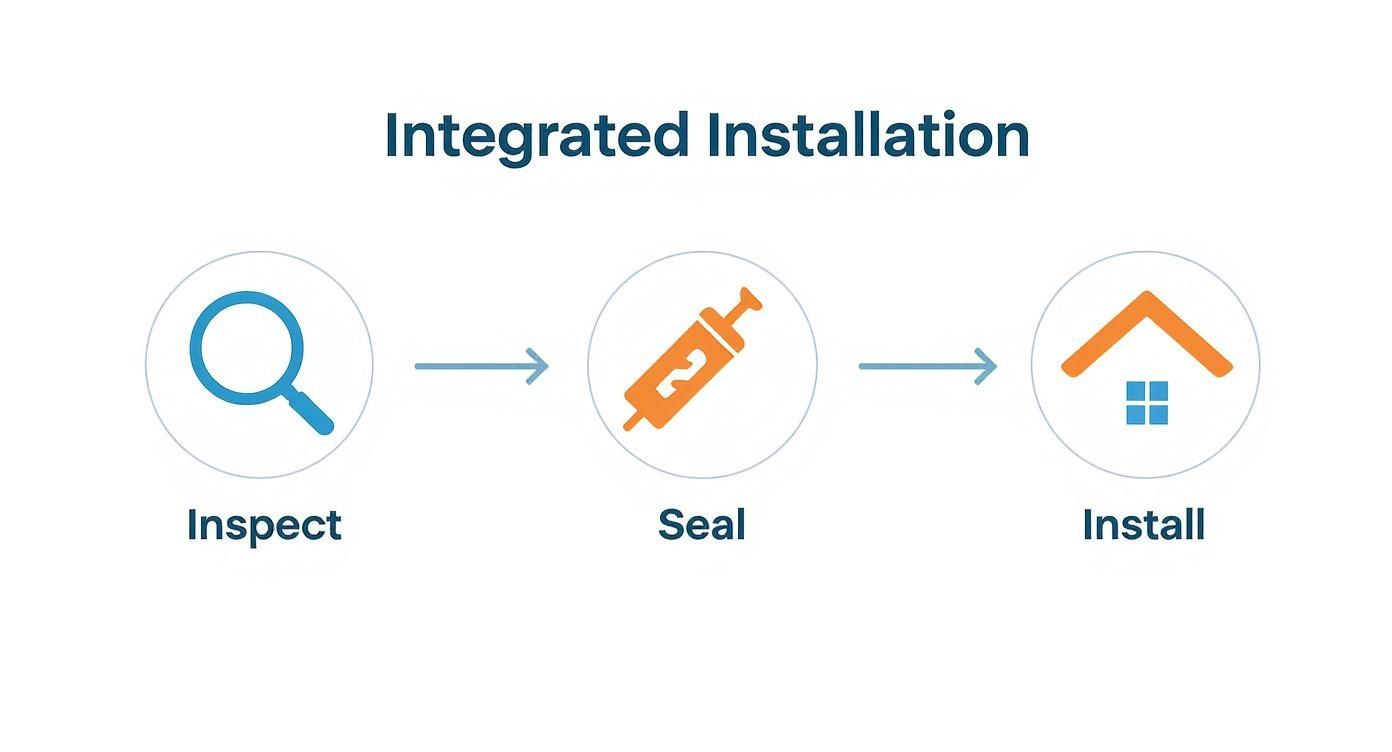
This simple "Inspect, Seal, Install" method ensures every part of the system is working together to give you the biggest bang for your buck.
Realistic Cost Expectations in Clearwater
Of course, you need to know what you're getting into upfront. The costs for attic insulation and roofing in Clearwater can vary quite a bit depending on the size of your attic and the materials you choose.
For insulation materials like fiberglass or cellulose, you can generally expect to pay somewhere between $0.50 and $2.00 per square foot for the materials themselves. Professional installation will be an additional cost on top of that. Getting a clear idea of local insulation costs is a great first step.
This is more than just a home repair; it's one of the smartest financial moves you can make as a Clearwater homeowner. By looking at the bigger picture and understanding the various strategies to reduce electricity bills, you can see how this single project delivers powerful, long-term returns.
See Your Home in a Whole New Way with Hi Low Roofing
Let’s be honest: your roof and your attic work together as one big system. This isn't just some abstract construction idea—for homeowners here in Clearwater and all over Central Florida, it’s the secret to actually being comfortable in our climate. The intense, baking sun and soupy humidity we deal with daily require more than just shingles on a roof. They demand a smart, integrated solution.
That’s why bundling your roofing replacement with an attic insulation upgrade is one of the shrewdest moves you can make for your home. You're not just tackling a necessary repair; you're making a strategic investment that starts paying you back immediately. We're talking lower power bills, less wear and tear on your air conditioner, and a home that feels consistently cool and comfortable. This isn't two separate projects—it's creating a complete thermal barrier over your head.
Your Go-To Experts for Central Florida Roofing and Insulation
When it's time to get this done, you need a team that truly gets Florida. Hi Low Roofing isn't just another company with a truck. We're your neighbors, and we know firsthand the unique challenges homes face every day, from Pinellas County all the way to Orlando. We know exactly how to design and build roofing and insulation systems that stand up to our specific climate, delivering real results for both residential and commercial properties.
Our promise is simple: to manage your project seamlessly and professionally, leaving you with more than just a new roof. We deliver the peace of mind that comes from knowing your home is finally protected, efficient, and ready for whatever Florida’s weather decides to do next.
Are you ready to feel the difference a cooler, more comfortable home can make, all while seeing your energy bills drop? It all starts with a proper, professional assessment from a team that understands the complete system. Let us show you how combining attic insulation paired with roofing in Clearwater will completely change your home for the better.
Contact Hi Low Roofing today to schedule your free, no-obligation roof and attic inspection. It’s the first step toward real comfort and long-term savings.
Got Questions? We've Got Answers
Even after seeing all the benefits, it's natural to have a few questions before you jump in. We get it. Let's tackle some of the most common things homeowners in Clearwater ask us about combining their roofing and attic insulation projects.
How Do I Know if My Attic Insulation is Past its Prime?
You don't need to be an expert to spot the warning signs. The easiest way is to just take a peek.
Pop your head up into the attic and look around. Can you easily see the wooden ceiling joists? If so, you definitely don't have enough insulation. For our hot, humid climate here in Clearwater, you're looking for a thick, consistent blanket of insulation that's about 11 to 13 inches deep to hit that sweet spot of an R-38 value.
Beyond a simple visual check, your home is probably already telling you something is wrong. Are your upstairs rooms unbearably hot in the summer? Do your AC bills seem to climb higher every year? Those are classic signs of a failing thermal barrier. Also, keep an eye out for insulation that looks clumpy, damp, matted down, or has signs of pests—those are all red flags.
Can I Just Put New Insulation on Top of the Old Stuff?
That's a great question, and the answer is a solid "maybe."
If your current insulation is still fluffy, dry, and clean, then yes, you can often add a new layer right on top to boost your R-value. This technique, sometimes called "capping," works quite well, especially when you're adding new blown-in insulation over an older layer of fiberglass batts.
But—and this is a big but—if the existing insulation is compressed, wet, or shows any sign of mold or pest contamination, it absolutely must come out. Trying to cover up a moisture or mold problem is a recipe for disaster. It can lead to wood rot, poor indoor air quality, and much bigger headaches down the road. The only way to know for sure is to have a professional take a look.
Are There Any Rebates in Clearwater for This Kind of Work?
Yes, and you should definitely take advantage of them! Upgrading your home's energy efficiency is a win for everyone, so there are often programs to help you save some money on the initial cost.
While the exact offers can change from year to year, here’s where to look:
- Your Utility Company: Providers like Duke Energy, which serves much of Pinellas County, often have rebate programs for homeowners who bring their attic insulation up to modern standards. It helps them manage the power grid, and it helps you save money.
- Federal Tax Credits: The U.S. government regularly offers tax credits for energy-saving home improvements. The Inflation Reduction Act, for instance, renewed and expanded credits for things like high-efficiency insulation and roofing.
- State and Local Programs: It's always a good idea to see if there are any Florida-specific or local programs that can offer an extra incentive.
These programs are constantly being updated, so the best bet is to talk to your insulation and roofing contractor. A team that's on top of their game, like Hi Low Roofing, will know exactly what's available and can help you navigate the paperwork to make sure you get every dollar you're entitled to.
Ready to make your home more comfortable and cut down those energy bills? The expert team at Hi Low Roofing is here to give you a complete picture of your roof and attic's health. We'll help you create a cooler, more affordable home. Schedule your free, no-obligation inspection today!
