
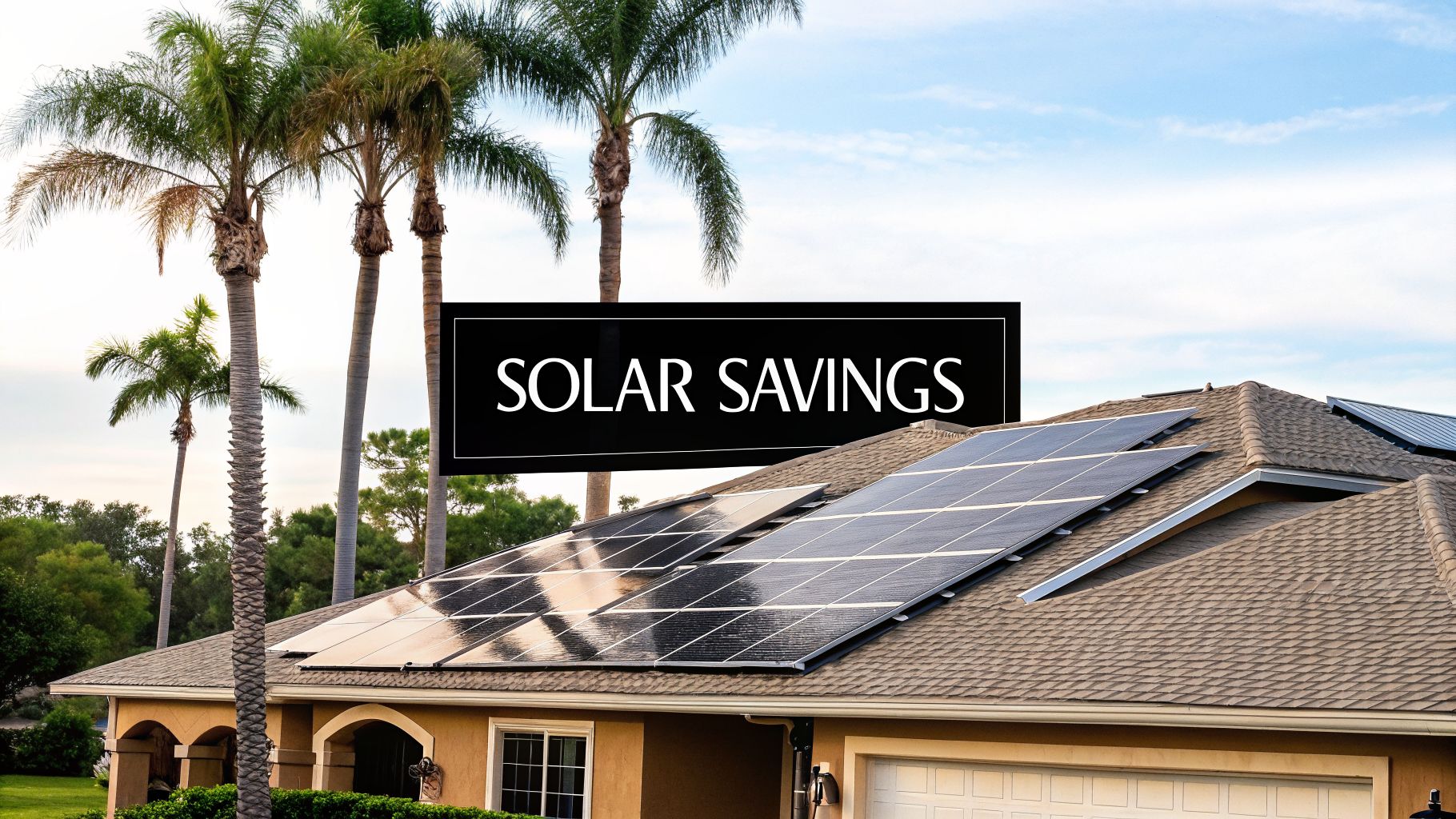
Absolutely. A solar roof isn't just an upgrade; it's a fundamental shift in how you power your life, and it’s one of the most reliable ways for Central Florida homeowners to slash or even zero out their monthly energy bills. Your standard roof is a constant expense. A solar roof, on the other hand, is an asset that generates a return every single day the sun is out.
Given Florida's incredible amount of sunshine and the steady climb of utility rates, the math for solar just makes sense, especially for residents in the service area of Hi Low Roofing, from Pinellas County all the way to Orlando.
Turn Your Roof Into A Money-Saving Asset

For homeowners anywhere from Pinellas County to Orlando, your roof can do so much more than just keep the rain out—it can become your personal power station. A conventional roof is purely a liability; it needs maintenance, faces an expensive replacement down the line, and does nothing to stop your energy costs from rising. A solar roof completely flips that equation.
By generating your own clean electricity right where you use it, you seize control over one of your biggest household expenses. Instead of just sending money to the power company month after month, you’re investing in an asset that produces real, measurable value every time the sun shines.
The Power of Sunshine in Central Florida
They don't call it the Sunshine State for nothing, and that nickname translates directly into a financial advantage for homeowners. We see it all the time—Florida families who install solar roofing are getting massive reductions in their energy bills simply by tapping into our state’s most abundant resource.
Let’s look at the numbers. Florida gets an average of 5.6 peak sun hours daily, which is why it's a top state for solar. Over 251,000 households have already made the switch. For a typical system, homeowners can expect to save an average of $51,910 over 25 years. That figure becomes even more compelling when you realize utility rates have already shot up 26% since 2020, a trend that shows no signs of slowing down, according to data from sites like PowerOutage.us.
At Hi Low Roofing, we’ve guided hundreds of homeowners across Central Florida, from the Tampa Bay area to Orlando's suburbs, through this exact process. We help them turn a depreciating roof into a long-term financial win that not only provides immediate savings but also builds home equity.
To put it all in perspective, here's a quick summary of the core benefits for homeowners right here in our community.
Solar Roofing Benefits At A Glance For Central Florida
The advantages of going solar are clear, especially in a sun-drenched region like ours. This table breaks down what you can realistically expect.
| Benefit | Description | Example For A Florida Homeowner |
|---|---|---|
| Drastic Bill Reduction | Generate your own power to offset or eliminate your monthly electricity bill. | An Orlando family with a $250 monthly power bill can reduce it to nearly $0, saving $3,000 annually. |
| Increased Home Value | Homes with solar sell faster and for a premium compared to those without. | A home in Pinellas County adds thousands to its resale value by offering a future of energy independence to buyers. |
| Energy Independence | Gain protection from unpredictable utility rate hikes and power outages. | During a storm, your home stays powered with a battery backup while the neighborhood goes dark. |
Ultimately, choosing a solar roof is about more than just panels; it’s an investment in your home’s overall efficiency, resilience, and market value. You can see how this stacks up against other options by exploring our guide on energy-efficient roofing in Brandon. With Hi Low Roofing, you get a single, trusted partner to protect your home and power its future.
How Florida Sunshine Translates To Real Savings
It's easy to look at a solar roof and just see a bunch of high-tech panels. But how they actually slash your power bill is surprisingly simple. Think of it as a direct path from sunlight to savings, putting you squarely in the driver's seat of your home's energy costs.
The journey starts the instant that famous Florida sun hits your roof. Your solar panels, which are filled with photovoltaic cells, get to work absorbing that sunlight. This creates a direct current (DC) of electricity—plenty of power, but not the kind your appliances can use just yet.
That’s where a critical piece of hardware, the inverter, steps in. Its one job is to convert that raw DC power into the alternating current (AC) electricity that runs everything in your home, from your AC unit to your TV.
The Magic of Net Metering
So what happens when your solar roof is cranking out more power than you're using? This is a daily occurrence on bright, sunny afternoons here in Central Florida. That extra electricity doesn't just vanish; it becomes a powerful credit on your utility bill.
This is all thanks to a program called net metering. It's a simple, brilliant concept:
- Any extra electricity your system generates is automatically fed back into the local power grid.
- Your utility company—whether that's Duke Energy, TECO, or FPL—keeps a running tab of every kilowatt-hour you send them.
- They give you credits for that power, which you can use at night or on cloudy days when you need to pull electricity from the grid.
Think of it like this: net metering lets you "spin your meter backward," banking energy credits when the sun is high and spending them when it's not. This is the core mechanism that allows you to lower your energy bills with solar roofing in Florida so dramatically. For some, it wipes out the bill entirely. To see if the numbers work for your home, you can find a more detailed analysis in our guide on whether solar panels are worth it.
Your roof stops being a one-way street for consuming power and becomes a two-way exchange. You’re not just a customer anymore; you're a producer, which helps stabilize the entire local grid while offsetting your own costs. It's a true win-win for homeowners from Orlando to the Tampa Bay area.
A Critical Window for Florida Homeowners
The financial upside of net metering is huge, but you need to know that the rules are changing. Recent Florida legislation has started a gradual phase-down of the full retail-rate credits that new solar customers get.
This creates a real sense of urgency. There's a limited time to lock in the best possible net metering rates available today. Homeowners who get their solar systems installed and connected to the grid before the 2027 policy adjustments are grandfathered into the current, more valuable credit structure for a full 20 years.
If you wait, you’ll receive less compensation for the surplus power your roof generates. That directly impacts your long-term savings and return on investment. Taking action now secures the best financial outcome from your solar investment, period. And to keep those savings rolling in, it helps to understand how often to clean solar panels to maximize your energy savings. While our Florida rain does a lot of the work, keeping them clear of seasonal pollen and debris ensures they perform at their absolute peak.
Calculating The Return On Your Central Florida Solar Roof
Let's get down to brass tacks. While the idea of solar is great, the real magic happens when you see how the numbers work for your home. Calculating the return on investment (ROI) for a solar roof isn't some generic estimate; it's a specific formula based on your family's power usage, your roof's unique setup, and the fantastic financial perks available right here in Central Florida.
Going solar is one of the smartest high-ROI home improvements a Floridian can make. Think about it: unlike a kitchen remodel, a solar roof actively starts paying you back from day one. You're turning a passive structure into an asset that generates real savings.
The speed of your payback depends on a few key things.
Factors That Shape Your Solar ROI
Your Current Electric Bill: This is the big one. The more you're currently paying your utility provider, the more you stand to save. A system designed to wipe out a $300/month bill will pay for itself much faster than one built for a $100/month bill.
Your Roof's Direction and Angle: In Florida, a clear, south-facing roof is the gold standard for catching maximum sun. But don't worry if that's not your house. East- and west-facing roofs are still incredibly productive, and our job at Hi Low Roofing is to design a panel layout that gets the absolute most out of whatever your roof looks like.
The Size of Your System: We measure solar systems in kilowatts (kW). The goal isn't just to get the biggest system possible, but the right-sized system for your needs. We'll look at your past utility bills to design a system that generates just the right amount of power to offset your typical usage.
The Financial Incentives That Make Florida Solar So Attractive
The price you see on an estimate is never the final price you pay—not by a long shot. A few powerful incentives slash the upfront cost and get you to profitability much quicker.
The most significant is the 30% Federal Solar Tax Credit. This isn't a deduction; it's a true credit that reduces what you owe the IRS, dollar-for-dollar. On a $30,000 system, that's a $9,000 credit, immediately dropping your net cost to $21,000.
On top of that, Florida adds its own powerful benefits:
- No Property Tax Increase: A solar roof absolutely increases your home's value. But thanks to a state exemption, that added value won't raise your property tax bill one cent.
- No Sales Tax: You pay 0% in sales tax on your solar equipment. On a typical system, this saves you well over a thousand dollars right off the bat.
These aren't just minor discounts; they are financial game-changers. When you stack the federal credit with Florida's exemptions, you can cut the true cost of your solar investment by a third or more right from the start.
This whole process turns your roof from a simple overhead expense into a power-generating asset that puts money back in your wallet.

It’s a straightforward path: sunshine hits your roof, your panels create power, and your monthly utility bill plummets.
A Realistic Look At ROI For Central Florida Homes
So, what does this look like in practice? Let's break down a common scenario for a family in the Orlando area with a typical-sized home.
This table illustrates a sample return on investment for a common system size in the Orlando area, factoring in incentives and savings.
| Metric | Value | Explanation |
|---|---|---|
| Initial System Cost | $24,300 | The gross cost for a 9 kW system before any incentives. |
| Federal Tax Credit (30%) | -$7,290 | A direct credit on your federal income taxes. |
| Your Net Cost | $17,010 | The actual out-of-pocket investment after the tax credit. |
| Avg. Monthly Savings | $200 | The amount you're no longer paying the utility company. |
| Annual Savings | $2,400 | Your total savings over one year. |
| Simple Payback Period | 7.08 Years | The time it takes for the system to pay for itself. |
| 25-Year Profit | $42,990+ | Total savings after the system has paid for itself. |
As you can see, the numbers are compelling. In this example, your system completely pays for itself in just over seven years.
After that point, every single watt of power your roof produces for the next 18+ years of its warranty is pure profit. You're not just saving money; you're insulated from the utility rate hikes we all know are coming. At Hi Low Roofing, this is what we do—we design the system that maximizes this exact return for your specific home and budget.
Pairing Solar Power With A Hurricane-Ready Roof

Here in Central Florida, from Pinellas all the way to Orlando, resilience isn't just a buzzword—it's a way of life. We all know the yearly threat of hurricanes means any big project on your home, especially on the roof, has to be built tough. That’s why tackling a new roof and a solar installation at the same time is simply the smartest, most secure way to go.
Putting brand-new solar panels on an old roof is a gamble. You're essentially bolting cutting-edge technology onto a foundation that's already nearing the end of its life, which can cause major headaches down the road. The right way to do it is to combine the projects, making sure every part works together as one solid, storm-ready system.
This integrated approach is exactly what we specialize in at Hi Low Roofing. We don't just bolt on panels. We build a complete roofing system where the solar array and the roof itself are designed from the ground up to meet—and beat—Florida's strict high-wind building codes. It’s all about giving you structural integrity and total peace of mind.
Built To Withstand Florida’s Toughest Storms
One of the first questions we always get is, "Can solar panels really survive a hurricane?" The answer is a confident yes, but only if they're installed by a team that truly knows both roofing and solar engineering.
Modern solar panels are incredibly tough and built to take a beating from hail and debris. But their real strength in a storm lies in the racking system that fastens them to your roof. We use specialized hardware and proven installation techniques that lock the panels down tight without ever compromising the roof's integrity or creating potential leak spots.
The secret to a hurricane-ready solar roof is simple: never compromise the roof’s main job of keeping water out. Because we're expert roofers first and foremost, we ensure every single attachment point is meticulously flashed and sealed. This protects your home's waterproof barrier while creating an unshakable foundation for your solar array.
By handling everything at once, we ensure both your new roof and your new solar system are covered under one straightforward warranty. You get a single point of contact and one team accountable for the performance and durability of your entire roof for years to come.
Achieving True Energy Independence With Battery Backup
While a solar roof is your ticket to lower energy bills with solar roofing Florida, adding a battery backup system is what gives you true energy independence. When the power goes out during a storm—a common occurrence here—homes with just solar panels will go dark, too. It's a built-in safety measure to protect utility workers repairing the grid.
But when you add a solar battery, your home instantly becomes its own self-sustaining power station.
- During the day: Your solar panels power your home and charge up the battery with any excess energy.
- When the grid fails: The battery immediately and automatically takes over, powering your essentials like the refrigerator, lights, AC, and any medical equipment without a flicker.
- Continuous Power: The next morning, your panels get right back to work, recharging the battery. This creates a powerful cycle of resilience that can keep your family safe and comfortable through outages lasting for days.
This trifecta—a storm-proof roof, a securely mounted solar array, and a reliable battery backup—offers the ultimate protection for any Central Florida homeowner. You're not just saving money; you're buying security and independence.
Your Solar Roof Project From Start to Finish

Thinking about going solar can feel like a huge undertaking, but it doesn't have to be. With the right team, it’s a straightforward process that we’ve refined over years of working with homeowners right here in Central Florida. We know what it takes to get it done right.
With a combined 100 years of local experience, our crew at Hi Low Roofing handles every detail, so you’re never left in the dark. We pride ourselves on clear communication and solid craftsmanship, making sure you feel confident from our first handshake to the day you flip the switch.
The Hi Low Roofing Journey
We’ve seen it all, and we've built a process that just works. We handle projects from Pinellas County to Orlando, and here’s a look at what you can expect when you partner with us.
Initial Consultation & Free Inspection: It all starts with a conversation about what you want to achieve. We then perform a detailed, no-obligation inspection of your roof and property to see what’s possible.
Custom System Design: No two homes are the same. Our team designs a solar array tailored to your roof’s layout, your home's architecture, and your family's actual energy usage. The goal is always to maximize your power production and your savings.
Clear Proposal & Financing: We’ll give you a proposal that lays everything out in plain English—the system details, your projected savings, and the total cost after all incentives. We’ll also show you financing options that make the investment manageable.
Permitting & Approvals: This is where things can get complicated, but we take care of all of it. Our team manages every permit with your city or county and navigates any HOA approvals for you.
We believe the process should be as seamless as the final product. Our dedicated project managers act as your single point of contact, coordinating every detail so you can continue your daily life with minimal disruption.
From Installation to Interconnection
Once the permits are in hand, our crews get to work. This is where having true roofing and solar experts on the same team makes all the difference.
First, if you're getting a new roof, our GAF Master Elite roofers install it to perfection. This gives your solar array a brand-new, fully warrantied foundation. Next, our solar technicians install the racking and panels, obsessing over every seal and connection to ensure your roof is 100% leak-proof and built to withstand hurricane-force winds.
After the panels are up, we work directly with your utility company for the final inspection and interconnection. This is the formal step of connecting your system to the grid so you can start earning those net metering credits. Once we get the green light—called "Permission to Operate" (PTO)—your system goes live. You can learn more about how we combine these trades in our article on solar panel and roof integration in Orlando.
The Long-Term Value for Florida Homeowners
Going solar is about more than just saving money month-to-month; it’s a major upgrade to your property's value and resilience. Over a solar panel's 25-30 year lifespan, a typical Florida home with high electricity use can see total savings of around $40,676. For many, a $0 power bill is a very real possibility.
And the benefits don’t stop there. A Zillow study found that homes with solar sell for a 4.1% premium. On a $400,000 home, that’s an extra $16,400 in your pocket. The market is booming for a reason, and it's a proven investment, as you can see from the growth in Florida's mature solar market on Palmetto.com.
Answering Your Top Solar Roofing Questions
Thinking about solar is a big step, and you probably have a list of questions running through your mind. That's completely normal. As roofing and solar experts who have worked with homeowners all over Central Florida, from Pinellas to Orlando, we've heard just about every question there is.
Let's walk through some of the most common ones we hear, giving you the straightforward answers you need.
How Long Do Solar Panels Last And What Is The Maintenance?
This is usually the first question people ask, and for good reason—Florida's weather is no joke. The good news is that modern solar panels are built for it. They're engineered to handle our intense sun, heavy downpours, and high winds, which is why manufacturers back them with a 25-year performance warranty.
The best part? They’re incredibly low-maintenance. Florida’s frequent rain does a great job of washing away any dust or pollen that builds up. For the most part, you don’t have to do a thing. We only use top-tier panels that are integrated directly into a roofing system built to last just as long, so you get decades of worry-free performance.
Will Installing Solar Panels Void My Roof Warranty?
This is a huge one, and you’re right to be concerned. If you hire a company that only does solar to put panels on your existing roof, you run a very real risk of voiding your roof’s warranty. The moment they drill into your shingles, most roofing manufacturers are off the hook for any future leaks or damage.
That’s exactly why our integrated roof-and-solar approach is the safest way to go. As certified GAF Master Elite roofers, we install your new roof and solar array as a single, cohesive system. Our comprehensive warranty covers both, giving you total protection and absolute peace of mind.
What Happens If I Sell My Home With Solar Panels?
Think of a solar system as a major home upgrade that pays you back. It’s a powerful asset that makes your property stand out, especially in the competitive Central Florida market. In fact, research from real estate platforms like Zillow consistently shows that homes with solar sell for a premium—often 4% or more than similar homes without one.
The system is a permanent fixture that transfers to the new owner, just like an updated kitchen. A low or non-existent power bill is an incredible selling point for any buyer, and we provide all the documentation to make the handover seamless when you sell.
Can I Go Solar If My Neighborhood Has An HOA?
Yes, absolutely. While this is a common worry, Florida law is firmly on your side. Florida Statute 163.04 protects a homeowner's right to install solar energy systems. This means your Homeowners Association (HOA) can't legally block you from going solar.
Your HOA can establish reasonable guidelines about where the panels are placed to keep a consistent look in the neighborhood, but they can't stop the installation itself. Our team has a ton of experience working with HOAs across Pinellas, Hillsborough, Pasco, Orange, Seminole, and surrounding counties. We handle the entire application and approval process for you to ensure everything is smooth and compliant.
Ready to see how a solar roof can transform your energy bills into a thing of the past? The team at Hi Low Roofing is here to give you a free, no-obligation inspection and a clear estimate of your potential savings.
