
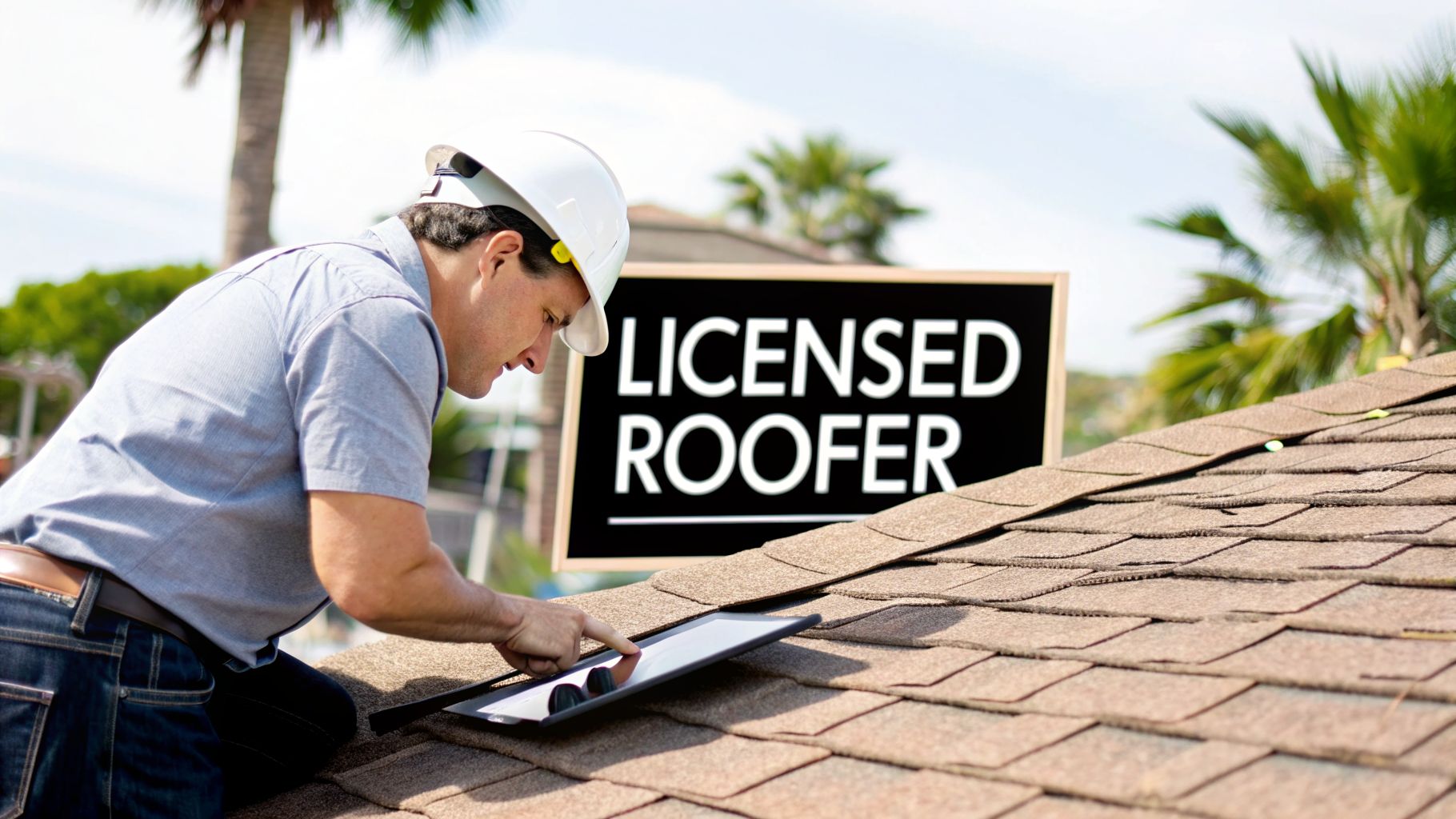
Your roof is the first and most important shield protecting your home from Florida’s relentless sun, crushing humidity, and, of course, hurricane season. That’s why hiring a licensed roofing contractor in Central Florida isn't just a smart move—it's the only way to safeguard your biggest investment. Working with a fully vetted professional ensures your project meets state codes and, more importantly, keeps you protected from serious liability.
Why a Licensed Roofer Is Your Best Defense
When you’re looking at a roof replacement for your home or commercial property, from Pinellas County all the way over to Orlando, choosing the right contractor is a huge decision. Going with an unlicensed or unqualified roofer can open you up to a world of financial pain and structural headaches.
A license is far more than a piece of paper. It’s tangible proof that a contractor has met Florida's demanding standards for industry knowledge, financial stability, and insurance coverage. It’s your guarantee that the company is legitimate and accountable. Without it, you have no real assurance the work will stand up to the Florida Building Code, which is specifically written to handle hurricane-force winds and driving rain.
The Real Cost of Cutting Corners
It’s tempting to jump on a low-ball offer, but this almost always ends in disaster. Hiring someone without verifying their license can lead to:
- Failed inspections that bring your project to a screeching halt, often requiring expensive tear-offs and rework.
- Full liability for on-site injuries if the roofer doesn't carry the proper workers' compensation insurance.
- Voided material warranties from the manufacturer because the shingles or tiles weren't installed to their exact specifications.
- Catastrophic roof failure during the next big storm, leading to thousands in water damage inside your home.
A professional roofing proposal should feel like a blueprint for success, not a mystery. If a contractor can't provide detailed, line-itemed costs and a clear scope of work, they are hiding their intention to cut corners.
Fueled by our unique weather challenges—from constant UV exposure to tropical storms—the Florida roofing market is valued at $6.7 billion. That makes up about 12% of all roofing revenue in the entire country. A market this big naturally attracts unqualified players, making your job of vetting contractors absolutely critical.
Partnering With a Proven Local Expert
A true licensed roofing contractor that Central Florida residents can rely on understands the specific abuse our roofs take. They know the local codes inside and out and carry the non-negotiable general liability and workers' compensation insurance to protect you from any and all risk.
This local expertise is vital, whether you're getting a standard roof replacement or tackling a more complex project like integrating a solar system. Both the roof's integrity and the new solar array must be flawless. To get a head start, it pays to know exactly what you're looking for. A great place to begin is by reading our guide on how to choose a roofing contractor for more in-depth tips.
Verifying a Contractor's License and Insurance
You’ve gathered a few names and now have a shortlist of potential roofers. This is where the real work begins. Before you even think about looking at a proposal, you absolutely must confirm that any licensed roofing contractor Central Florida homeowners consider is legitimate, active, and fully insured.
Frankly, this isn't just a box to check—it's the single most important thing you can do to protect your home, your finances, and yourself from fraud and liability.
Your first stop should be the Florida Department of Business and Professional Regulation (DBPR) online portal. This is a free, public database, and it's your best friend for weeding out phonies. You can search by the company’s name, the owner's name, or their license number.

In just a few clicks, you can verify that their license is listed as "Current, Active" and that the business name on the license actually matches the name on their truck and marketing materials. If they don't match, that’s a major red flag.
Florida Contractor License Verification Guide
To make this process foolproof, here's a quick guide to what you need to check and why it's so important. Think of this as your personal vetting checklist.
| Verification Step | What to Do | Why It's Critical |
|---|---|---|
| Check DBPR License | Go to the DBPR online portal and search for the contractor's license number or company name. | Confirms they are legally permitted to work in Florida and aren't operating with an expired or suspended license. |
| Verify General Liability | Ask for a Certificate of Insurance (COI) to be sent directly from their insurance agent to you. | This protects your property. If they damage your siding, windows, or landscaping, their policy covers it—not your homeowner's insurance. |
| Confirm Workers' Comp | Demand proof of Workers' Compensation Insurance, also sent directly from the provider. | This is non-negotiable. Without it, if a worker gets injured on your property, you could be held liable for their medical bills and lost wages. |
| Cross-Reference Names | Ensure the name on the license, insurance, and their contract all match perfectly. | Prevents a shady operator from using another company's legitimate credentials to appear credible. |
This isn't about being difficult; it's about being smart. A legitimate, professional roofer will have zero issue providing this documentation and will often have it ready to go.
Key Insurance You Must Verify
Let's be blunt: a contractor simply telling you they are "licensed and insured" means absolutely nothing without proof. This is an area where homeowners can get into serious trouble. There are two policies you cannot skip verifying.
- General Liability Insurance: This protects your property. If a ladder falls and shatters a window or a bundle of shingles damages your driveway, their policy should cover the repair costs.
- Workers' Compensation Insurance: This is the big one. Roofing is a dangerous job. This policy covers the workers if they get injured on your property, shielding you from personal liability and potentially devastating lawsuits.
Expert Tip: Never, ever accept a photocopy of an insurance certificate from the contractor. Always insist their insurance provider email or mail a Certificate of Insurance (COI) directly to you. This is the only way to be certain the policy is active and hasn't been altered.
Red Flags to Watch For
As you dig into these credentials, keep your eyes open for warning signs. For instance, a brand-new license could indicate a lack of local experience or, worse, a "storm chaser" who just blew into town after the latest hurricane.
Any hesitation, pushback, or outright refusal to provide insurance verification is an immediate deal-breaker. No excuses. Walk away.
While paperwork is paramount, don't forget the human element. Exploring customer feedback adds another crucial layer of vetting, and understanding Why Online Reviews Matter For Florida Businesses can give you real-world insight into their service quality.
This process becomes even more vital after a major storm. If you find yourself in that situation, our guide on navigating insurance claims for roof damage in Winter Haven provides more specific advice. A true professional like Hi Low Roofing will offer all this documentation upfront, proving their transparency and accountability from the very first conversation.
How to Read a Roofing Proposal Like a Pro

You’ve checked their license and confirmed their insurance. Now comes the moment of truth: the proposal. This document is where a contractor shows their true colors. A professional’s proposal will be a detailed, multi-page blueprint for your project. A one-page quote? That’s a giant red flag.
Trying to compare vague estimates is like comparing apples to oranges—it’s impossible. A thorough proposal from a trusted company like Hi Low Roofing breaks down every single line item. This transparency is powerful. It lets you judge based on long-term value and quality, not just the number at the bottom of the page.
It's About More Than Just the Price Tag
That rock-bottom price can be incredibly tempting, but you have to ask yourself: what’s being left out to get the price that low? A quality proposal from a licensed roofing contractor in Central Florida should read like a game plan, spelling out every component and every step.
Here’s exactly what you need to look for to make sure you're getting a complete job:
- Specific Material Callouts: The proposal needs to list the exact manufacturer, product line, and color for your shingles, tiles, or metal panels. "Architectural shingles" is lazy and vague. You want to see something concrete, like "CertainTeed Landmark shingles in Moire Black."
- A Clear Scope of Work: This section should detail the entire process. It must include a full tear-off of the old roof, a mandatory inspection of the underlying roof deck, and a plan for replacing any rotted or damaged wood they find.
- The "Extras" That Aren't Extra: Look for specifics on the underlayment (e.g., synthetic peel-and-stick) and flashing. A good proposal will explicitly state that all flashing around chimneys, vents, and valleys will be replaced. This is a critical waterproofing step that shady contractors often skip to save a few bucks.
If these details are missing, you have absolutely no guarantee about the quality of the materials or the work. It's a wide-open invitation for a roofer to use cheaper, inferior products to pad their profit margin at your expense.
How to Spot Hidden Costs and Sneaky Omissions
The details—or the glaring lack of them—tell you everything you need to know about a contractor's integrity. Vague terms are often a deliberate tactic to leave wiggle room for surprise charges down the line.
A professional roofing estimate should be an exercise in transparency. If the proposal feels like a mystery, it's because the contractor doesn't want you to see what they're leaving out. True professionals, like the team at Hi Low Roofing, provide line-itemed estimates to give you complete confidence.
For instance, a good proposal will clearly state the cost for replacing plywood decking, usually as a "per sheet" price. If that's not mentioned, you could be blindsided by a huge, non-negotiable bill when they inevitably find rotten wood—a very common issue in our humid Florida climate.
Also, look for a clear plan for attic ventilation. In Central Florida, proper ventilation is non-negotiable for managing intense heat and moisture, and it plays a huge role in how long your new roof will actually last.
Ultimately, a detailed proposal from a professional roofer is your best protection. It becomes a clear, binding agreement that ensures you get exactly what you paid for—no shortcuts, no surprises, and no premature failures.
More Than Just Shingles: Building a Roof for Florida's Climate
Here in Central Florida, a roof isn’t just a roof—it’s your home's first line of defense. It has to stand up to a barrage of blistering sun, torrential rain, and, of course, the brutal force of hurricane winds. A true professional understands that building a roof from Orlando to the Pinellas coast is a specialized science.
Anyone can nail down a shingle, but that's not what keeps your home safe. A properly installed roof has to meet the exacting standards of the Florida Building Code, which has some of the toughest wind mitigation requirements in the entire country. Following these rules isn't just about passing an inspection; it’s about having a roof that can actually weather a major storm. It can even help lower your homeowner's insurance premiums.
Choosing Materials That Can Take a Beating
The materials you select are going to have a huge impact on how long your roof lasts and how well it performs. While you want it to look good, durability is the name of the game for both residential and commercial properties in our climate.
Here’s a look at some of the most reliable options we see succeed time and again:
- Architectural Shingles: Think of these as the modern, heavy-duty version of the classic shingle. Their layered, thicker construction gives them far better resistance to wind uplift than older 3-tab styles, making them a fantastic value for the protection they offer.
- Modern Tile (Clay or Concrete): You can't go wrong with the classic Florida tile roof. They're incredibly durable and naturally resistant to fire and rot. With a professional installation, it's not uncommon for a tile roof to last 50 years or more, making it a true long-term investment.
- Durable Metal Roofing: Once reserved for commercial buildings, metal has become a top-tier choice for homeowners. It offers incredible wind resistance, reflects the sun's heat to cut down on energy bills, and is practically maintenance-free.
A good contractor will sit down with you and lay out the real pros and cons of each, helping you find the right fit for your home and your budget—no high-pressure sales tactics.
The Value of a Pro on Standby and a Crew You Can Trust
When a hurricane finally moves on, the real chaos begins. Finding someone who can get to your property quickly for emergency tarping and a clear damage assessment is everything. That immediate response is what sets a true local professional apart from the rest. Having a team ready 24/7 to stop more water from getting in and causing further damage is non-negotiable.
This kind of reliability is more critical now than ever. The entire roofing industry is grappling with a serious shortage of skilled labor. One recent report highlighted that 38% of residential roofing contractors are struggling to find enough qualified workers.
This is why partnering with an established company like Hi Low Roofing, which has its own experienced crews, is so important. It’s your best guarantee that the job will be done right and on schedule, without cutting corners. You can find more details about these roofing industry trends to get a better sense of the current market.
Getting a New Roof? It's the Perfect Time to Add Solar
If you're already planning to replace your roof, you have a golden opportunity. Think of it as a clean slate for a major upgrade that can actually pay you back for years to come—a solar energy system. Here in Central Florida, more and more homeowners and commercial property managers are catching on that bundling a roof replacement with a solar installation is one of the smartest financial moves you can make.

It just makes sense. Imagine installing a brand-new, 25-year solar system on a roof that only has 10 or 15 years of life left. You’re setting yourself up for a massive—and costly—headache. A decade from now, you'll have to pay a crew to remove the entire solar array and then reinstall it, just to replace the worn-out roof underneath.
Why pay for the same job twice?
The Advantage of a Single, Certified Contractor
When you hire separate roofing and solar companies, you open the door to a world of problems. The first time a leak appears, the finger-pointing begins. The roofer blames the solar installer’s mounting hardware, and the solar company swears the roof was the issue.
By hiring one dual-certified team, like Hi Low Roofing, you get a single point of accountability. Your roofing and solar warranties are streamlined under one roof—literally. The installation is designed as one cohesive system, with a team that knows exactly how to mount solar panels without ever compromising the integrity and waterproofing of your new roof.
A single, trusted team manages everything. This ensures the structural supports, waterproofing, and panel layout are all designed to work together from the very beginning. To see what a well-planned project looks like, learn more about solar panel and roof integration in Orlando and how it protects your entire investment.
Energy Independence and Storm Resilience
A custom-designed solar system does a lot more than just shrink your power bill; it can give you true energy independence. When you pair it with a battery backup, you get incredible peace of mind knowing you'll have power even when the grid goes down—a common reality during Florida’s hurricane season.
And this upgrade is more accessible than most people think. Flexible financing options, including special offers and even 0% financing for qualified buyers, can make both the critical roof replacement and the forward-thinking solar upgrade affordable. It turns two major expenses into one manageable investment in your property's value and resilience.
Once your system is up and running, a little maintenance will keep it performing at its best for decades. For those who like a hands-on approach, this helpful DIY solar panel cleaning guide gives you practical tips to keep your panels clean and efficient.
Common Questions We Hear from Central Florida Homeowners
When it's time to think about your roof, you're going to have questions. It’s a big investment, and you need straight answers before you sign anything. From Orlando all the way to Pinellas County, we hear the same concerns from property owners. Let's tackle some of the most common ones we get asked every day.
Do I Need a Full Replacement or Just a Repair?
This is the million-dollar question, isn't it? The honest answer is: it depends. A few missing shingles from a storm or a small, isolated leak can often be handled with a simple, targeted repair. But sometimes, a repair is just putting a band-aid on a much bigger problem.
A full roof replacement is usually the smarter, more cost-effective move in the long run if you're seeing signs of system-wide failure.
When to consider a full replacement:
- Your roof is hitting that 15-year mark or older. Most asphalt shingle roofs in Florida don't last much longer than that.
- You're finding shingle granules—the sandy, gritty stuff—piling up in your gutters. This means the shingles are "bald" and have lost their protection.
- You can see shingles that are curling up at the edges, cracking, or looking brittle across large sections of the roof.
- A major storm has caused widespread or significant damage.
A trustworthy roofer, like the team at Hi Low Roofing, will get up on your roof, take detailed photos of any problem areas, and walk you through their findings without any high-pressure sales tactics.
What Exactly Is a Workmanship Warranty?
This is a big one, and it's easy to get confused. You have two different warranties at play: one from the shingle manufacturer and one from your roofer. The manufacturer's warranty covers defects in the actual roofing materials.
A workmanship warranty, on the other hand, is your roofer’s personal guarantee on their own work. It’s their promise that if a leak or any other problem happens because of how the roof was installed, they will come back and fix it on their own dime. Think of it as a measure of the company's confidence in its own crew. Always, always get the terms of this warranty in writing.
Will My Insurance Pay for a New Roof After a Storm?
In a storm-prone state like Florida, this is a critical question. The answer really hinges on your specific homeowner's policy and what caused the damage. Most policies cover roof damage from a specific, documented event—what they call a "named peril," like a hurricane or a severe hailstorm.
What they typically won't cover is a roof that's simply old and worn out from age or lack of maintenance. This is where an experienced local roofer becomes your best asset. They know exactly what to look for, how to document storm damage properly for a claim, and how to communicate effectively with insurance adjusters to make sure your claim is represented accurately. We've helped countless homeowners navigate this process to get a fair assessment.
When you're ready to protect your home or commercial property with a team you can trust, count on Hi Low Roofing & Solar. For a free, no-obligation inspection and a clear plan for your roofing needs, visit us online to schedule your appointment today.
