

Filing a roof damage claim in Winter Haven can feel like you're climbing a mountain, especially right after a storm has turned your life upside down. Let's be honest: many homeowners across Central Florida are caught off guard by just how complicated the whole process is. Florida's insurance market has become notoriously difficult, and that's not just a headline—it's the reality on the ground. This guide is here to give you a clear, strategic plan to navigate your claim with confidence right from the start.
The Reality of Winter Haven Roof Damage Claims
When a storm barrels through Polk County, the cleanup involves more than just picking up fallen branches. For too many homeowners, it's the start of a confusing and often frustrating dive into the world of insurance claims. It’s rarely as simple as calling your agent and waiting for a check to arrive.
At the end of the day, insurance companies are businesses, and their primary goal is to minimize what they pay out. Their adjusters are skilled at finding reasons to limit or even deny a claim, pointing to anything from pre-existing wear and tear to obscure clauses buried deep in your policy. This is particularly true here in Central Florida, where we're constantly facing threats from hurricanes, wicked thunderstorms, and hail.
Why Winter Haven Claims Are So Tough
A few local factors make filing an insurance claim for roof damage in Winter Haven a unique headache. The sheer number of weather events we get means insurers are swamped with thousands of claims at once. This leads to long delays and overworked adjusters who might rush through your inspection and miss critical details.
This isn't just a feeling; the numbers back it up. Roof damage claims in our area have exploded in recent years. While about one in 36 insured homes in the U.S. files a property damage claim for wind or hail each year, that rate is much higher here because of Florida’s wild climate. You can get a better sense of these trends by understanding the insurance industry and the pressures it faces.
Your insurance policy is a legal contract, but remember who wrote it: the insurer's lawyers. The single most powerful thing you can do to protect your home is to understand your rights and responsibilities before you even file.
Navigating this process starts with a plan. Here are the immediate actions you should take the moment you suspect your roof has been damaged.
Your First Steps After Discovering Roof Damage
| Action Item | Why It's Critical | Pro Tip |
|---|---|---|
| Document Everything | Photos and videos create undeniable proof of the "before" state for your claim. | Take more pictures than you think you need, from every angle. Get close-ups of damage and wide shots showing the whole roof. |
| Mitigate Further Damage | Your policy requires you to prevent more damage (e.g., from water leaks). | Tarping the roof is a standard first step. Keep receipts for any materials you buy; they're often reimbursable. |
| Review Your Policy | Know your deductible and what's covered before you talk to the insurer. | Look for the "Declarations Page" for a quick summary of your coverage limits and deductible. |
| Call a Local Roofer | Get a professional inspection to identify all damage—not just what's obvious. | A reputable roofer can spot issues an untrained eye would miss and provide an independent damage assessment. |
Taking these steps lays the groundwork for a much smoother and more successful claim process.
Setting the Stage for Success
To get the outcome you deserve, you have to treat your claim not as a simple request, but as a carefully built case. This means shifting your mindset from being reactive to proactive. Don't wait for the insurance company to tell you what they'll cover; instead, build an airtight case that proves what you're owed. This all starts with meticulous documentation, a solid understanding of your policy, and finding an expert who can be your advocate.
Before you even dial your insurer, there are critical things you need to do. For homeowners dealing with unexpected damage, knowing how to handle the immediate aftermath is key. Our guide on storm damage roof repair offers essential advice for securing your property safely and correctly.
How to Document Roof Damage and Build a Rock-Solid Claim
Once the storm has passed, your smartphone becomes your most powerful asset. The proof you gather right after the event can be the deciding factor between a denied claim and a fair payout for a new roof. You’re not just taking a few pictures—you're building a detailed, undeniable file that leaves no room for your insurance company to downplay the damage.
Think of it this way: an adjuster might just see a few missing shingles from the ground. But a well-documented claim tells the full story—the wind uplift that compromised the seals, the widespread granule loss that aged your roof by a decade, and the subtle water stains that followed. Strong evidence is the only real leverage you have when it comes to insurance claims for roof damage in Winter Haven.
This simple infographic breaks down the immediate first steps. It’s all about staying safe, gathering proof, and stopping the problem from getting worse.
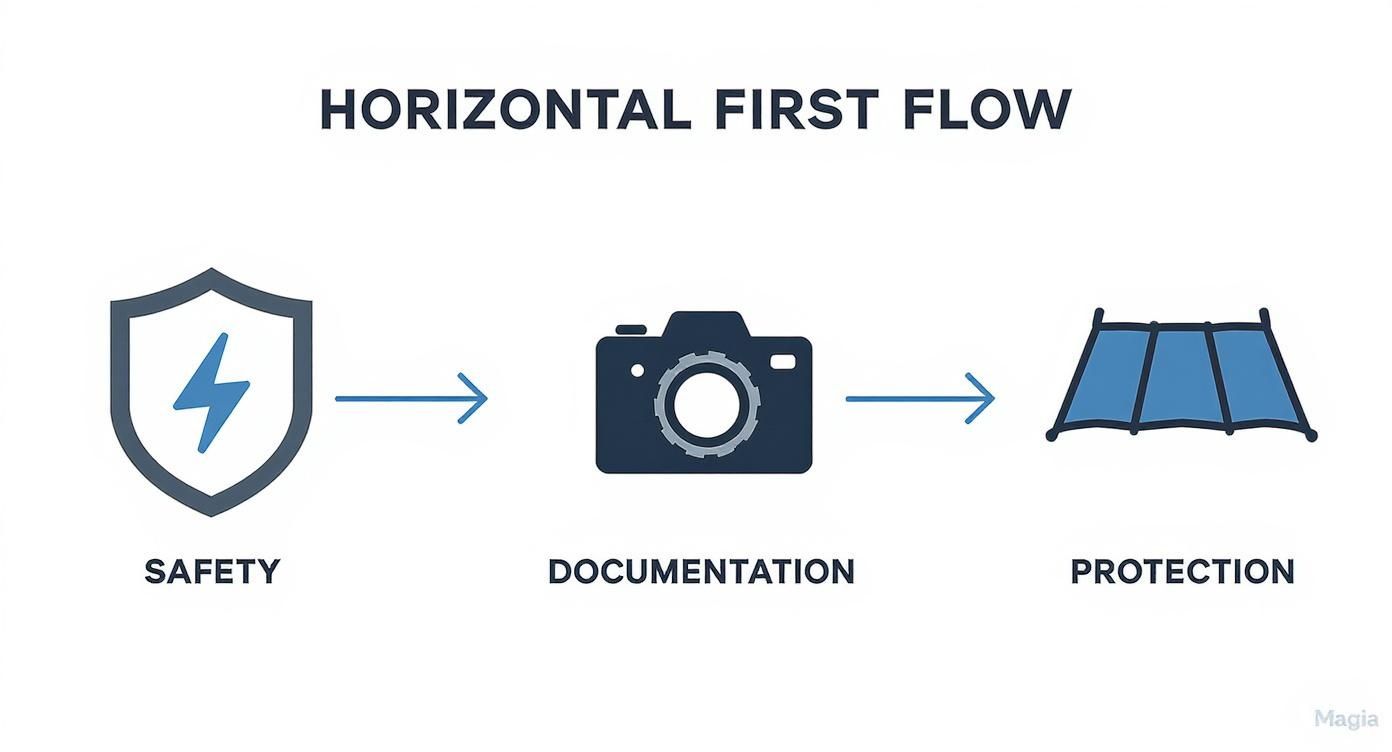
As you can see, documentation is the crucial bridge between securing your family's safety and protecting your home from further harm. It’s the foundation of your entire claim.
Tell the Story with Photos and Video
Get outside and start with the big picture. Take wide shots of all four sides of your house, showing the entire roof from different angles. Then, zoom in.
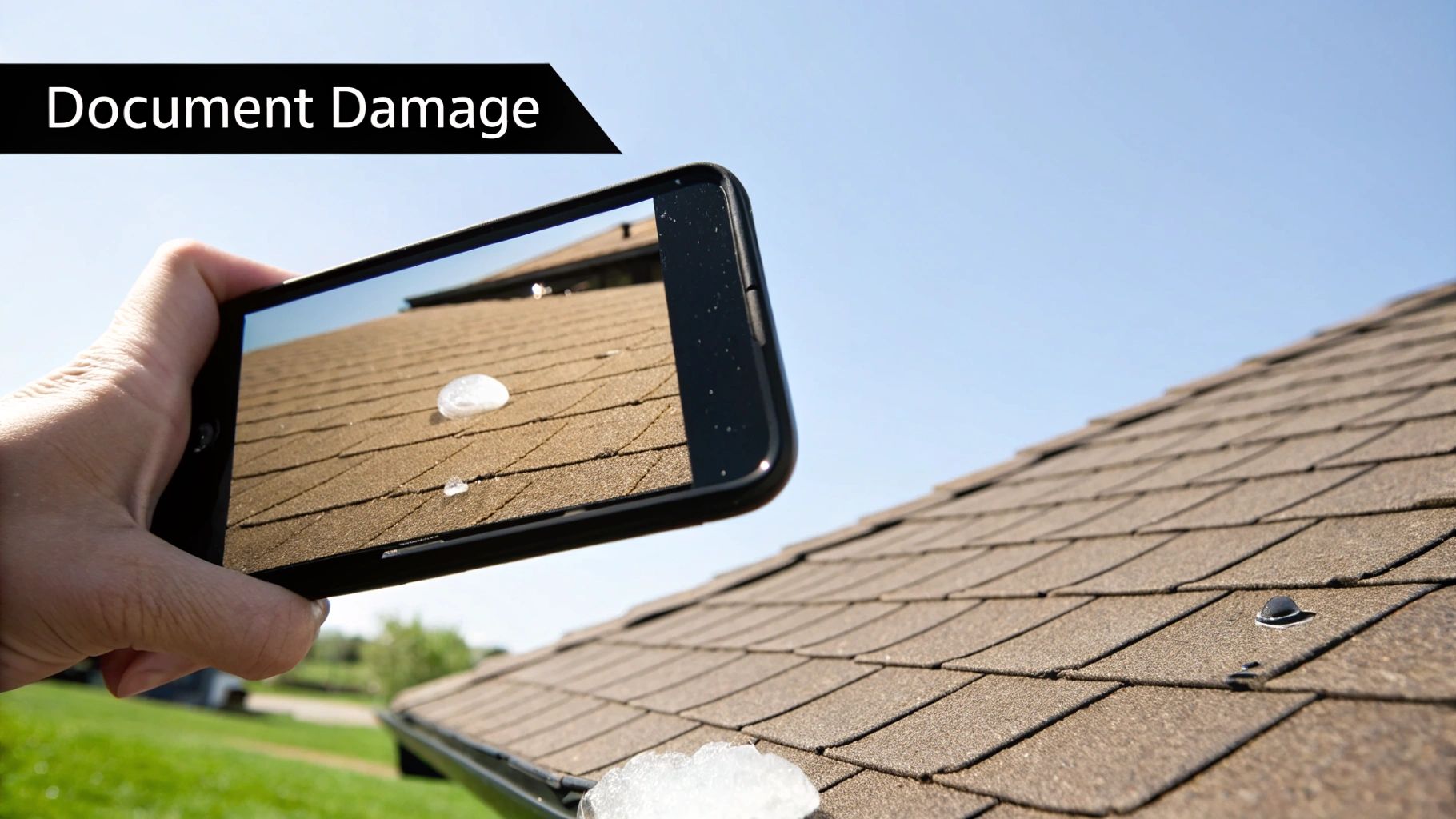
For wind damage, you need clear photos of shingles that are lifted, creased, or completely gone. For hail damage, grab a quarter or a golf ball and place it next to the dents. This gives the adjuster an immediate, undeniable sense of scale. Don't stop at the roof—photograph any damage to gutters, window screens, siding, or A/C units.
Now, switch to video. Do a slow, steady walk-around of your property. Talk to the camera and narrate what you're seeing in real-time. Point out specific areas of concern. This creates a dynamic, timestamped record that’s incredibly hard for an insurer to argue with.
Keep a Running Log of Everything
Your evidence isn't just visual. You need a simple written log to create a clear timeline of what happened and when.
- Date of Loss: Pinpoint the exact date and approximate time the storm rolled through Winter Haven.
- Your Observations: Jot down exactly what you found. For example: "Noticed 15-20 missing shingles on the back slope" or "Discovered new water stains on the ceiling in the master bedroom."
- Temporary Fixes: If you need to tarp a section to prevent more water from getting in, take "before" and "after" pictures. Keep every single receipt for tarps, nails, or wood—these costs are almost always reimbursable.
A detailed log transforms your memories into a factual record. When an adjuster asks for a timeline three months down the road, you won’t have to guess. You’ll have an organized, dated document that backs up every part of your story.
This methodical approach puts you in a position of strength. If you want a more structured way to inspect your property, our comprehensive roof inspection checklist for homeowners is a great resource. By putting in this work upfront, you ensure that when the adjuster shows up, you’re not just a homeowner with a problem—you’re a prepared client with a case that’s too strong to ignore.
Know Your Policy Before You Pick Up the Phone

Before you ever dial your insurance company's number, you need to get familiar with the rulebook for this whole game: your policy. I know, it's a dense document loaded with legal jargon, but understanding a few key parts can completely change the outcome of your insurance claims for roof damage in Winter Haven.
Rushing to file a claim without doing this homework is a classic mistake, and it can cost you. For example, are you sure what your deductible is for wind or hurricane damage? It's often a separate, much higher amount than your standard deductible, usually a percentage of your home's total insured value. If your claim is small, it might not even be more than that deductible, which means you'd get a claim on your record for nothing.
What Kind of Coverage Do You Actually Have?
One of the biggest factors in your final payout is how your insurer agrees to pay for your roof. It almost always falls into one of two buckets, and the difference between them is thousands of dollars.
- Replacement Cost Value (RCV): This is the one you want. RCV covers the full cost to replace your damaged roof with brand-new materials of a similar quality, with no deduction for age or wear. You get the money needed to make your roof whole again based on today's labor and material prices.
- Actual Cash Value (ACV): This is the less desirable option. ACV coverage pays you for the replacement cost minus depreciation. So, if your roof is 10 years old, the insurance company will subtract a decade's worth of value, leaving you with a check that covers only a portion of a new roof.
Figuring out which one you have is the first step in setting realistic expectations. For a deeper dive, this guide to navigating home insurance claims can be a huge help in understanding the broader process.
The Florida Factor: Your Roof's Age Matters
Here in Florida, the age of your roof isn't just a number—it’s a major factor in your insurance coverage. Insurers are getting stricter about what's known as the '15-year roof rule.' Once a roof hits that 15-year mark, many companies will demand an inspection, refuse to renew your policy, or, most commonly, switch your coverage from RCV down to ACV.
Your smartest first move? Get a professional roof inspection before you even think about filing. A trusted local roofer can give you an honest, real-world assessment of the damage and a detailed repair estimate.
This expert opinion does two things. First, it helps you decide if filing a claim is even worth it. If the repair cost is just a bit over your deductible, you might be better off paying out of pocket to avoid a potential premium hike.
Second, if the damage is significant, that inspection report becomes your most powerful piece of evidence. It gives you a strong foundation to build your claim on and puts you in a much better position when you start talking with the insurance adjuster.
What to Expect From the Adjuster Meeting and Claims Process
After you've filed the initial paperwork, the adjuster's visit is where the rubber meets the road. This single meeting is often the most pivotal moment for your entire claim. Honestly, how you prepare for and handle this conversation can make the difference between getting a fair settlement and facing a frustrating denial.
The adjuster’s job, plain and simple, is to protect the insurance company’s bottom line. They’re trained to evaluate damage from their employer's perspective, which means they are actively looking for reasons to minimize the payout. They'll hunt for signs of old wear and tear, previous damage, or even installation mistakes—anything that lets them attribute the problem to something other than the recent storm.
This is exactly why having your own expert in your corner isn't just a good idea; it's a necessity.
Your Secret Weapon: Have Your Roofer There
We can't stress this enough: always have a professional from Hi Low Roofing on-site when the adjuster shows up. Think of it this way—you wouldn't go to court without a lawyer, right? It's the same principle. You need an expert who is working for you.
Here’s why this is a game-changer for your insurance claim for roof damage in Winter Haven:
- They Speak the Lingo: A roofer knows exactly what to look for. They can spot things like subtle wind lift on shingles or granule loss from hail that an adjuster might conveniently overlook or dismiss as "normal wear."
- They Shut Down Lowball Offers: We see it all the time. Adjusters use outdated pricing software that doesn't reflect the true cost of materials and labor right here in Winter Haven. Your roofer comes prepared with a detailed, accurate estimate based on current local rates.
- They Create Undeniable Proof: Your roofer can walk the roof right alongside the adjuster, pointing out every single damaged spot and making sure it gets noted in the official report.
An adjuster might see a couple of displaced shingles and call it a day. A roofer sees a compromised sealing strip, potential underlayment exposure, and a roof system that’s now vulnerable to the next storm. Having your roofer there ensures the full story of the damage is told from the start.
Taking this one step completely eliminates the back-and-forth arguments that can drag a claim out for months.
The Claim Timeline and Staying Organized
Once the adjuster leaves, the waiting begins. While every claim has its own quirks, you can generally expect to see an initial settlement offer or a decision within a few weeks.
The key is to stay proactive. Keep a simple log of every single interaction with the insurance company. It doesn't have to be fancy. Just grab a notebook and for every call, write down:
- The date and time.
- The name and title of the person you talked to.
- A quick summary of what you discussed and what they promised.
This little log can be your saving grace if your claim gets delayed or if you suddenly start getting conflicting information from different people. It gives you a clear, factual record to hold the insurance company accountable and keep things moving.
How to Respond to a Low Offer or Denial
It’s a gut punch. After everything you’ve been through with a storm-damaged roof, getting a lowball offer or an outright denial from your insurance company can feel like the final insult. But you need to know this, especially in Florida’s tough insurance market: the first offer is almost never the final word.
Think of it as the start of a negotiation, not the end of the line.
Frankly, that initial low offer is often a test. Insurers are banking on the hope that you’ll be too worn out or intimidated to push back. With the right approach and solid evidence, however, you can absolutely challenge their assessment and get the full amount you’re entitled to.
This is particularly true for insurance claims for roof damage in Winter Haven. Florida's property insurance market is notoriously difficult. A huge percentage of residential claims are closed without a single dollar paid out. In fact, some local insurers have denial rates as high as 60-70%, and roofs are always a major point of contention. To get a sense of the uphill battle, you can discover more about Florida's challenging insurance landscape and see what you’re up against.
Dissecting the Adjuster's Decision
Your first move is to formally request the adjuster’s full report. Don’t settle for a simple summary letter. You need the detailed, line-item breakdown that shows exactly how they came up with their number.
Once you have that report in hand, it's time to play detective. Look for these classic red flags:
- Incorrect Measurements: Did they get the square footage of your roof wrong? It happens more than you'd think.
- Missed Damage: Adjusters can be in a hurry. Did they completely overlook damage to crucial components like flashing, vents, or the underlayment?
- Outdated Pricing: Are the costs they're using for materials and labor based on today's actual market rates in Winter Haven, or are they from last year?
- Misattributed Cause: This is a big one. Did they dismiss clear storm damage as "wear and tear" or blame it on a phantom "improper installation"?
This report is the blueprint for your counter-argument. Go through it line by line, preferably with your roofer by your side.
Building Your Counter-Offer
Now you have their report and the detailed estimate from your own trusted contractor. It's time to craft a professional response. This isn't the time for an angry, emotional email; this is a calm, fact-based rebuttal.
An insurance company's initial offer is based on their interpretation of the damage. Your counter-offer, backed by expert documentation and a detailed contractor estimate, presents a more accurate interpretation—one grounded in the reality of repairing your roof correctly.
Your response letter should clearly and methodically point out every discrepancy you found. Reference the specific photos from your documentation to prove your points, and attach the fully itemized estimate from your roofer.
Suddenly, the conversation is no longer just your word against theirs. It becomes a professional dispute between their field adjuster’s assessment and a local expert’s findings. This is where having a seasoned pro on your team really pays off. Our guide on how to choose a roofing contractor can walk you through finding the right partner for this critical step.
When an insurer sees that your appeal is backed by a reputable local company like Hi Low Roofing, they are far more likely to take it seriously and come back to the table for a fair renegotiation.
Got Questions About Your Winter Haven Roof Claim? We've Got Answers.
Going through the claims process can feel like you're navigating a maze blindfolded. You've documented the damage, maybe even spoken to an adjuster, but a few nagging questions always seem to pop up. Let's clear the air and tackle the most common concerns we hear from homeowners right here in Winter Haven and across Central Florida.
Is Filing a Claim Going to Make My Insurance Rates Skyrocket?
This is, without a doubt, the number one worry for most people. It's a valid concern. The good news is that Florida law prevents an insurer from jacking up your individual premium or canceling your policy just because you filed a single claim from a weather event, what they often call an "Act of God."
But here's the catch: that doesn't make you totally immune to rate increases. Insurance companies can, and frequently do, raise rates for an entire area—like all of Winter Haven—if they see a spike in storm frequency and claims. This is exactly why getting a professional inspection before you file is so critical. It's probably not worth filing a minor claim that barely clears your deductible, especially if you risk being reviewed for non-renewal down the road for having too many claims in a short period.
What’s the Deadline for Filing a Roof Damage Claim?
After a storm rolls through, the clock starts ticking. In Florida, you generally have one year from the "date of loss" (the day the storm hit) to file a new claim for roof damage.
Don't procrastinate on this. Even though you have a year, our advice is always to file as soon as you know there's damage. Waiting can muddy the waters and give your insurance company a reason to argue that something else happened to your roof in the months since the storm.
It's always smart to double-check your policy for any specific clauses, but moving quickly will almost always work in your favor.
What Should I Do If the Insurance Company's Offer Is a Lowball?
First, don't panic. This happens all the time with insurance claims for roof damage in Winter Haven. A low initial offer isn't the final word; it's the opening bid in a negotiation.
When your roofer's estimate comes in much higher than what the adjuster approved, it's time to dig in. The trick is to lay both documents out side-by-side and compare them line by line. You’d be surprised what adjusters often miss—they might overlook critical components, forget to factor in current local building codes, or use pricing for materials and labor that’s completely out of date.
This is where your roofer steps back in to submit a formal "supplement" to the insurance company. This isn't just a simple request for more money; it’s a detailed, evidence-backed argument that includes:
- An Itemized List: A breakdown of every single cost the adjuster's initial estimate missed.
- Clear Photo Evidence: More pictures that highlight the specific damage or items they overlooked.
- Building Code Citations: Proof of local codes that require certain materials or repair methods, which adds to the cost.
By presenting a solid case built on facts and evidence, you compel the insurer to take a second look and adjust their payout to reflect the actual cost of getting your roof repaired correctly.
When you’re up against an insurance company, you need a pro on your side of the table. Hi Low Roofing & Solar has been through this countless times for both residential and commercial properties from Pinellas County to Orlando. We know how to properly document damage, meet with adjusters, and advocate for the fair settlement you’re entitled to. Contact us today for a free, no-obligation inspection.
